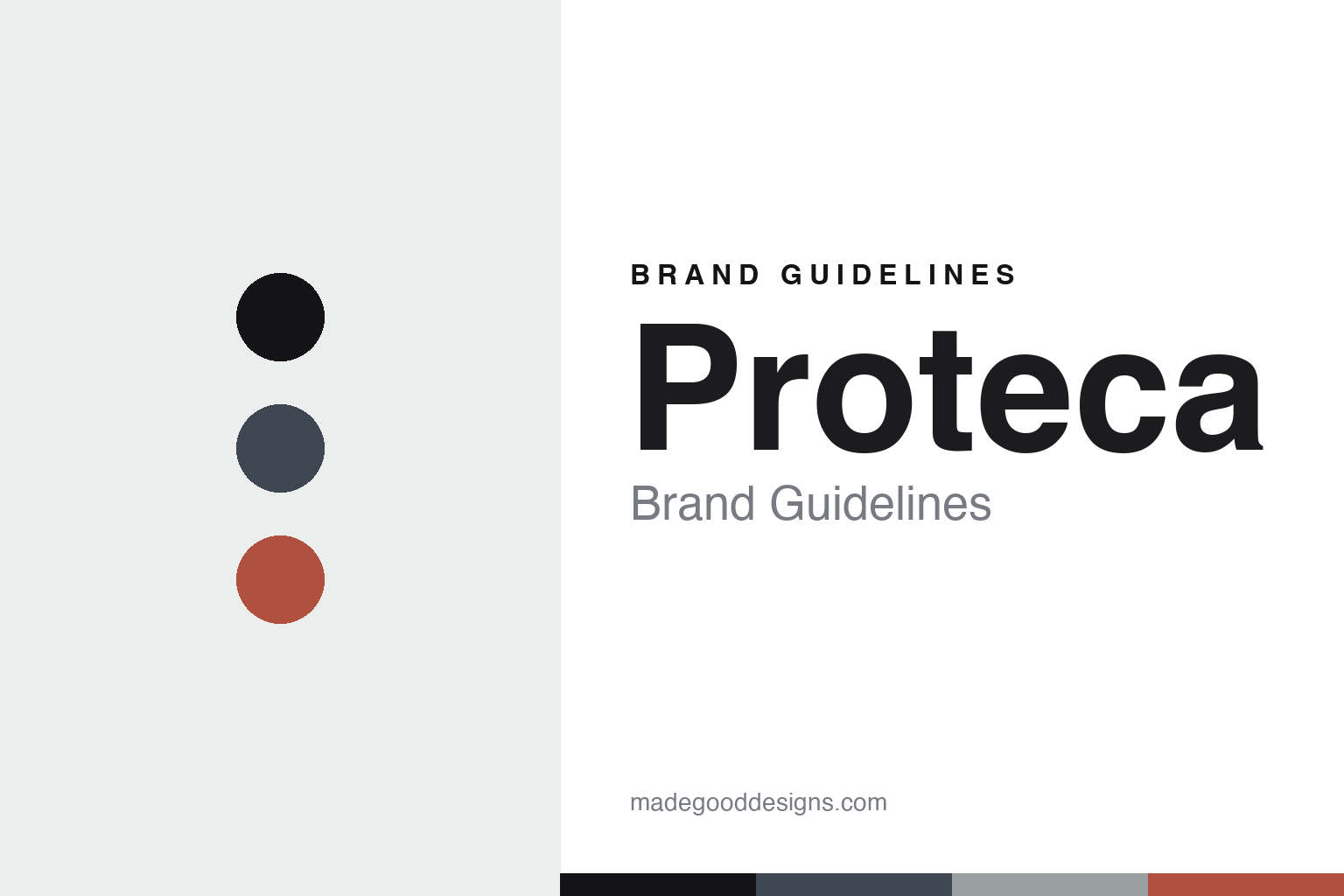
Proteca Brand Guidelines
The made-in-Japan case.
Aa
Two constants: a slate-and-silver palette and a precision sans register. Abstract homage — not the Proteca products or packaging.
The made-in-Japan case
Proteca makes suitcases to a Japanese standard.
Proteca is a lesson in a standard as identity. A brand of the Japanese maker ACE Co., Ltd. — a company that traces to a 1940 Osaka bag business — it builds hard-shell suitcases to an exacting in-house benchmark.
Its identity is made-in-Japan precision. The brand foregrounds a proprietary “New Proteca Standard,” backs it with ACE’s A.T.I. quality lab, and adds a Premium Care promise of a three-year warranty with unlimited free repairs. Its signature detail is the “Magic Stop” one-touch caster lock, across ranges like the 360 series, Maxpass and Staria. Quiet engineering, made at home in Japan. The made-in-Japan quality story is the hook.
(Honest notes: Proteca is a brand of ACE, not a standalone company, so we attribute the founding heritage to ACE and honour founder Ryusaku Shinkai carefully via the company’s memorial to him. “Made in Japan” is the brand’s own official positioning — verified as a claim — but the specific factory isn’t named on the pages we reached, so we say “reportedly produced domestically in Japan.” The brand’s launch year isn’t published, so we don’t assert one. There’s no official brand hex, so these tones are an unofficial interpretation. This is design commentary and does not promote any product.)
Colour
Proteca lives in a slate-and-silver palette. Click a swatch to copy the hex.
Proteca’s identity is precise, quiet and Japanese — a slate, an ink, a silver, a vermilion, and a chalk. The palette pairs a slate with a silver — the register of precision-made hard-shell luggage. It signals engineering and quality rather than novelty. The honest caveat: with no published brand hex, these tones are an original, unofficial interpretation, not first-party values.
The lesson is a slate with a silver signals a precision suitcase maker. Proteca’s world is a quietly exacting case. For designers, it is a reminder that a named, defended standard — plus a country-of-make story — can be the whole identity. The takeaways: define a standard; back it with testing and warranty; keep one signature detail; and treat any single hex as unofficial.
Typography
The register is a precision sans — precise, quiet, Japanese.
Proteca’s identity carries a precise, quiet, Japanese spirit — an exacting hard-shell case. A clean legible sans captures the mood: it is neutral and engineered, the register of precision manufacture. Set in a slate-and-silver palette, the precision sans feels precise and quiet — exactly the personality Proteca carries. It is machined rather than decorative, mirroring a made-in-Japan shell. (Proteca’s real products and wordmark are works we describe but do not reproduce, and the exact typeface is not ours to use.) Because it is not ours to use, the honest description is “a precision sans spirit,” shown here in a stand-in. The type behaves like the brand: precise, quiet and Japanese.
Aa
A precision sans spirit — precise and quiet. (Specimen set in Lexend, a clean legible sans STAND-IN; NOT the Proteca packaging.)
A standard as identity
Proteca stands for made-in-Japan precision.
Proteca is a lesson in making a standard the identity. A slate-and-silver palette, a precision sans and an exacting case make made-in-Japan quality the whole brand — precise, quiet, Japanese. The standard is the differentiator. The differentiator is a defended, named quality benchmark.
For designers and brand-builders, Proteca offers a clear takeaway: define and defend a standard. The lessons: define a standard; back it with testing and warranty; keep one signature detail (Magic Stop); and be honest about the story. It is also a reminder to stay accurate: it’s a brand of ACE (founded as Shinkai Shoten, 1940), its made-in-Japan claim is official while the specific factory is reported, and the palette here is an unofficial interpretation. Proteca made a standard the brand — proof that a benchmark can be the difference.
Explore & save
Keep Proteca’s identity on hand — save it to a board in the Made Good inspiration library.
Proteca identity set
Pin the slate-and-silver palette and the precision-sans register to your own board.