Vienna Acoustics Brand Guidelines
The Austrian loudspeaker maker that named its speakers after Vienna’s composers.
Aa
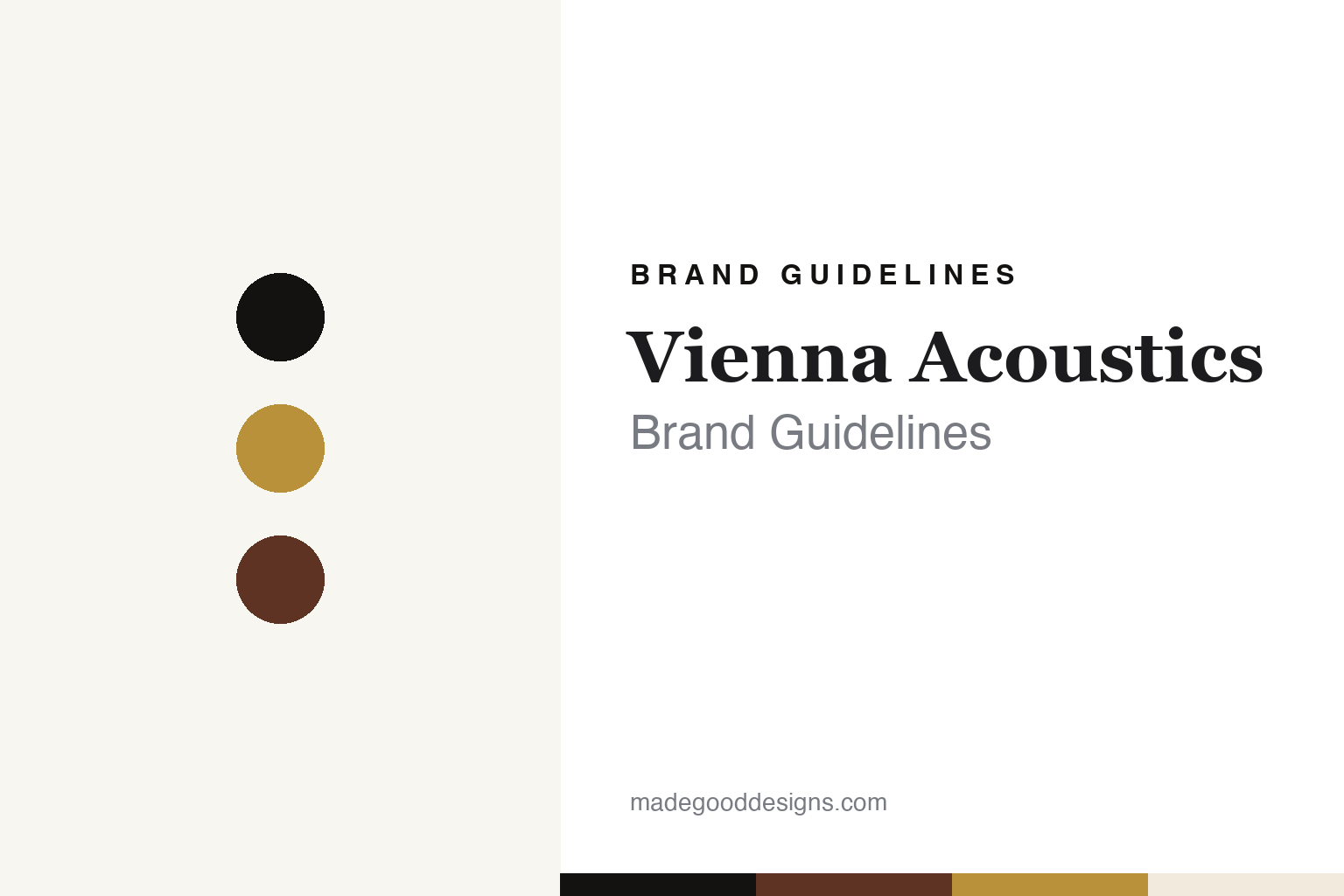
Two constants: a sapele, piano black and Secession gold palette and a Viennese serif register. Abstract homage — not a Vienna Acoustics product or mark; no loudspeaker, logo or nameplate is reproduced.
A partner and a factory
A designer, an unnamed partner and a first factory.
Vienna Acoustics was founded in 1989 by Peter Gansterer, who still designs its loudspeakers. The company’s website calls him its “founder and chief designer” and says he “came of age in Vienna,” where he studied acoustical engineering. In an interview with Roy Gregory for the British magazine Hi-Fi+, which the company publishes on its website, Gansterer said he had “a background in acoustical engineering from university”; a profile in the magazine of the American retailer Magnolia instead described him studying “something unrelated,” going to lectures on electro-acoustics and building speakers for friends, then for friends of friends. We note the difference.
Gansterer told Hi-Fi+ that he started “together with a partner,” whom he did not name, and that “we bought ground and built the factory.” Some summaries online name a co-founder and place the company in Burgenland; we found neither claim in any source we could read, so we leave both out. The company took its speakers to the Consumer Electronics Show in 1991, Gansterer said, and found an American distributor in Sumiko. In 1998, he said, “the previous company was bought out by the present one,” which brought in a new director to run marketing and business worldwide and left him free to concentrate on research and development.
The company’s own timeline of early models, archived in 2013, lists speakers called Isis and Maestro, a cost-no-object model called Silver Shadow of 1995–96, a two-way called Musi built from 38 rings of solid maple, and even a valve amplifier, the Cubus of 1992–93 — dropped, it says, because “company growth forced us to focus on speakers exclusively.” It also lists “an early evolution stage of Mozart” from 1993–95; the Mozart name is still in the range.
Colour
Composers, a painter and a flat cone.
Vienna Acoustics names its speakers after figures linked with the city — Haydn, Mozart, Beethoven, Mahler, Schönberg and Liszt among them — and its top range after the painter Gustav Klimt. Maria Gansterer told Magnolia’s magazine that, beginning with the Classic Series, the names were meant “to draw a connection between our products and the wonderful city where they are built.” The company’s website names the Goldener Musikvereinssaal, the main hall of Vienna’s Musikverein, as an inspiration for its sound.
Its technical signature is the flat Spider-Cone: a flat midrange cone stiffened by radial ribs, which Stereophile said Gansterer optimised for rigidity using finite-element analysis, with a silk-dome tweeter at its centre as a coincident driver. The cone is made from a polymer the company calls X3P. The driver first appeared in The Music, the Klimt flagship that SoundStage! Ultra says was introduced at the 2008 Consumer Electronics Show, and then in The Kiss, which Stereophile says made its debut at the 2009 show at $16,000 a pair. A smaller, 15 cm version went into the Liszt, which an American dealer listed as due in 2014 at about $15,000 a pair.
The company’s website describes the cone as patented. The only patent we found under Gansterer’s name in Google Patents is a United States design patent for a loudspeaker, filed in 2002, granted in 2003 and later assigned to the company; we searched no other patent databases. In earlier interviews Gansterer said he disliked metal drive units — “you’ll never find metal drivers in our speakers,” he told Hi-Fi+ — and preferred front baffles at least 40 mm thick. The current range, according to the website, runs from the Haydn SE Signature and Mozart SE Signature through the Beethoven Baby Grand and Beethoven Concert Grand Reference to the Liszt Reference, the Mozart Infinity and the Klimt Series of The Music, The Kiss and Poetry.
Typography
Two countries, one trade.
Switzerland’s audio reputation was built largely on professional machines. Stefan Kudelski made the first Nagra tape recorder in 1951, and it became the standard for film sound from the 1960s to the 1990s, English Wikipedia says; the brand now belongs to Audio Technology Switzerland, near Lausanne. Willi Studer founded Studer in Zurich in 1948 and registered the Revox name for consumer equipment in 1951. Thorens is older still: it was registered at Sainte-Croix, in Vaud, in 1883.
Austria’s record centres on Vienna. AKG was founded there in the late 1940s by Rudolf Görike and Ernst Pless; its owner, Harman, closed its Vienna operations in 2017. Pro-Ject, founded by Heinz Lichtenegger in 1991, designs its turntables at Mistelbach, in Lower Austria, and makes them in the Czech Republic, Slovakia and Germany.
Vienna is now the trade’s meeting place too. In September 2024 the High End Society announced that its HIGH END show would leave Munich after 2025, StereoNET reported; the first Vienna edition was held at the Austria Center Vienna from 4 to 7 June 2026.
According to their own websites, Goldmund is at Satigny and darTZeel at Vessy, both in the canton of Geneva; CH Precision is at Préverenges, near Lausanne; Soulution’s maker, Spemot, is at Dulliken, in the canton of Solothurn; Piega is at Horgen, on Lake Zurich; Revox, Swiss by origin, is now run from Villingen-Schwenningen in Germany; and Vienna Acoustics is at Weigelsdorf, south of Vienna.
This guide sets out what can be checked about each brand — who founded it, who owns it, and what it says about where its products are made — and marks clearly what rests only on the company’s own word.
Aa
A Viennese serif — a name borrowed from the city. (Specimen set in Cormorant Garamond, a serif STAND-IN; NOT the Vienna Acoustics logo.)
Vienna Acoustics
Named for the city, built just outside it.
The company says it makes loudspeakers “in Vienna, Austria,” and its telephone number uses the Vienna code. Its legal address is more precise. An archived 2008 imprint names the company as v.a. lautsprecherprodukt. GmbH, on Lehnergasse in Vienna’s 23rd district, with Helge Leinich and Maria Gansterer as managing directors. Today’s imprint names V.A. Lautsprechermanufaktur GmbH, at Boschanstrasse 3 in Weigelsdorf, a village in the town of Ebreichsdorf in Lower Austria, south of Vienna, registered at the commercial court in Wiener Neustadt, with Maria Gansterer — Peter Gansterer’s sister, the German website i-fidelity.net reported in 2014 — as managing director. In that report she said the company had moved to its present, larger factory in mid-2013 because it had run out of space.
What “made in” means here is partly checkable. i-fidelity.net saw speakers assembled and measured at Weigelsdorf, usually five pairs at a time, each checked against a reference speaker, and described drive units made by Scan-Speak “specially for the Austrians.” In 2015 Kevin Wolff of Vienna Acoustics told SoundStage! Ultra that the company designs its drivers itself, has the cones moulded at a separate facility in Vienna and has the Liszt’s coincident driver built by Scan-Speak; the earlier Music driver, the magazine said, was made by Eton. The company’s website says its cabinets are made by outside joineries to its own specification book and inspected on arrival, with 7 to 10 percent of a delivery typically sent back, and Maria Gansterer told i-fidelity.net that every component is made “for or by” Vienna Acoustics. We give those as the company’s claims. A business-register summary lists two shareholders, whom we have not checked; the company calls itself “independent.”
For a design guide, Vienna Acoustics shows how a small manufacturer can borrow a city’s cultural names — composers, a painter, a concert hall — and back them with engineering it explains in detail. Compare Pro-Ject, another Austrian audio maker, and Piega, the Swiss loudspeaker maker. For this guide we use sapele brown, piano black and a Secession gold with a serif, an unofficial interpretation; no product or logo is reproduced.
Explore & save
Keep Vienna Acoustics’s identity on hand — save it to a board in the Made Good inspiration library.
Vienna Acoustics identity set
Pin the Vienna Acoustics sapele, piano black and Secession gold palette and the Viennese serif register to your own board.