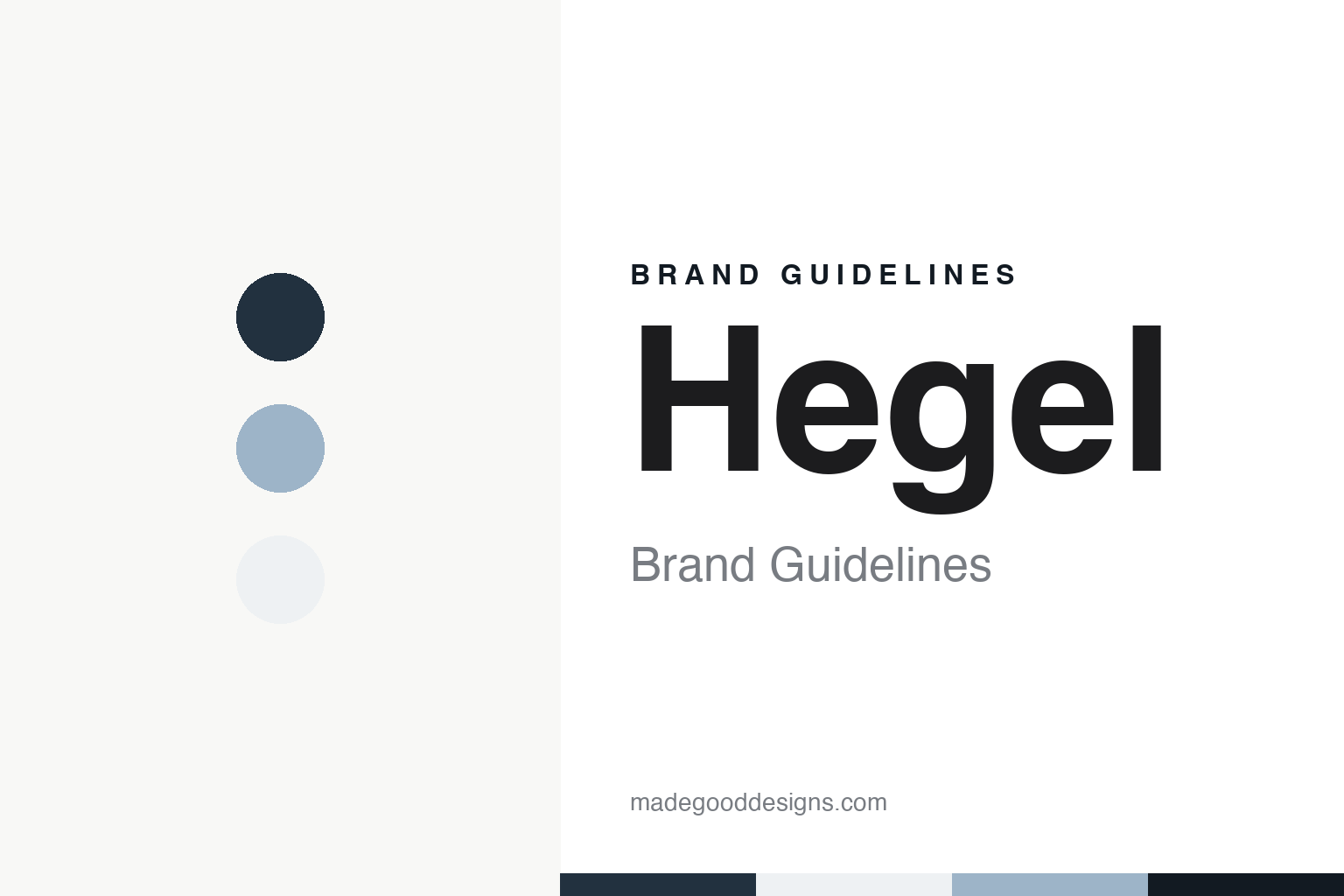
Hegel Brand Guidelines
The Oslo amplifier maker built on a student’s distortion research.
Aa
Two constants: a Hegel slate, ice and snow palette and a geometric sans register. Abstract homage — not a Hegel product or mark; no amplifier, logo or nameplate is reproduced.
A band called Hegel
A guitarist from Gjøvik, a student committee and a set of concert amplifiers.
Hegel’s story is usually told as starting in 1988, and the company’s own website still says “the story begins in 1988.” The fuller history it now publishes shows that the date marks the start of an idea rather than of a business. Its founder, Bent Holter, grew up in Gjøvik, north of Oslo, where, the company says, he began building guitar amplifiers, effects pedals and stage equipment because good gear was too expensive. In the early 1980s he played in bands, and when two bandmates moved away he renamed the remaining power trio Hegel — a name first borrowed from the German philosopher, which he kept as a tribute when the band ended.
In 1986 Holter moved to Trondheim to study microelectronics at the university now called NTNU. There he joined the student society’s amplifier committee, and in 1988, the company says, it approved his plan to build power amplifiers for the society’s main concert hall. Hegel says four were finished by 1989 and one is still in use; The Absolute Sound, visiting in 2012, was told there were six. One now sits in what the company calls its Hegel museum in Oslo.
At university Holter also began the work that became SoundEngine, which the company describes as a patented method of cancelling amplifier distortion as it happens. The company’s older history says the problem that drove him was distortion — that an amplifier returns the signal “plus something else.” The company says he used the university’s Cray supercomputer to simulate an audio amplifier digitally, work it says led to the patent. That idea, rather than any single product, is what Hegel has built its name on.
Colour
Three starts: 1990, 1998 and 2002.
The business took several attempts. In 1990, the company says, Holter founded Hegel Electronics and sold his first hand-built amplifier, having spent his student loan on chassis. After his master’s degree he put Hegel aside and worked at Sandar Electronics, Tandberg and the research institute SINTEF; John Darko, visiting in 2018, reported that Holter had developed electronics for the oil industry.
In 1997 Holter returned to Hegel full time with outside investors, whose plan, the company says, was not to build amplifiers but to license SoundEngine to established manufacturers. Their engineers proved reluctant, and in 1998 the first mass-produced Hegel amplifiers went on sale, shown that year at CES in Las Vegas, where, the company says, they drew particular interest from Japan. Hegel now calls 1998 “the start of Hegel.” Darko gave a third date: in 2018 he wished “Happy 21st birthday” to a company he said was set up in 1997.
After the dot-com crash the backing was withdrawn and the company was dissolved. In 2001, the company says, Holter bought its assets and the SoundEngine patent, and in 2002 he started again as Hegel Music Systems. Norway’s business register agrees on that date: the present company, registered as Hegel Music System AS, was founded in January 2002, with an address in Oslo.
The products that made the name were integrated amplifiers. Hegel lists the H1, made from 2001 to 2007, and the H200, made from 2005 to 2011, which it calls its first major commercial success. It says its 2007 H100 was the first hi-fi amplifier with a built-in USB input, and that its 2014 H160 carried an AirPlay implementation developed in-house; it launched its first separate DAC in 2009.
Typography
Norway and the Nordic tradition.
The Nordic loudspeaker trade goes back to the 1920s. In Norway, Vebjørn Tandberg founded Tandbergs Radiofabrikk in Oslo in 1933; it went bankrupt in 1978, English Wikipedia says. In 1950 the Radionette founder Jan Wessel and the Danish engineer Carl Christian Nørgaard Madsen set up Seas, which moved to Moss in 1951, according to Danish Loudspeakers, the 2015 centenary history published for the Danish Sound Innovation Network.
Denmark had several driver makers. The same history traces Peerless to a Copenhagen sales company of 1926, Videbæk Højttalerfabrik — later Vifa — to 1933, and Scan-Speak to 1 February 1970, when Ejvind Skaaning founded it. Vifa-Speak and Peerless combined as Danish Sound Technology in 2000, and in 2005 the group was sold to Tymphany.
Elsewhere, Finland’s Genelec was founded in Iisalmi in 1978 by Ilpo Martikainen and Topi Partanen, English Wikipedia says, and in Sweden Audio Pro says it has made speakers since 1978, while Primare says it was founded in 1985 by the Danish designer Bo Christensen.
The makers in this guide are spread across the region. Hegel is in Oslo and Seas outside Moss, in Norway; Primare gives an address in Limhamn, Malmö, and Audio Pro is based in Helsingborg, both in southern Sweden; Gato Audio is in Herlev, on the edge of Copenhagen; and Argon Audio gives an address in Nørager, in North Jutland. Peerless now belongs to Tymphany, which says it is headquartered in Taiwan.
This guide sets out what can be checked about each brand — who founded it, who owns it, and what it says about where its products are made — and marks clearly what rests only on the company’s own word.
Aa
A clean geometric sans for an engineering-led brand. (Specimen set in Jost, a sans STAND-IN; NOT the Hegel logo.)
Hegel
Designed in Oslo, made in China.
Hegel is open about the division of labour once asked. Visiting the company in Oslo in 2018, Darko reported that it makes “nothing but prototypes” there: “Manufacturing takes place in China, leaving the Norway HQ for product development, circuit design, parts sourcing, testing, repairs and software coding.” SoundStage! Hi-Fi said the same in August 2020: Hegel’s products “are designed in Norway by a team led by founder Bent Holter, and all are manufactured in China.” The company’s own history says that “all Hegel research and development takes place in Oslo,” where a small team designs the electronics, mechanical parts and firmware.
Hegel remains small. The register lists eight employees for the Oslo company, alongside two related companies at the same address, Hegel Audio AS, founded in 2006, and Hegel AS, founded in 2017; Holter, its founder, still leads the engineering team, according to the company. Its range runs from the H95 to the H600 integrated amplifier, with pre- and power amplifiers, the Viking CD player, a DAC and a phono stage. Hegel says it has won multiple EISA awards across amplifiers, DACs, phono stages and CD players, including one for the H600 as a high-end streaming amplifier — the jury, as quoted by Hegel, credited its “bespoke SoundEngine 2 error-cancelling technology” — and that its products are sold in more than 70 countries. Its American arm, Hegel America, dates from 2009, according to the company’s staff page.
The name is often the first question. Hegel the company is named not directly after the philosopher but after Holter’s band, which, the company adds, is “still performing to this day.”
For a design guide, Hegel shows how a small engineering company can build a brand on one technical idea and a founder’s story. Compare Electrocompaniet, another Norwegian amplifier maker, and Primare. For this guide we use slate, ice blue and snow white with a sans, an unofficial interpretation; no product or logo is reproduced.
Explore & save
Keep Hegel’s identity on hand — save it to a board in the Made Good inspiration library.
Hegel identity set
Pin the Hegel slate, ice and snow palette and the geometric sans register to your own board.