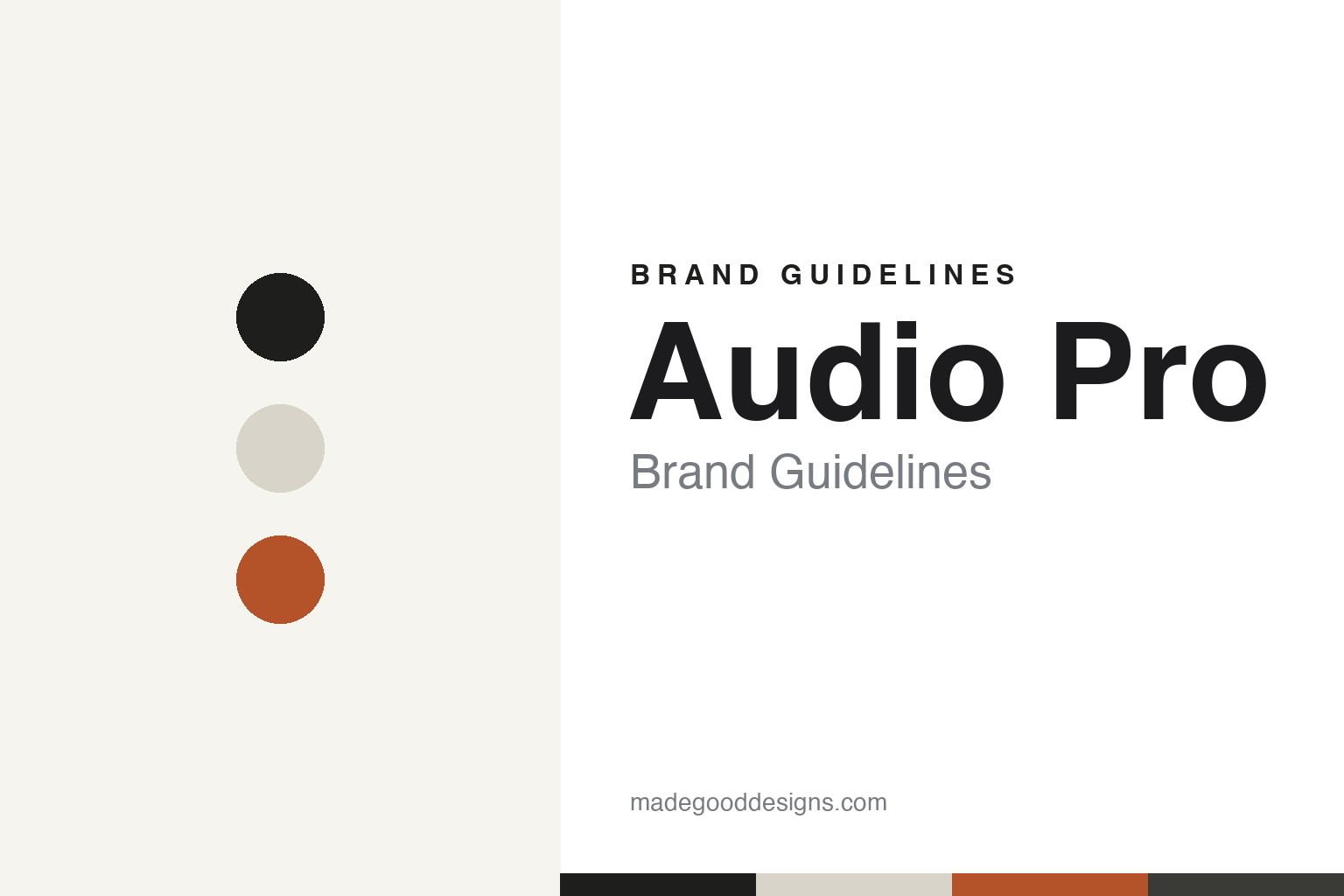
Audio Pro Brand Guidelines
The Helsingborg speaker maker built on ACE-Bass.
Aa
Two constants: an Audio Pro charcoal, oat and brick palette and a friendly sans register. Abstract homage — not an Audio Pro product or mark; no speaker, logo or nameplate is reproduced.
ACE-Bass
An engineer, a patent and a small box with deep bass.
Audio Pro was founded in 1978 and is based in Helsingborg, on Sweden’s south-west coast, Swedish Wikipedia says. The company credits its start to the engineer Karl-Erik Ståhl, and to one idea: getting deep bass out of a small cabinet. It calls the technique ACE-Bass. Sources expand the initials in different ways — “Amplifier Controlled Euphonic” bass in some, “Active Control of Electroacoustic” bass in others — so we use the name as the company does.
The idea is documented outside the company’s own story. In November 1978, at the 61st convention of the Audio Engineering Society in New York, Karl Erik Ståhl presented a paper titled “Synthesis of Loudspeaker Mechanical Parameters by Electrical Means,” according to the society’s e-library, which lists his affiliation as 3Dgruppen ab of Stockholm. The method gives the amplifier a negative output resistance and uses it to change, electrically, how heavy, stiff and well-damped the bass driver appears to be. A United States patent in his name, granted in 1978, describes the same approach and reports a 12-inch driver whose lower limit fell from 70 Hz to between 40 and 20 Hz, depending on the tuning.
The first products put the idea in a box. The company says its 1978 range included the A4.14, a 14-litre speaker with a built-in amplifier and ACE-Bass, and the B2-50 powered subwoofer; it says that when the B2-50 was demonstrated, an American magazine editor told the team, “You’ve done the impossible” — a story we give as the company tells it. The A2.2 mini speaker followed in 1980, along with a car subwoofer, the B2-07.
Colour
From export success to wireless.
Through the 1980s and 1990s Audio Pro became an export business. The Swedish hi-fi wiki SweFi says it sold to more than 50 countries in those years, with ranges including Bravo and Image. The company says its B1.20 subwoofer stayed in production for nearly two decades, and that its Black Diamond floor-standing speaker of 1998 was well received by the Swedish press.
The ownership of those decades is harder to document. The company’s own press release of July 2018 describes Stefan Pantzar as its previous owner, who had built the business up since the 1990s; we found no dated record of how or when he acquired it, and no source for a period of ownership by a larger group.
In the 2000s the products changed with listeners. The company lists the colourful Allroom speakers, the Stereo One system, the Porto dock for iPods and the Living LV3, which it calls the first true hi-fi wireless speaker. The move had a cost: when Audio Pro went wireless, the 2018 press release says, it lost almost its entire export market, though it stayed strong in the Nordic countries.
It came back with a small Bluetooth speaker. The Addon T10 of 2013 was named the best wireless speaker of the year by the Swedish magazine Ljud & Bild, according to Swedish Wikipedia, which adds that Audio Pro products appeared among the wireless-speaker winners of the What Hi-Fi? Awards in 2015, 2016 and 2017. In November 2018, the Australian trade site ChannelNews reported, the company took four What Hi-Fi? Awards at once: for the Addon C3, the Addon C10 and the Drumfire, and for a multi-room system built from the C5, the C10 and the Link 1. Swedish Wikipedia says the company’s reach grew from 30 countries in 2013 to 45 in 2018; the company now says 55.
Typography
Nordic hi-fi.
The Nordic loudspeaker trade goes back to the 1920s. In Norway, Vebjørn Tandberg founded Tandbergs Radiofabrikk in Oslo in 1933; it went bankrupt in 1978, English Wikipedia says. In 1950 the Radionette founder Jan Wessel and the Danish engineer Carl Christian Nørgaard Madsen set up Seas, which moved to Moss in 1951, according to Danish Loudspeakers, the 2015 centenary history published for the Danish Sound Innovation Network.
Denmark had several driver makers. The same history traces Peerless to a Copenhagen sales company of 1926, Videbæk Højttalerfabrik — later Vifa — to 1933, and Scan-Speak to 1 February 1970, when Ejvind Skaaning founded it. Vifa-Speak and Peerless combined as Danish Sound Technology in 2000, and in 2005 the group was sold to Tymphany.
Elsewhere, Finland’s Genelec was founded in Iisalmi in 1978 by Ilpo Martikainen and Topi Partanen, English Wikipedia says, and in Sweden Audio Pro says it has made speakers since 1978, while Primare says it was founded in 1985 by the Danish designer Bo Christensen.
The makers in this guide are spread across the region. Hegel is in Oslo and Seas outside Moss, in Norway; Primare gives an address in Limhamn, Malmö, and Audio Pro is based in Helsingborg, both in southern Sweden; Gato Audio is in Herlev, on the edge of Copenhagen; and Argon Audio gives an address in Nørager, in North Jutland. Peerless now belongs to Tymphany, which says it is headquartered in Taiwan.
This guide sets out what can be checked about each brand — who founded it, who owns it, and what it says about where its products are made — and marks clearly what rests only on the company’s own word.
Aa
A rounded, friendly sans for a brand that sells to living rooms. (Specimen set in DM Sans, a sans STAND-IN; NOT the Audio Pro logo.)
Audio Pro
Two former Zound executives take over.
On 1 July 2018 Audio Pro changed hands. Jens Henriksen and Nils Ankarcrona, previously global sales chief and chief financial officer at Zound Industries, the Swedish headphone and speaker company, took over from Pantzar, the company announced. Both had joined Audio Pro in the autumn of 2016. The press release said turnover had grown tenfold in five years, reaching 340 million kronor in 2017 with strong profitability, and that the company was selling in more than 45 countries and had a subsidiary in the United States. Sweden’s company registers list Audio Pro Aktiebolag at Garnisonsgatan 52 in Helsingborg, owned through Audio Pro Holding AB and Audio Pro Invest AB, with Ankarcrona as chief executive.
The same announcement renamed the business-to-business arm. Since 2012 Audio Pro had sold wireless speakers for shops, restaurants and showrooms under the old Swedish name Sonab, once attached to the loudspeakers of the designer Stig Carlsson; that division became Audio Pro Business. The company also says it has made piano monitors for the Swedish instrument maker Nord Keyboards since 2018, and in 2018 it marked its 40th anniversary with a limited, numbered speaker called the A40.
On manufacturing, the company describes its speakers as rooted in Scandinavian design and says it keeps spare parts and offers repairs, but on the pages we read it does not say where they are built, so we do not either. Its look is consistent rather than codified: compact cabinets in black, white and muted colours, fabric fronts and, it says, a signature layout of two tweeters and one woofer in its smaller models.
For a design guide, Audio Pro shows how one patented idea about bass can give a brand a story it is still telling decades later. Compare Jamo, a Danish speaker maker that also sold to a mass market, and DALI. For this guide we use charcoal, oat and a brick red with a sans, an unofficial interpretation; no product or logo is reproduced.
Explore & save
Keep Audio Pro’s identity on hand — save it to a board in the Made Good inspiration library.
Audio Pro identity set
Pin the Audio Pro charcoal, oat and brick palette and the friendly sans register to your own board.