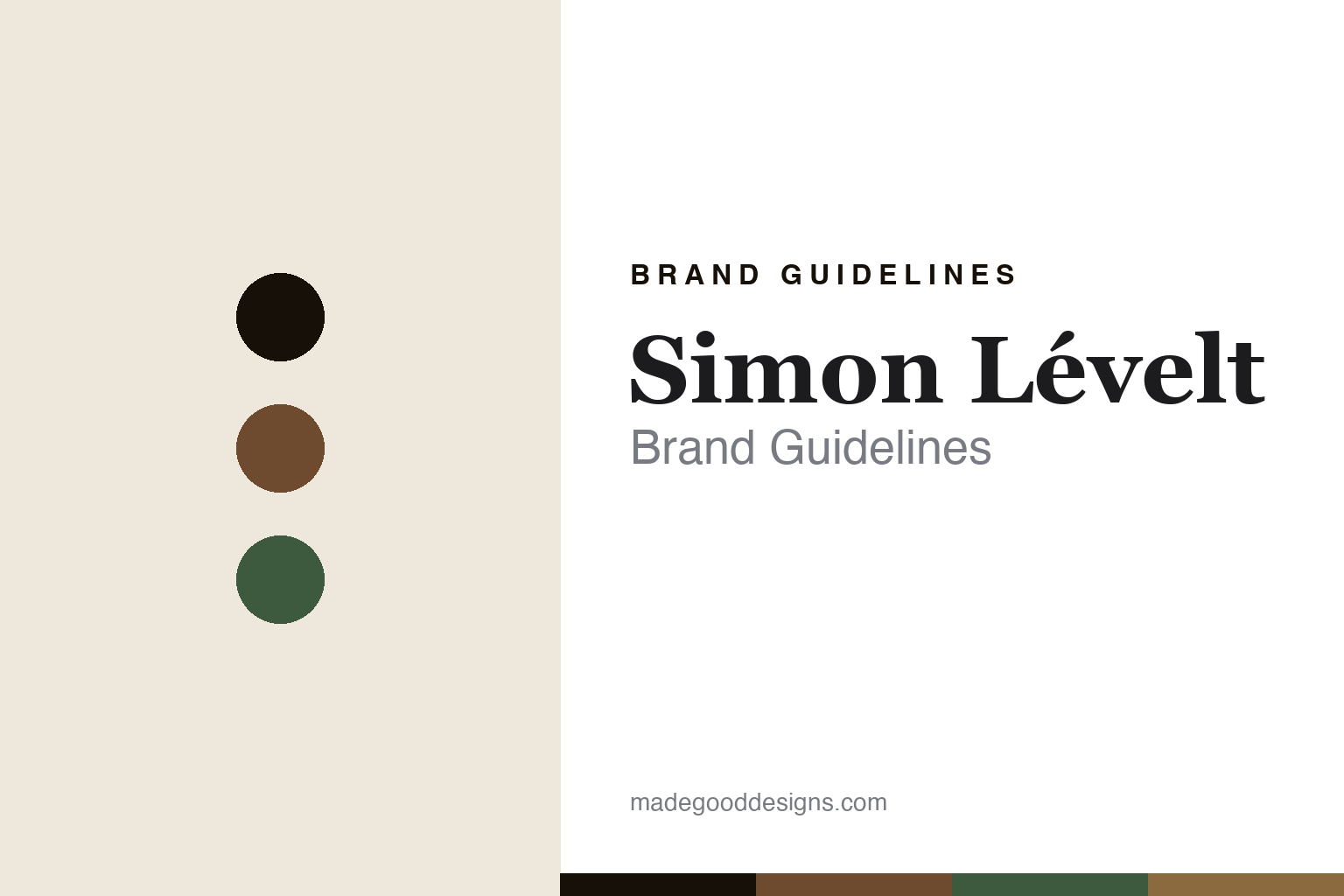
Simon Lévelt Brand Guidelines
The merchant.
Aa
Two constants: a roast-brown-and-green palette and a merchant serif register. Abstract homage — not the Simon Lévelt packaging.
The merchant
Simon Lévelt has weighed out coffee and tea for two centuries.
Simon Lévelt is a lesson in a merchant tradition as identity. Founded in 1826 in Amsterdam by Simon Lévelt — a merchant in colonial goods who built into coffee and tea — it is a genuine two-century koffie- en theehandel (coffee and tea trade), now headquartered in Haarlem and still owned by the sixth generation of the family.
Its identity is the heritage specialty shop: loose and bulk coffee and tea weighed out from tins and jars in experiential stores built around tasting, learning the origin and getting personal advice — over 150 teas and around 25 coffees, each with a sourcing story. Layered on top is a strong organic and sustainable positioning: it began selling organic in the late 1970s, among the first in the Netherlands, and sources much of its coffee and tea directly from origin.
(Honest notes: the founding year is 1826 in Amsterdam — not 1817 — and the founder was a colonial-goods merchant who grew into coffee and tea, not a roastery from day one; the headquarters is now in Haarlem. Simon Lévelt is independent and family-owned (Mikkel Levelt, sixth generation), not acquired. Its organic share is best stated as “largely to fully certified” (its own pages vary between an ~80% figure and 100%), and there’s no official brand hex, so these tones are an unofficial interpretation.)
Colour
Simon Lévelt lives in a roast-brown-and-green palette. Click a swatch to copy the hex.
Simon Lévelt’s identity is heritage, natural and honest — a roast brown, an ink, a tea green, an amber, and a cream. The palette pairs a roast brown with a tea green — the register of a coffee-and-tea merchant. It signals craft and origin rather than novelty. The honest caveat: with no published brand hex, these tones are an original, unofficial interpretation, not first-party values.
The lesson is a roast brown with a tea green signals a coffee-and-tea merchant. Simon Lévelt’s world is a shop of tins and jars. For designers, it is a reminder that a warm, natural, earthy palette reads as heritage and honest — right for a two-century trader. The takeaways: source the palette from the goods (roast brown, tea green, amber); keep it warm and heritage; sell from tins and jars; and treat any single hex as unofficial.
Typography
The register is a merchant serif — heritage, warm, honest.
Simon Lévelt’s identity carries a heritage, warm, honest spirit — a two-century shop and a scoop of loose tea. A merchant serif captures the mood: it is characterful and grounded, the register of an old trading house. Set in a roast-brown-and-green palette, the merchant serif feels heritage and warm — exactly the personality Simon Lévelt carries. It is honest rather than slick, mirroring a shop of tins and jars. (Simon Lévelt’s real packaging is work we describe but do not reproduce, and the exact typeface is not ours to use.) Because it is not ours to use, the honest description is “a merchant serif spirit,” shown here in a stand-in. The type behaves like the brand: heritage, warm and honest.
Aa
A merchant serif spirit — heritage and warm. (Specimen set in Fraunces, a characterful old-style serif STAND-IN; NOT the Simon Lévelt packaging.)
A merchant tradition as identity
Simon Lévelt stands for weighing it out by hand.
Simon Lévelt is a lesson in making a merchant tradition the identity. A roast-brown-and-green palette, a merchant serif and a shop of tins and jars make a two-century trade the whole brand — heritage, warm, honest. The merchant ritual is the differentiator. The differentiator is a coffee-and-tea-merchant identity.
For designers and brand-builders, Simon Lévelt offers a clear takeaway: let the ritual of the shop be the brand. The lessons: sell from tins and jars (weigh it out); tell the origin (a story per tea); carry a real heritage (two centuries, honestly dated); and lead on values (organic pioneer). It is also a reminder to stay accurate: it’s 1826 not 1817, HQ is Haarlem, it’s family-owned, and the palette here is an unofficial interpretation. Simon Lévelt made the merchant tradition the brand — proof that a shop ritual can be the difference.
Explore & save
Keep Simon Lévelt’s identity on hand — save it to a board in the Made Good inspiration library.
Simon Lévelt identity set
Pin the roast-brown-and-green palette and the merchant-serif register to your own board.