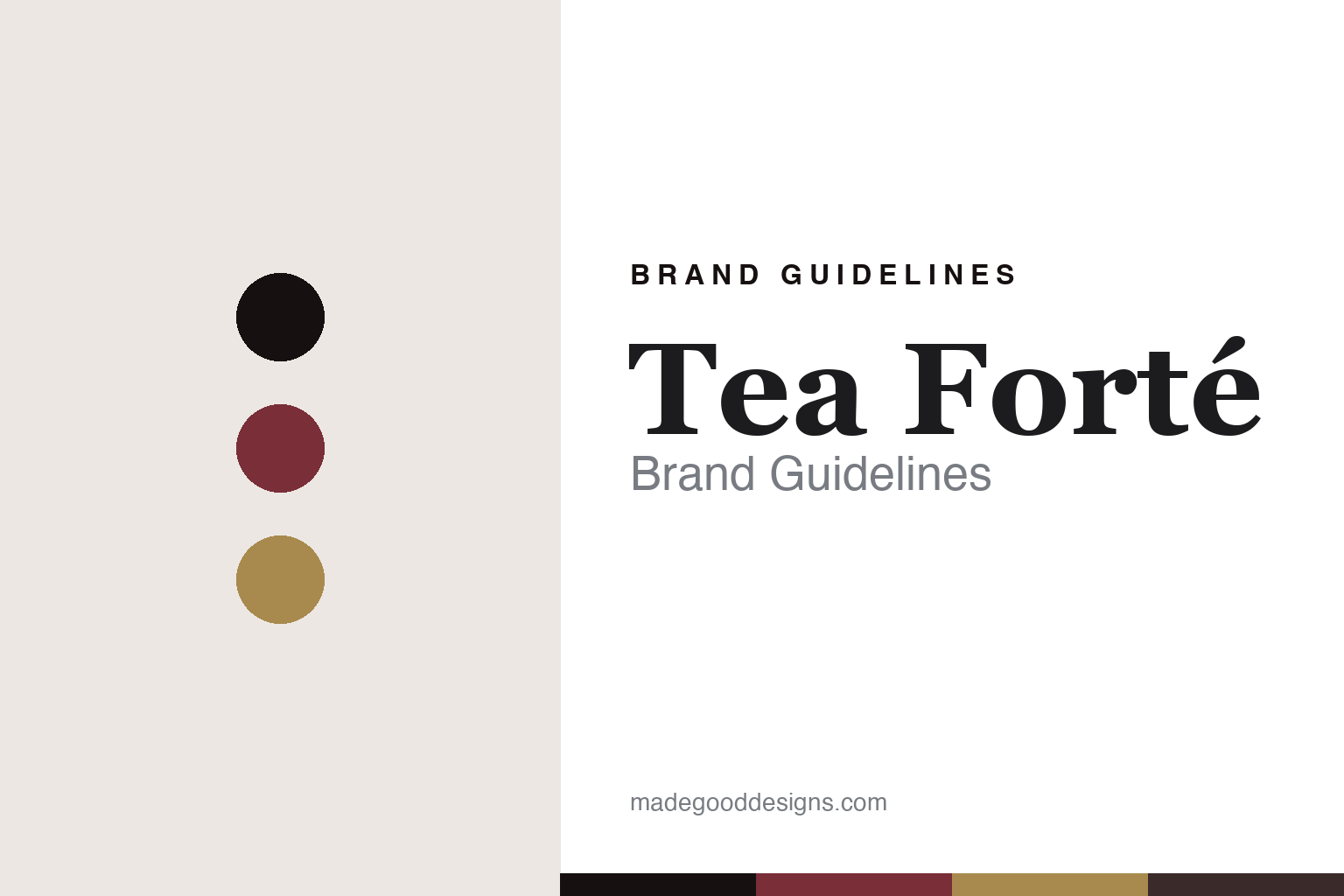
Tea Forté Brand Guidelines
The leaf on the pyramid.
Aa
Two constants: a claret-and-gold palette and a refined serif register. Abstract homage — not the Tea Forté packaging.
The leaf on the pyramid
Tea Forté made the infuser the design object.
Tea Forté is a lesson in a design object as identity. Founded in 2003 in Concord, Massachusetts (now based in Maynard) by Peter Hewitt — an American product designer trained at RISD — it is, at heart, a design company that happens to sell tea.
Its identity is the pyramid infuser with the leaf on a stem: a trademarked, elongated silken pyramid holds whole-leaf tea, and a small hand-tied leaf-shaped tag rises from the top on a stem — an iconic, ownable design object (its Café Cup even has a hole in the lid so the leaf peeks through). The brand is gift-oriented and keepsake-minded, drawing on a Japanese tea-ceremony aesthetic. Its formats are presentations: the Presentation Box of mixed pyramids, Single Steeps pouches, Tea Over Ice, and premium teaware.
(Honest notes: the founder is Peter Hewitt, a RISD product designer; the brand was founded in 2003 in Concord and is now based in Maynard, MA. It’s privately held with no public record of acquisition. The pyramid design is trademarked (we don’t cite a patent number), and while it’s designed in Massachusetts, the pyramids are made in China. There’s no official brand hex, so these tones are an unofficial interpretation.)
Colour
Tea Forté lives in a claret-and-gold palette. Click a swatch to copy the hex.
Tea Forté’s identity is refined, design-led and gift-worthy — a Forté claret, an ink, a leaf gold, a cocoa, and a chalk. The palette pairs a deep claret with a leaf gold — the register of an elegant keepsake box. It signals design and occasion rather than everyday tea. The honest caveat: with no published brand hex, these tones are an original, unofficial interpretation, not first-party values.
The lesson is a deep claret with a leaf gold signals a design-led gift. Tea Forté’s world is a presentation box of pyramids. For designers, it is a reminder that a refined, jewel-and-gold palette reads as considered and gift-worthy — right for a brand built by a product designer. The takeaways: design an ownable object (the pyramid and leaf); make the package a keepsake; keep the palette refined and elegant; and treat any single hex as unofficial.
Typography
The register is a refined serif — elegant, considered, design-led.
Tea Forté’s identity carries a refined, considered, design-led spirit — a keepsake box and an ownable object. A refined serif captures the mood: it is elegant and precise, the register of a design company. Set in a claret-and-gold palette, the refined serif feels elegant and considered — exactly the personality Tea Forté carries. It is design-led rather than loud, mirroring a presentation box. (Tea Forté’s real packaging and pyramid are works we describe but do not reproduce, and the exact typeface is not ours to use.) Because it is not ours to use, the honest description is “a refined serif spirit,” shown here in a stand-in. The type behaves like the brand: elegant, considered and design-led.
Aa
A refined serif spirit — elegant and considered. (Specimen set in Spectral, a refined serif STAND-IN; NOT the Tea Forté packaging.)
A design object as identity
Tea Forté stands for the infuser as icon.
Tea Forté is a lesson in making a design object the identity. A claret-and-gold palette, a refined serif and the pyramid-and-leaf make an object the whole brand — elegant, considered, design-led. The object is the differentiator. The differentiator is a design-object, keepsake identity.
For designers and brand-builders, Tea Forté offers a clear takeaway: design an object people recognise. The lessons: make one ownable form (the pyramid and its leaf); treat packaging as a keepsake; keep the palette and type refined; and be honest about the making. It is also a reminder to stay accurate: it’s a 2003 design-led brand, designed in Massachusetts and made in China, and the palette here is an unofficial interpretation. Tea Forté made a design object the brand — proof that a single form can be the difference.
Explore & save
Keep Tea Forté’s identity on hand — save it to a board in the Made Good inspiration library.
Tea Forté identity set
Pin the claret-and-gold palette and the refined-serif register to your own board.