Yogi Tea Brand Guidelines
Wisdom on the tag.
Aa
Two constants: a spice-rust-and-turmeric palette and a warm slab register. Abstract homage — not the Yogi Tea packaging.
Wisdom on the tag
Yogi Tea puts an inspirational line on every tea bag.
Yogi Tea is a lesson in a small detail as identity. The brand grew out of the spiced Ayurvedic “yogi tea” associated with Yogi Bhajan, who began teaching in the United States around 1969; the commercial brand is generally dated to 1984 (some sources cite 1973 for an earlier filing). Its heart is Ayurvedic wellness tea, warm and herbal.
Its identity is the wisdom on the tag: each tea bag’s tag carries a short inspirational saying — a tiny, ownable ritual that turns a cup into a moment. Around it is a warm, earthy, illustrative folk-art aesthetic and function-led naming: Bedtime, Egyptian Licorice, Honey Lavender Stress Relief, Sweet Tangerine Positive Energy, alongside the original Classic Ayurvedic spice blend of cinnamon, cardamom, ginger, clove and black pepper. The range is organised by outcome — Energizing, Restful, Digestive, Immunity.
(Honest notes: Yogi Tea isn’t founder-owned in an artisanal sense — it runs as two operators, East West Tea Company in the US and YOGI TEA GmbH in Europe, and it’s a certified B Corp. It grew from a recipe associated with Yogi Bhajan rather than being “founded by” him. There’s no official brand hex, so these tones are an unofficial interpretation.)
Colour
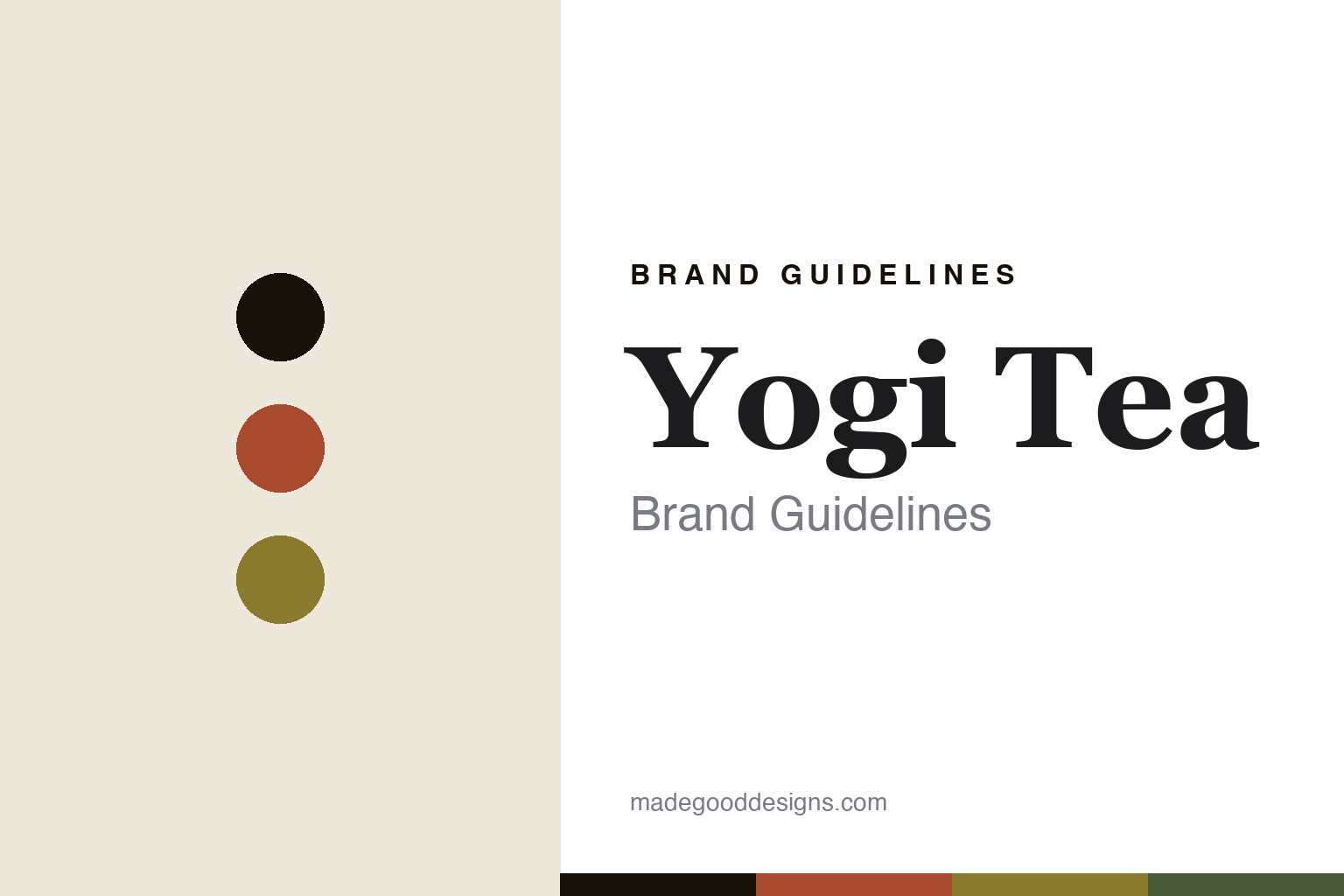
Yogi Tea lives in a spice-rust-and-turmeric palette. Click a swatch to copy the hex.
Yogi Tea’s identity is warm, earthy and wellness-led — a spice rust, an ink, a turmeric, a sage, and a cream. The palette pairs a spice rust with a turmeric, grounded by a herbal sage — the register of an Ayurvedic spice tin. It signals warmth and wellbeing rather than novelty. The honest caveat: with no published brand hex, these tones are an original, unofficial interpretation, not first-party values.
The lesson is a spice rust with a turmeric signals Ayurvedic wellness. Yogi Tea’s world is a warm cup and a small saying. For designers, it is a reminder that an earthy, spice-derived palette reads as natural and calming — right for a wellness brand. The takeaways: source the palette from the spices (rust, turmeric, sage); add a small ritual (the tag); name by outcome (Bedtime, Positive Energy); and treat any single hex as unofficial.
Typography
The register is a warm slab — earthy, grounded, wellness-led.
Yogi Tea’s identity carries a warm, grounded, wellness-led spirit — a spice cup and a small piece of wisdom. A warm slab serif captures the mood: it is sturdy and earthy, the register of a natural-wellness brand. Set in a spice-rust-and-turmeric palette, the warm slab feels earthy and grounded — exactly the personality Yogi Tea carries. It is wellness-led rather than loud, mirroring a folk-art tin. (Yogi Tea’s real packaging is work we describe but do not reproduce, and the exact typeface is not ours to use.) Because it is not ours to use, the honest description is “a warm slab spirit,” shown here in a stand-in. The type behaves like the brand: earthy, grounded and wellness-led.
Aa
A warm slab spirit — earthy and grounded. (Specimen set in Bitter, a warm slab serif STAND-IN; NOT the Yogi Tea packaging.)
A small detail as identity
Yogi Tea stands for a saying with every cup.
Yogi Tea is a lesson in making a small detail the identity. A spice-rust-and-turmeric palette, a warm slab and a saying on the tag make a tiny ritual the whole brand — warm, earthy, wellness-led. The tag is the differentiator. The differentiator is an Ayurvedic, wisdom-on-the-tag identity.
For designers and brand-builders, Yogi Tea offers a clear takeaway: a tiny detail can carry a brand. The lessons: add a small ritual (the wisdom tag); name by outcome (Bedtime, Immunity); keep the palette earthy and natural; and be honest about the story. It is also a reminder to stay accurate: it runs as two operators (US and Europe), it grew from a recipe associated with Yogi Bhajan rather than founded by him, and the palette here is an unofficial interpretation. Yogi Tea made a small detail the brand — proof that a tag can be the difference.
Explore & save
Keep Yogi Tea’s identity on hand — save it to a board in the Made Good inspiration library.
Yogi Tea identity set
Pin the spice-rust-and-turmeric palette and the warm-slab register to your own board.