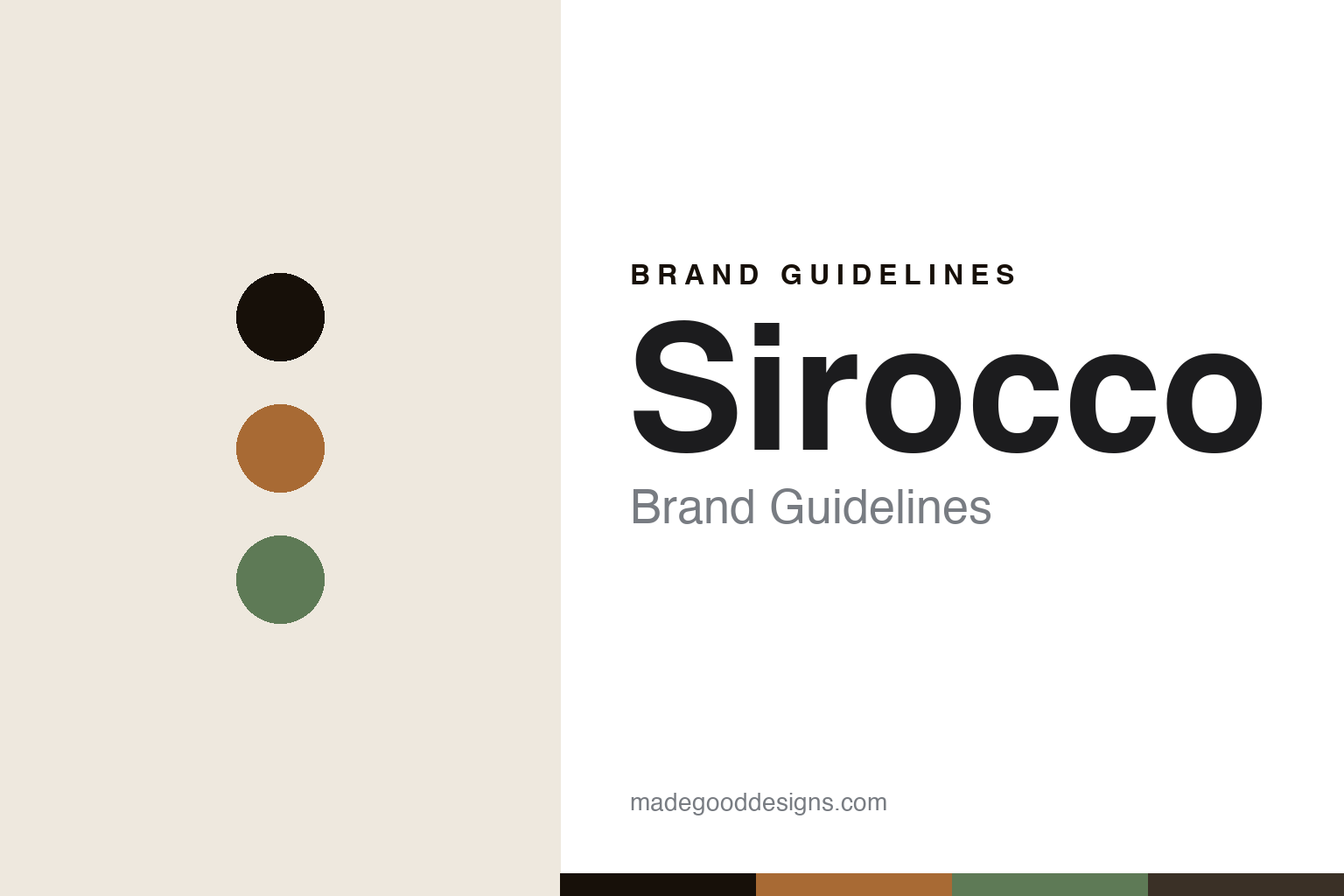
Sirocco Brand Guidelines
The warm wind.
Aa
Two constants: an amber-and-green palette and a Swiss sans register. Abstract homage — not the Sirocco packaging.
The warm wind
Sirocco has roasted and blended in Switzerland since 1908.
Sirocco is a lesson in a heritage house as identity. Founded in 1908 as A. Kuster, Sirocco-Kaffee — a Swiss coffee roastery in Schmerikon — it grew into a coffee-and-tea house, and its organic-tea line now sits alongside the coffee under the same century-old name. The name itself is the hot Mediterranean wind, the sirocco: an apt image for a roaster built on heat.
Its identity is a refined, contemporary “Genuss” (indulgence) house. The most distinctive signature is the handmade cotton tea sachet, paired with a “since 1908” heritage wordmark that unifies a broad coffee, tea and gourmet range. The teas are named evocatively — Golden Assam, Jade Oolong, Jasmine Dragon Pearls, White Silver Needle — with a Swiss-Alpine flourish in a herbal blend called Piz Palü.
(Honest notes: Sirocco is independent and family-held (the Kuster family) — not part of the Migros or Delica group. It was a coffee roastery first, so it’s best described as a Swiss coffee-and-tea house since 1908, with tea as a later line. The founder is recorded as “A. Kuster,” and Sirocco the brand should not be confused with the wind, the car or other “Sirocco” names. There’s no official brand hex, so these tones are an unofficial interpretation.)
Colour
Sirocco lives in an amber-and-green palette. Click a swatch to copy the hex.
Sirocco’s identity is warm, refined and heritage — a desert amber, an ink, a tea green, an espresso, and a sand. The palette pairs a desert amber with a tea green — the register of a warm wind and a leaf. It signals warmth and craft rather than novelty. The honest caveat: with no published brand hex, these tones are an original, unofficial interpretation, not first-party values.
The lesson is a warm amber with a tea green signals a roaster’s tea. Sirocco’s world is a century-old Swiss house of coffee and tea. For designers, it is a reminder that a warm, sandy palette reads as heritage and indulgent — right for a “Genuss” house. The takeaways: source the palette from the name and the roast (amber, espresso, sand); pair it with a tea green; keep the register refined; and treat any single hex as unofficial.
Typography
The register is a Swiss sans — refined, clean, heritage.
Sirocco’s identity carries a refined, clean, heritage spirit — a handmade sachet and a century-old wordmark. A Swiss sans captures the mood: it is neat and understated, the register of a precise Swiss house. Set in an amber-and-green palette, the Swiss sans feels refined and heritage — exactly the personality Sirocco carries. It is clean rather than loud, mirroring a quiet premium sachet. (Sirocco’s real packaging is work we describe but do not reproduce, and the exact typeface is not ours to use.) Because it is not ours to use, the honest description is “a Swiss sans spirit,” shown here in a stand-in. The type behaves like the brand: refined, clean and heritage.
Aa
A Swiss sans spirit — refined and clean. (Specimen set in Onest, a clean neutral sans STAND-IN; NOT the Sirocco packaging.)
A heritage house as identity
Sirocco stands for a century of Swiss craft.
Sirocco is a lesson in making a heritage house the identity. An amber-and-green palette, a Swiss sans and a handmade sachet make a century of craft the whole brand — refined, clean, heritage. The 1908 house is the differentiator. The differentiator is a coffee-and-tea heritage identity.
For designers and brand-builders, Sirocco offers a clear takeaway: let a real date and a good name do the work. The lessons: carry the heritage plainly (“since 1908”); find a distinctive format (the cotton sachet); name evocatively (Piz Palü); and be honest about the business. It is also a reminder to stay accurate: it’s coffee-first, independent and family-held (not Migros/Delica), and the palette here is an unofficial interpretation. Sirocco made a heritage house the brand — proof that a real century can be the difference.
Explore & save
Keep Sirocco’s identity on hand — save it to a board in the Made Good inspiration library.
Sirocco identity set
Pin the amber-and-green palette and the Swiss-sans register to your own board.