To’ak Brand Guidelines
Chocolate aged like whisky.
Aa
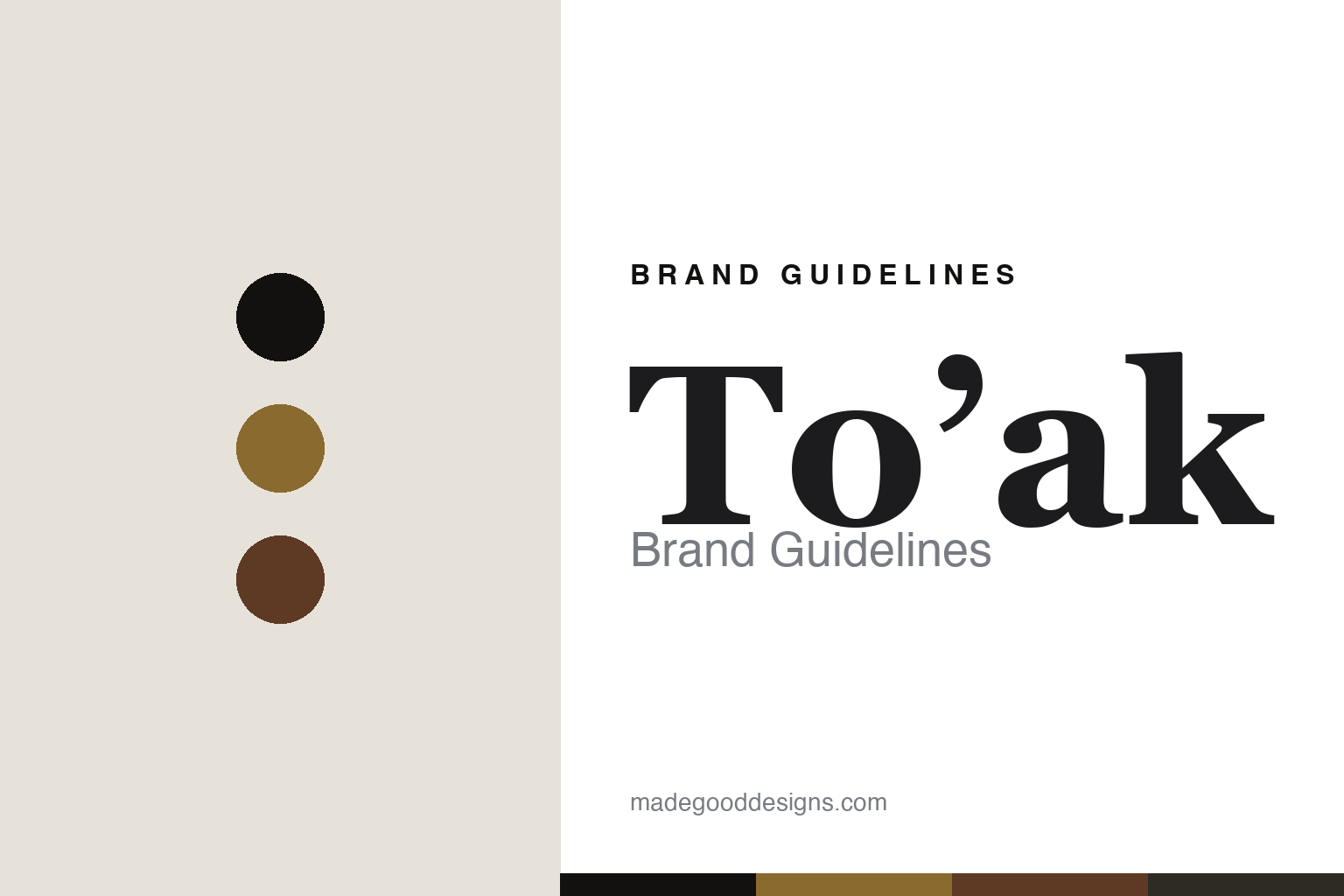
Two constants: a whisky-gold-and-wood palette and a luxury didone register. Abstract homage — not the To’ak packaging.
Chocolate aged like whisky
To’ak treats chocolate like fine wine and spirits.
To’ak is a lesson in luxury framing as identity. Founded in 2013 in Ecuador’s coastal Manabí province by Jerry Toth, Carl Schweizer and Dennise Valencia — beginning in a thatched bamboo house near a rainforest reserve — it set out to make chocolate the way the finest wine and whisky are made.
Its identity has three signatures. First, rare heirloom Nacional cacao, once thought extinct, presented as single-harvest “vintages,” with a single roasted bean set in the centre of each bar. Second, cask-aging: bars matured in casks that held whisky, cognac or port, billed as “the world’s first vintage chocolate.” Third, the numbered wooden box: each bar comes in a handcrafted hardwood box with its individual number engraved on the base (Origin editions limited to 150 bars).
(Honest notes: the founders are Toth, Schweizer and Valencia — “Servio,” the master cacao grower, is a separate figure. The “world’s most expensive chocolate” tag traces to a 2017 CNBC piece, and prices vary by edition. There’s no named designer, and there’s no official brand hex, so these tones are an unofficial interpretation.)
Colour
To’ak lives in a whisky-gold-and-wood palette. Click a swatch to copy the hex.
To’ak’s identity is dark, aged and luxurious — a whisky gold, an ink black, a cask wood, a graphite, and a bone. The palette pairs a whisky gold with a cask wood — the register of a spirits cellar. It signals rarity and age rather than everyday chocolate. The honest caveat: with no published brand hex, these tones are an original, unofficial interpretation, not first-party values.
The lesson is a whisky gold with a cask wood signals aged luxury. To’ak’s world is a numbered box and an oak cask. For designers, it is a reminder that a dark, spirits-derived palette reads as rare and collectible — right for a wine-and-whisky framing. The takeaways: borrow another category’s codes (vintages, casks); present in a numbered keepsake (a wooden box); keep the palette dark and aged; and — because a mid-gold fails as small text — keep type dark and let the gold live in the accents, palette and band; treat any single hex as unofficial.
Typography
The register is a luxury didone — rare, dark, spirit-like.
To’ak’s identity carries a rare, dark, spirit-like spirit — a numbered box and an aged bar. A high-contrast luxury didone captures the mood: it is elegant and formal, the register of a fine spirit. Set in a whisky-gold-and-wood palette, the luxury didone feels rare and dark — exactly the personality To’ak projects. It is spirit-like rather than confectionery, mirroring a cask-aged bar. (To’ak’s real packaging and box are works we describe but do not reproduce, and the exact typeface is not ours to use.) Because it is not ours to use, the honest description is “a luxury didone spirit,” shown here in a stand-in. The type behaves like the brand: rare, dark and spirit-like.
Aa
A luxury didone spirit — rare and dark. (Specimen set in Prata, a high-contrast didone STAND-IN; NOT the To’ak packaging.)
Luxury framing as identity
To’ak stands for chocolate as a rare vintage.
To’ak is a lesson in making luxury framing the identity. A whisky-gold-and-wood palette, a luxury didone and a numbered wooden box make a spirits framing the whole brand — rare, dark, spirit-like. The framing is the differentiator. The differentiator is a vintage, cask-aged identity.
For designers and brand-builders, To’ak offers a clear takeaway: borrow the codes of a more luxurious category. The lessons: frame the product as a vintage (single-harvest years); age and number it (casks, engraved boxes); present it as a keepsake; and be honest about the story. It is also a reminder to stay accurate: it’s a 2013 Ecuadorian maker, the “most expensive” tag is a press label, and the palette here is an unofficial interpretation. To’ak made a luxury framing the brand — proof that borrowed codes can be the difference.
Explore & save
Keep To’ak’s identity on hand — save it to a board in the Made Good inspiration library.
To’ak identity set
Pin the whisky-gold-and-wood palette and the luxury-didone register to your own board.