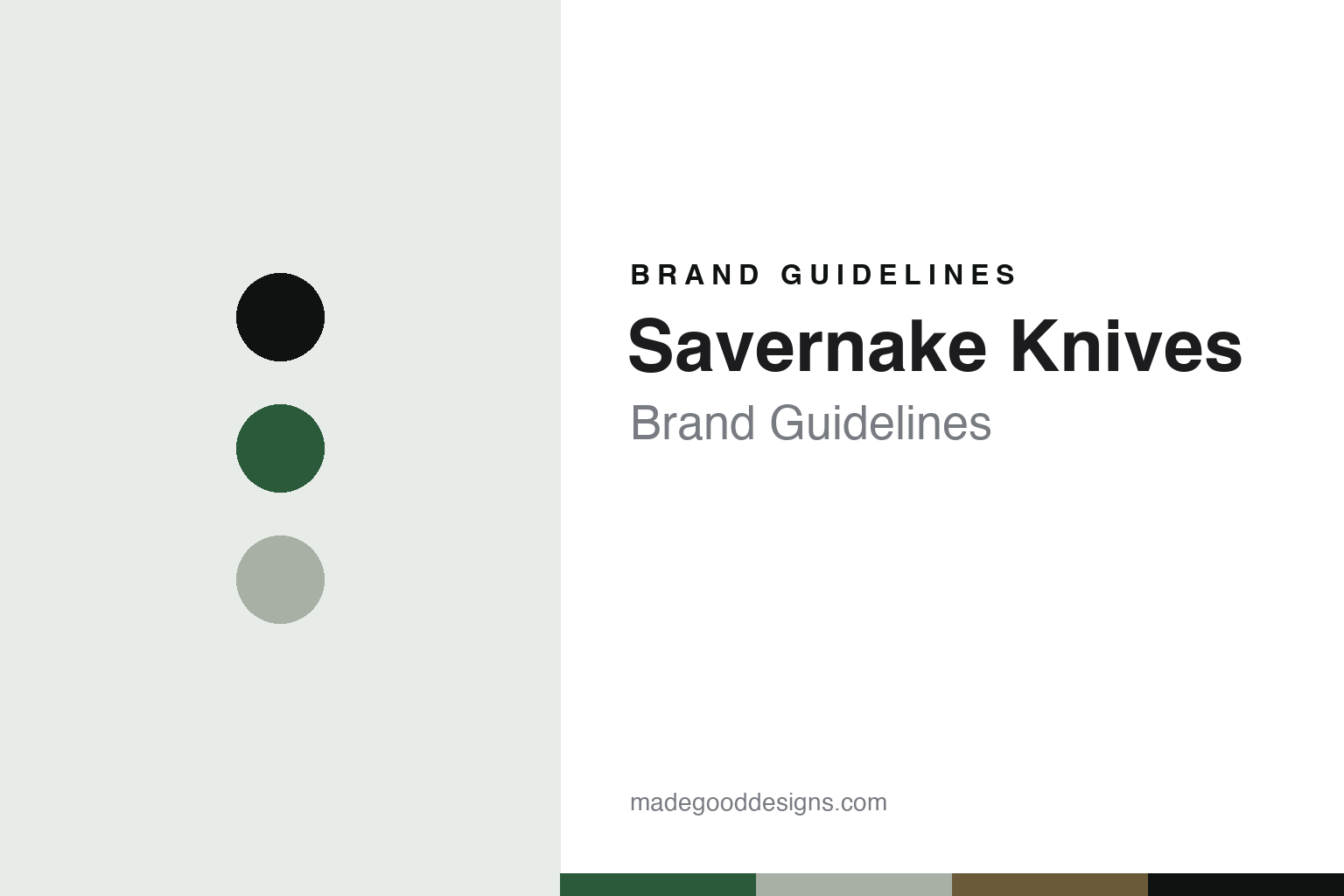
Savernake Knives Brand Guidelines
Made to order in Wiltshire.
Aa
Two constants: a forest-green palette and a contemporary-sans register. Abstract homage — not a Savernake knife, grind or wordmark.
Made to order in Wiltshire
Savernake Knives is an English maker whose bespoke, concave-ground knives are made to order in Wiltshire.
Savernake is a lesson in made-to-order as the identity. From a converted 1854 sawmill on the edge of Savernake Forest, in Wiltshire, it makes kitchen knives one at a time, to each customer’s specification, with a distinctive concave blade grind the workshop calls its own. Its answer to how a knife is made is a personal one: you speak to the people who will make your knife, and the blade is built for you. A knife made to order, in England.
Its identity is the steel and the edge, made for one person. Savernake’s concave grind, its English making and its bespoke, one-at-a-time model are the work it is known for. A service, made a signature. A workshop where the knife is built around its owner.
(Honest notes, so the story stays precise. Savernake Knives was established in the early 2010s — its limited company was incorporated in 2017 — and is founded by Laurie Timpson; we name Laurie as founder and do not assert a co-founder we could not verify. It is genuinely made in Wiltshire, England, in a converted 1854 sawmill by Savernake Forest, with every knife made to order to the customer’s specification. Its signature is a concave blade grind the workshop describes as unusual in kitchen knives, using Sandvik 14C28N steel hardened to around 60 HRC, with independent cutting-test results it cites. We describe the ranges it actually shows — Essentials, Design Your Own, Collaborations and bespoke steak knives — rather than a range name we could not confirm. Its designs and wordmark are its IP, described but never reproduced, and there is no official brand hex — these tones are an unofficial interpretation. This is design commentary and does not promote any product.)
Colour
Savernake lives in a forest-green palette. Click a swatch to copy the hex.
Savernake’s identity is contemporary, English and grounded — a forest green, an ink, a sage, a sawmill oak, and a chalk. The palette leans forest green and sage: the register of an ancient forest and a working sawmill. It signals place and craft over gloss. The honest caveat: with no published brand hex, these values are an original, unofficial interpretation, not first-party colours.
The lesson is a forest-green palette signals a grounded, made-in-England identity. Savernake’s world is a bespoke, concave-ground, made-in-Wiltshire object. For designers, it is a reminder that a deep forest green and a soft sage can carry a brand built on made-to-order craft — the green of Savernake Forest and the grey-green of its edge. Because these tones can fail as small text, keep type dark and let the colour live in the accents, palette and band. The takeaways: make it to order; keep the making in Wiltshire; be honest about the dates and the ranges; and treat any single hex as unofficial.
Typography
The register is a contemporary sans — clean, precise, modern-English.
Savernake’s identity carries a clean, precise, modern-English spirit — a bespoke object, not a mass one. A contemporary sans captures the mood: even, confident and current, the register of a modern British workshop. Set in a forest-green palette, the contemporary sans feels clean and precise — exactly the personality Savernake carries. It is modern rather than rustic, mirroring a made-to-order knife. (Savernake’s real designs and wordmark are things we describe but do not reproduce, and the exact typeface is not ours to use.) Because it is not ours to use, the honest description is “a contemporary-sans spirit,” shown here in a stand-in. The type behaves like the maker: clean, precise and modern-English.
Aa
A contemporary-sans spirit — clean and precise. (Specimen set in Archivo, a contemporary-sans STAND-IN; NOT the Savernake wordmark or any knife design.)
How a knife is made
Savernake stands for the made-to-order knife.
Savernake is a lesson in making bespoke the identity. A forest-green palette, a contemporary sans and a concave-ground blade make one thing — a knife made to order for one person — the whole maker: contemporary, English and grounded. The made-to-order model is the differentiator. The differentiator is that the knife is built for its owner: a specific grind, a specific spec, made by the people you actually speak to.
Put to work, the identity is bespoke as design. A maker building in this spirit would make each object to order rather than to stock, keep the workshop small and its makers named, and let a genuinely unusual technical choice — here, a concave grind — be the signature. It would treat the direct line between customer and maker as part of the product. It would say plainly where and how it is made, and be careful about its own founding date rather than rounding it back. It would keep the conversation between maker and owner open, so the specification is a dialogue rather than a menu, and let the wait for a made-to-order knife become part of its worth. A brand learning from it would treat that direct relationship — you speak to the person who makes your blade — as the product as much as the edge itself, and would let a genuinely unusual technical choice earn its place by working, not by looking different. It would rather make fewer knives, each fitted to its owner, than many fitted to no one. The lesson Savernake teaches is that made-to-order can build a brand: the bespoke model gives it intimacy, and the Wiltshire making gives it substance. The service is the personality, and the concave edge is the proof.
For designers and brand-builders, Savernake holds the bespoke pole in this round about how a knife is made: make each object to order, and let one technical choice be the signature. The lessons: make to order; keep the makers named; be honest about the dates; and never reproduce a protected design. It is also a reminder to stay precise: Savernake Knives is an English maker established in the early 2010s, founded by Laurie Timpson, its bespoke concave-ground knives made to order in a Wiltshire sawmill — with the palette here an unofficial interpretation. Savernake made made-to-order the maker — proof that a bespoke edge can be the difference.
Explore & save
Keep Savernake Knives’s identity on hand — save it to a board in the Made Good inspiration library.
Savernake Knives identity set
Pin the forest-green palette and the contemporary-sans register to your own board.