Perceval Brand Guidelines
The knife from a single piece.
Aa
Two constants: a slate-blue palette and a minimal-sans register. Abstract homage — not a Perceval knife, design or wordmark.
The knife from a single piece
Perceval is a Thiers atelier whose signature 9.47 is a table knife cut from one piece of steel, made in France.
Perceval is a lesson in minimalism as the identity. An atelier in Thiers — France’s historic knife-making capital — it is best known for the 9.47, a table knife made as a single piece of steel, with no separate applied handle, and for the L08, a folding pocket knife with a rounded, 1950s-car handle. Its answer to how a knife is made is a designer’s one: reduce it to a single continuous form and finish the edge by hand. A knife that is all one piece.
Its identity is the steel and the edge, in one continuous form. Perceval’s monobloc design, its Thiers making and its stripped-back look are the work it is known for. A reduction, made a signature. An atelier that turned a table knife into a piece of minimalist design.
(Honest notes, so the story stays precise. The atelier — Atelier Perceval — is in Thiers, was founded in 1993 by Emmanuel Chavassieux and established in its present form in 1996, and takes its name from co-founder Éric Perceval, a real person whose surname’s resemblance to the legend is coincidental. It is no longer founder- or family-run: management has changed, most recently under Félix Poché from 2022, though it remains an independent Thiers atelier. It is genuinely made entirely in Thiers — cutting, hardening, grinding, hand-sharpening blade by blade, and assembly — while the raw steel, as is normal, is sourced from steelmakers, so we do not imply the atelier smelts its own steel. The 9.47 is its signature monobloc table knife, extended into a 9.47 Cuisine kitchen range; the L08 is its folding knife. Two honest limits: we do not credit a named external designer for these, attributing them to the atelier itself; and we do not assert what the “9.47” name means, since explanations conflict. Its designs and wordmark are its IP, described but never reproduced, and there is no official brand hex — these tones are an unofficial interpretation. This is design commentary and does not promote any product.)
Colour
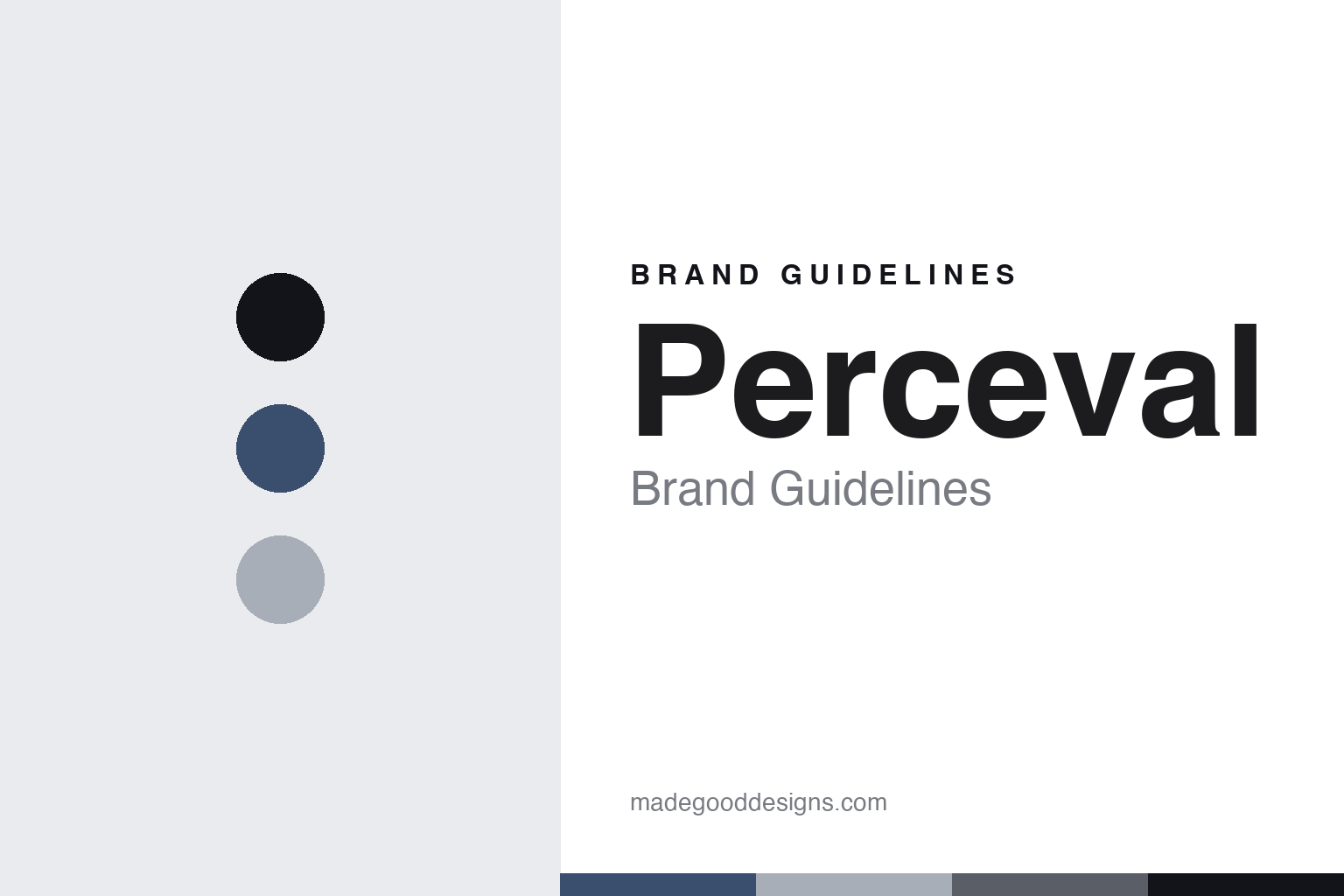
Perceval lives in a slate-blue palette. Click a swatch to copy the hex.
Perceval’s identity is minimal, modern and French — a slate blue, an ink, a steel grey, a graphite, and a chalk. The palette leans slate blue and steel: the register of bare, polished metal and a designer’s restraint. It signals reduction over ornament. The honest caveat: with no published brand hex, these values are an original, unofficial interpretation, not first-party colours.
The lesson is a slate-blue palette signals a minimal, made-in-France identity. Perceval’s world is a one-piece, hand-finished, made-in-Thiers object. For designers, it is a reminder that a cool slate blue and a steel grey can carry a brand built on reduction — the blue of a shadow on bare metal and the grey of the steel itself. Because these tones can fail as small text, keep type dark and let the colour live in the accents, palette and band. The takeaways: reduce the form; keep the making at home; be honest about sourced steel and management; and treat any single hex as unofficial.
Typography
The register is a minimal sans — clean, geometric, modern.
Perceval’s identity carries a clean, geometric, modern spirit — a design object, not a rustic one. A minimal sans captures the mood: even, quiet and contemporary, closer to Scandinavian design than a traditional French folder, the register of a stripped-back knife. Set in a slate-blue palette, the minimal sans feels clean and geometric — exactly the personality Perceval carries. It is modern rather than ornamental, mirroring a one-piece knife. (Perceval’s real designs and wordmark are things we describe but do not reproduce, and the exact typeface is not ours to use.) Because it is not ours to use, the honest description is “a minimal-sans spirit,” shown here in a stand-in. The type behaves like the maker: clean, geometric and modern.
Aa
A minimal-sans spirit — clean and modern. (Specimen set in Space Grotesk, a minimal-sans STAND-IN; NOT the Perceval wordmark or any knife design.)
How a knife is made
Perceval stands for the knife from a single piece.
Perceval is a lesson in making reduction the identity. A slate-blue palette, a minimal sans and a one-piece blade make one thing — a table knife cut from a single piece of steel — the whole maker: minimal, modern and French. The reduction is the differentiator. The differentiator is design restraint applied to the oldest of objects: strip a knife to one continuous form, remove the applied handle, and let the steel be the whole thing.
Put to work, the identity is minimalism as design. A maker building in this spirit would reduce an object to its essence, keep the making in a place with the craft to execute it, and be honest that a clean idea still depends on sourced steel and hand-finishing. It would treat the single-piece form as the whole point, and let a folding knife’s soft curve be its one flourish. It would say plainly it is made in Thiers, without dressing up its history or overclaiming who designed what. A brand learning from it would let the absence of ornament be the statement, trusting the bare, continuous form to carry the whole identity, and would resist adding a feature that a single piece of steel does not need. The lesson Perceval teaches is that reduction can build a brand: the restraint gives it a modern identity, and the Thiers making gives it substance. The minimalism is the personality, and the one-piece knife is the proof.
For designers and brand-builders, Perceval holds the minimalist pole in this round about how a knife is made: reduce the object to one form, and keep a real craft step at home. The lessons: reduce with intent; keep the making home; be honest about steel, designers and management; and never reproduce a protected design. It is also a reminder to stay precise: Perceval is an independent Thiers atelier founded in 1993 and established in 1996, its knives made entirely in Thiers, no longer founder-run — with the palette here an unofficial interpretation. Perceval made reduction the maker — proof that a single piece of steel can be the difference.
Explore & save
Keep Perceval’s identity on hand — save it to a board in the Made Good inspiration library.
Perceval identity set
Pin the slate-blue palette and the minimal-sans register to your own board.