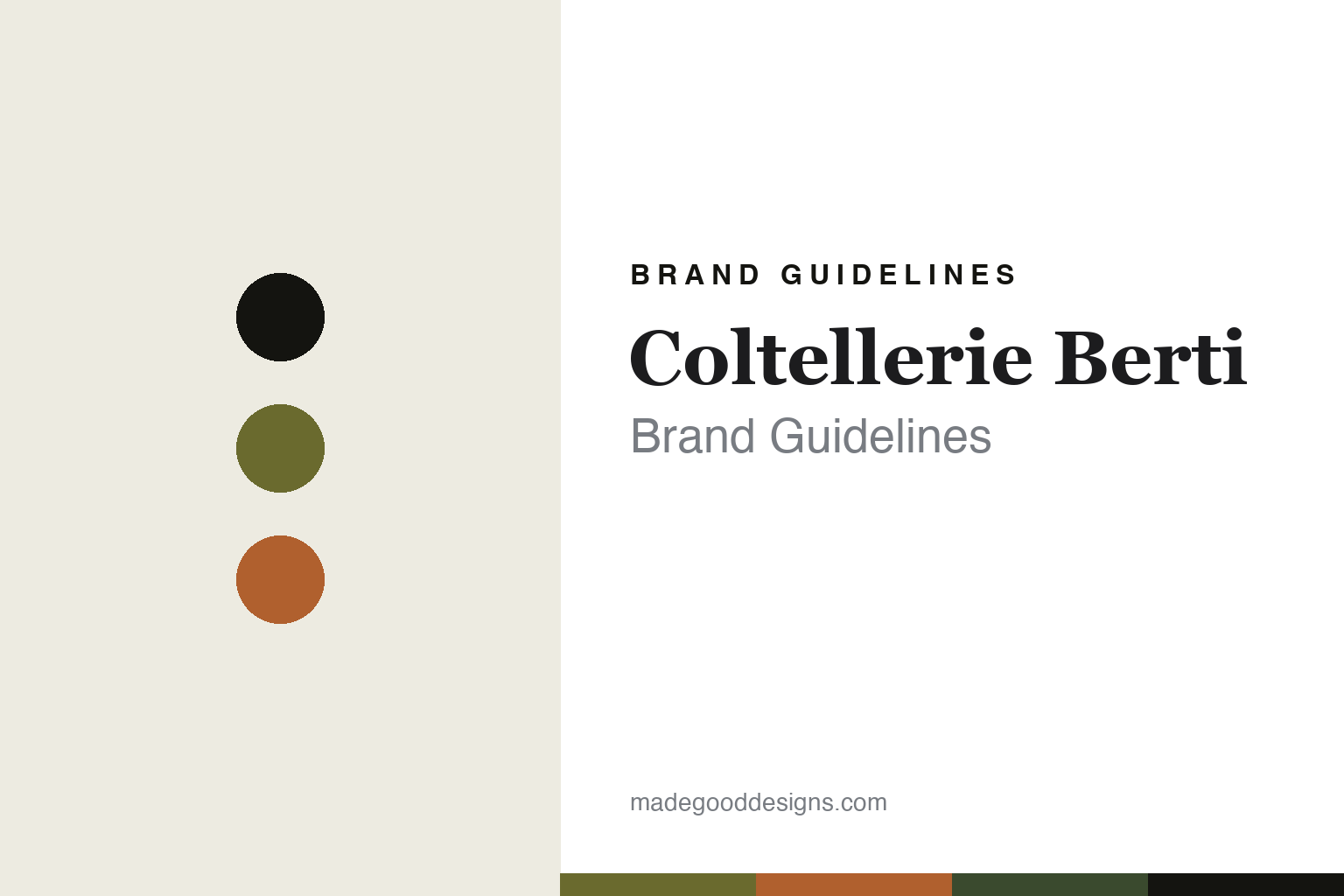
Coltellerie Berti Brand Guidelines
One artisan, one knife.
Aa
Two constants: an olive palette and a Tuscan-serif register. Abstract homage — not a Berti knife, mark or wordmark.
One artisan, one knife
Coltellerie Berti is a Scarperia house where one artisan makes each knife start to finish and signs it.
Coltellerie Berti is a lesson in the single hand as the identity. Founded in 1895 in Scarperia — the Tuscan town famous for hand-made knives — its rule is that one craftsperson makes each knife from start to finish, marks it with their initials, and stands behind its value. Its answer to how a knife is made is a human one: not a line of stations, but one person carrying a single blade the whole way. A knife made by one identifiable pair of hands.
Its identity is the steel and the edge, made by one artisan. Berti’s single-maker rule, its Scarperia making and its hand-finished table and kitchen knives are the work it is known for. A method, made a signature. A house where each knife has an author.
(Honest notes, so the story stays precise. Coltellerie Berti was founded in 1895 by David Berti in Scarperia, in the Florence province, and is a fourth-generation family firm — David, then Severino, then Alvaro, then Andrea today. It is genuinely handmade in Italy, in Scarperia, and its signature rule is stated by the house itself: one artisan starts the knife, finishes it, initials it and declares its value. Its hero line is the Convivio; because each knife is made and finished by hand by one person, no two are exactly alike — our characterisation, not a company slogan. One honest note: “Insieme” is not a signature knife but the name of block-and-tool sets, so we lead with Convivio. Its designs and mark are its IP, described but never reproduced, and there is no official brand hex — these tones are an unofficial interpretation. This is design commentary and does not promote any product.)
Colour
Coltellerie Berti lives in an olive palette. Click a swatch to copy the hex.
Berti’s identity is warm, Tuscan and hand-made — an olive, an ink, a terracotta, a cypress, and a chalk. The palette leans olive and terracotta: the register of a Tuscan hill town and a warm workshop. It signals craft and place over industry. The honest caveat: with no published brand hex, these values are an original, unofficial interpretation, not first-party colours.
The lesson is an olive palette signals a warm, made-in-Italy identity. Berti’s world is a single-maker, hand-finished, made-in-Scarperia object. For designers, it is a reminder that an olive and a terracotta can carry a brand built on the human hand — the olive of a Tuscan grove and the terracotta of a roof and a floor. Because these tones can fail as small text, keep type dark and let the colour live in the accents, palette and band. The takeaways: keep one maker per object; make it in Scarperia; let the author sign it; and treat any single hex as unofficial.
Typography
The register is a Tuscan serif — classical, warm, human.
Berti’s identity carries a classical, warm, human spirit — a hand-made object, not an industrial one. A Tuscan serif captures the mood: graceful, readable and old, the register of a nineteenth-century workshop. Set in an olive palette, the Tuscan serif feels classical and warm — exactly the personality Berti carries. It is human rather than mechanical, mirroring a knife made by one person. (Berti’s real designs and mark are things we describe but do not reproduce, and the exact typeface is not ours to use.) Because it is not ours to use, the honest description is “a Tuscan-serif spirit,” shown here in a stand-in. The type behaves like the maker: classical, warm and human.
Aa
A Tuscan-serif spirit — classical and warm. (Specimen set in Cormorant Garamond, a Tuscan-serif STAND-IN; NOT the Berti wordmark or any knife design.)
How a knife is made
Coltellerie Berti stands for one artisan, one knife.
Berti is a lesson in making the single hand the identity. An olive palette, a Tuscan serif and a signed blade make one thing — a knife made start to finish by one artisan — the whole maker: warm, Tuscan and hand-made. The single hand is the differentiator. The differentiator is authorship: one person owns the whole knife, initials it, and stands behind it, so each piece carries a name rather than a batch number.
Put to work, the identity is authorship as design. A maker building in this spirit would give one person responsibility for a whole object, keep the making in the town that defines the craft, and let the maker’s mark be the guarantee. It would treat the small differences between hand-made pieces as the point, not a flaw. It would say plainly that each knife is made and signed by one artisan, without turning a set into a signature model. It would keep the workshop small enough that a single maker can own a whole piece from steel to edge, and record who made what, so the initials on the blade mean something real rather than decorative. A brand learning from it would treat that traceability — a name behind every edge — as the heart of the promise, not a marketing flourish, and would let the small differences between hand-made pieces stand as evidence of the hand rather than a defect to sand away. It would let the pace of one maker per knife set the pace of the business, choosing depth over volume. The lesson Berti teaches is that authorship can build a brand: the single hand gives it soul, and the Scarperia making gives it substance. The single maker is the personality, and the signed edge is the proof.
For designers and brand-builders, Berti holds the authorship pole in this round about how a knife is made: let one hand make the whole object and sign it. The lessons: one maker per piece; keep the craft in its town; let the mark guarantee it; and never reproduce a protected design. It is also a reminder to stay precise: Coltellerie Berti is a fourth-generation family house founded in 1895, handmade in Scarperia, where one artisan makes and initials each knife — with the palette here an unofficial interpretation. Berti made the single hand the maker — proof that authorship can be the difference.
Explore & save
Keep Coltellerie Berti’s identity on hand — save it to a board in the Made Good inspiration library.
Coltellerie Berti identity set
Pin the olive palette and the Tuscan-serif register to your own board.