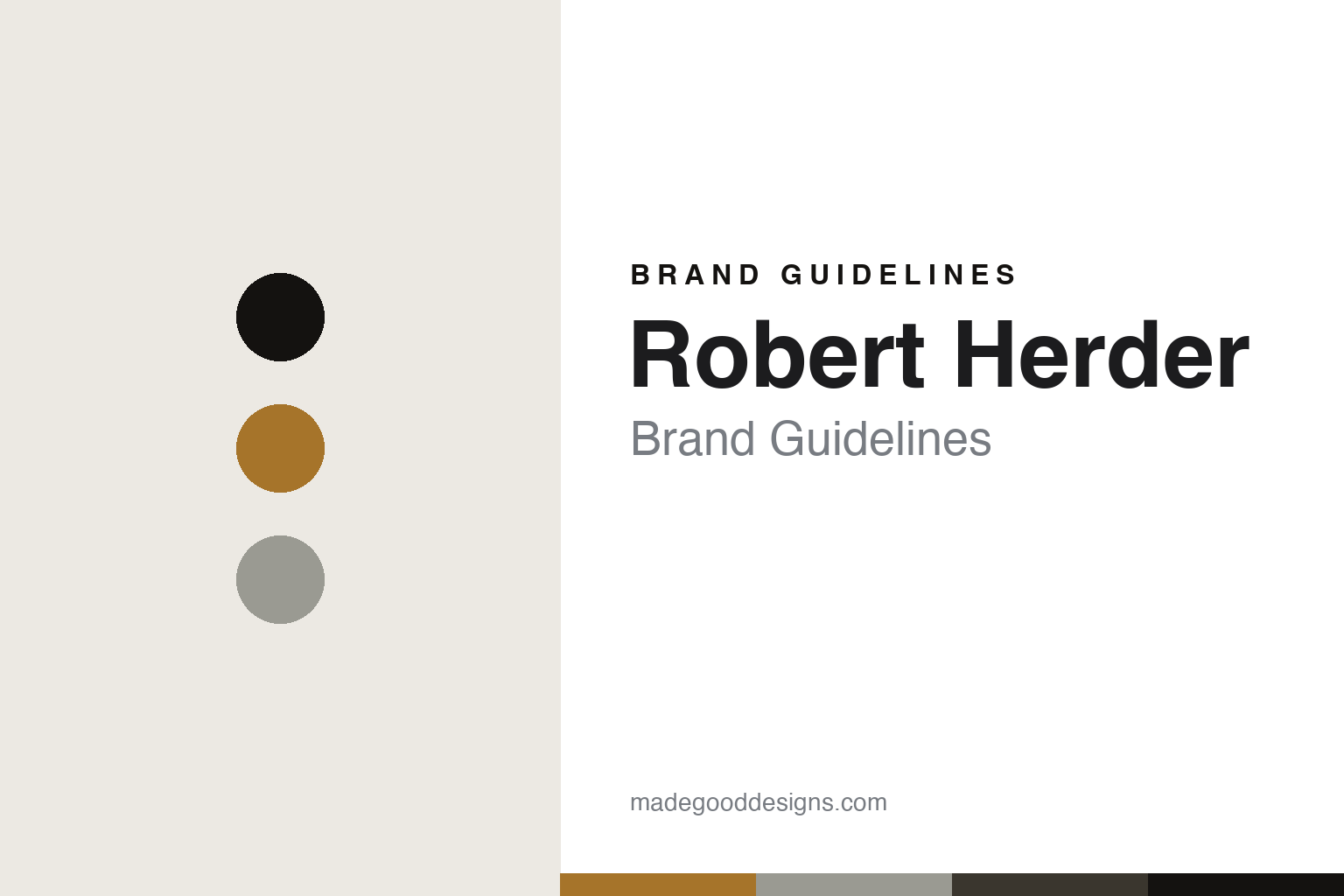
Robert Herder Brand Guidelines
The windmill knife of Solingen.
Aa
Two constants: a sandstone palette and a Solingen-sans register. Abstract homage — not a Robert Herder blade, the windmill mark or wordmark.
The windmill knife of Solingen
Robert Herder makes thin, hand-ground Windmühlenmesser knives in Solingen, Germany, since 1872.
Robert Herder is a lesson in the thin, hand-ground blade as the identity. A Solingen manufactory since 1872, known by its windmill mark as Windmühlenmesser, it is one of the last makers still grinding blades thin, by hand, on rotating wet stones. Its answer to how a country makes the everyday blade is a hand-grinding one: take an ordinary paring or kitchen knife and grind it thinner and finer than machines allow, so it cuts beautifully. A knife made sharp by hand.
Its identity is the everyday blade, hand-ground thin in Solingen. Herder’s thin-grind, its Solingen hand-work and its windmill mark are the work it is known for. A technique, made a signature. A house that kept true hand-grinding alive.
(Honest notes, so the story stays precise. Robert Herder was founded in Solingen in 1872, and its windmill — Windmühle — is a registered trademark, giving the Windmühlenmesser (“windmill knife”) name; we describe the mark but never reproduce it. It is a family-run, independent Solingen manufactory — we do not attach a specific owner’s family name we could not verify. It is made in Solingen, and is celebrated as one of the last makers doing full traditional wet hand-grinding on rotating stones, producing very thin carbon and stainless blades; the honest, verifiable claim is that the grinding and finishing are hand-done in Solingen, while raw steel may be sourced. We describe its legendary paring and kitchen knives without asserting a specific series name. Its designs and mark are its IP, described but never reproduced, and there is no official brand hex — these tones are an unofficial interpretation. This is design commentary and does not promote any product.)
Colour
Robert Herder lives in a sandstone palette. Click a swatch to copy the hex.
Herder’s identity is traditional, hand-worked and German — a sandstone, an ink, a steel, an iron, and a chalk. The palette leans sandstone and steel: the register of a wet grinding-stone and a thin bright blade. It signals hand-work and craft over machinery. The honest caveat: with no published brand hex, these values are an original, unofficial interpretation, not first-party colours.
The lesson is a sandstone palette signals a hand-ground, Solingen identity. Herder’s world is a thin, hand-ground, made-in-Solingen object. For designers, it is a reminder that a warm sandstone and a cool steel can carry a brand built on hand-grinding — the sandstone of a grinding wheel and the grey of a thin blade. Because these tones can fail as small text, keep type dark and let the colour live in the accents, palette and band. The takeaways: grind it thin by hand; keep the work in Solingen; be honest about sourced steel; and treat any single hex as unofficial.
Typography
The register is a Solingen sans — clean, precise, technical.
Herder’s identity carries a clean, precise, technical spirit — a hand-ground tool, not an ornamental one. A precise sans captures the mood: even, engineered and quiet, the register of a Solingen manufactory. Set in a sandstone palette, the Solingen sans feels clean and precise — exactly the personality Herder carries. It is technical rather than showy, mirroring a thin, hand-ground blade. (Herder’s real designs and windmill mark are things we describe but do not reproduce, and the exact typeface is not ours to use.) Because it is not ours to use, the honest description is “a Solingen-sans spirit,” shown here in a stand-in. The type behaves like the maker: clean, precise and technical.
Aa
A Solingen-sans spirit — clean and precise. (Specimen set in IBM Plex Sans, a precise-sans STAND-IN; NOT the Robert Herder wordmark, the windmill mark or any blade design.)
The knife around the world
Robert Herder stands for the thin, hand-ground blade.
Robert Herder is a lesson in making hand-grinding the identity. A sandstone palette, a Solingen sans and a thin, hand-ground blade make one thing — an everyday knife ground finer than machines allow — the whole maker: traditional, hand-worked and German. The hand-grinding is the differentiator. The differentiator is a preserved technique: full traditional wet grinding on rotating stones, kept alive when almost everyone else has stopped, producing blades thin enough to cut exceptionally well.
Put to work, the identity is a preserved craft as design. A maker building in this spirit would keep a rare hand technique alive as its whole point, ground its identity in the town that means its craft, and be honest that hand-grinding is the step it owns, even if steel is sourced. It would treat the thinness of the blade — the felt result of hand-work — as the proof. It would say plainly it is hand-ground in Solingen, and let the windmill stand for the method rather than reproduce it. A brand learning from it would protect the rare skill by training the next hands to grind, since a preserved craft dies the moment no one is left who can do it, and would let the felt thinness of the blade convince the user where words about tradition cannot. It would keep the grinding wheels turning as long as there are hands to turn them, treating the workshop itself as the heritage worth defending. It would let the difference be felt rather than argued — a blade so thin it glides where a thicker one shoves — since the proof of hand-grinding is in the cut, not the story. The lesson Herder teaches is that a preserved craft can build a brand: the hand-grinding gives it rarity, and the Solingen making gives it substance. The technique is the personality, and the thin edge is the proof.
For designers and brand-builders, Robert Herder closes this round about the knife around the world on the hand-craft pole: keep a rare technique alive, and let it be the whole identity. The lessons: grind it thin by hand; keep the craft in its town; be honest about sourced steel; and never reproduce a protected mark. It is also a reminder to stay precise: Robert Herder is a family-run Solingen manufactory founded in 1872, its Windmühlenmesser knives hand-ground thin in Germany — with the palette here an unofficial interpretation. Herder made hand-grinding the maker — proof that a preserved craft can be the difference.
Explore & save
Keep Robert Herder’s identity on hand — save it to a board in the Made Good inspiration library.
Robert Herder identity set
Pin the sandstone palette and the Solingen-sans register to your own board.