Roselli Brand Guidelines
The Finnish forged knife.
Aa
Two constants: a pine-teal palette and a Nordic-sans register. Abstract homage — not a Roselli knife, handle or wordmark.
The Finnish forged knife
Roselli is a Finnish workshop hand-forging high-carbon knives in Finland since 1976.
Roselli is a lesson in hand-forged high-carbon steel as the identity. From a single workshop at Harmoinen, in Finland, it hand-forges knives — outdoor blades and a genuine kitchen range of chef, carving and Santoku knives — in high-carbon steel that takes a keen edge and a living patina. Its answer to how a country makes the everyday blade is a forge one: heat, hammer and grind a carbon blade by hand, in one place, and let it age with use. A knife forged by hand in Finland.
Its identity is the everyday blade, hand-forged in carbon steel. Roselli’s hand-forging, its Finnish making and its high-carbon edge are the work it is known for. A material choice, made a signature. A workshop where the steel is meant to patina.
(Honest notes, so the story stays precise. Roselli was founded in 1976 by Heimo Roselli — a modern workshop, not a centuries-old house, so we do not imply antiquity — and works from a single workshop at Harmoinen, in Finland. It is genuinely one hundred per cent hand-made in Finland, a clean single-origin story with no offshore production. It makes a real kitchen range alongside its outdoor knives, and its edge is high-carbon (ultra-high-carbon) steel that forms a patina — not stainless — so we describe it as carbon rather than stainless. We chose Roselli as this round’s Finnish maker precisely for that clean, made-in-Finland kitchen story. Its designs and wordmark are its IP, described but never reproduced, and there is no official brand hex — these tones are an unofficial interpretation. This is design commentary and does not promote any product.)
Colour
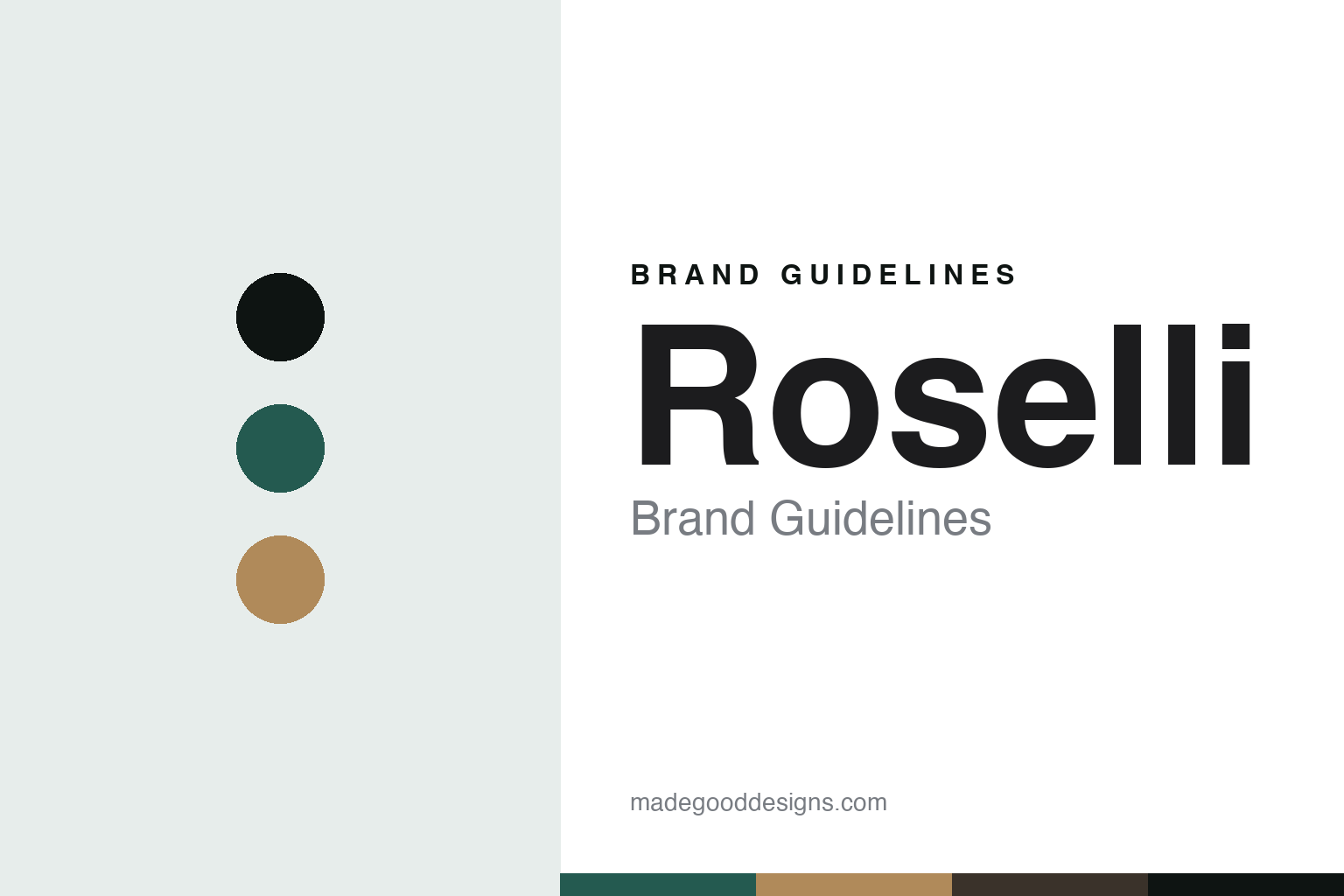
Roselli lives in a pine-teal palette. Click a swatch to copy the hex.
Roselli’s identity is rugged, natural and Finnish — a pine teal, an ink, a copper, a bark, and a chalk. The palette leans pine teal and copper: the register of a Finnish forest and the warm patina of carbon steel. It signals material and craft over polish. The honest caveat: with no published brand hex, these values are an original, unofficial interpretation, not first-party colours.
The lesson is a pine-teal palette signals a rugged, made-in-Finland identity. Roselli’s world is a hand-forged, high-carbon, made-in-Finland object. For designers, it is a reminder that a deep pine teal and a warm copper can carry a brand built on the forge and the material — the green of a northern forest and the copper of an ageing carbon edge. Because these tones can fail as small text, keep type dark and let the colour live in the accents, palette and band. The takeaways: hand-forge it; keep it in one workshop; let the material be honest; and treat any single hex as unofficial.
Typography
The register is a Nordic sans — clean, plain, natural.
Roselli’s identity carries a clean, plain, natural spirit — a forged, material-honest object, not a slick one. A Nordic sans captures the mood: even, quiet and unadorned, the register of a Finnish workshop. Set in a pine-teal palette, the Nordic sans feels clean and plain — exactly the personality Roselli carries. It is natural rather than polished, mirroring a hand-forged carbon blade. (Roselli’s real designs and wordmark are things we describe but do not reproduce, and the exact typeface is not ours to use.) Because it is not ours to use, the honest description is “a Nordic-sans spirit,” shown here in a stand-in. The type behaves like the maker: clean, plain and natural.
Aa
A Nordic-sans spirit — clean and plain. (Specimen set in Familjen Grotesk, a Nordic-sans STAND-IN; NOT the Roselli wordmark or any knife design.)
The knife around the world
Roselli stands for the hand-forged carbon knife.
Roselli is a lesson in making hand-forged material honesty the identity. A pine-teal palette, a Nordic sans and a high-carbon blade make one thing — a knife forged by hand and meant to patina — the whole maker: rugged, natural and Finnish. The material is the differentiator. The differentiator is an honest choice: high-carbon steel that takes a fine edge and shows its age, hand-forged in one Finnish workshop rather than machined at scale.
Put to work, the identity is material honesty as design. A maker building in this spirit would choose a material for how it performs and ages rather than how it markets, keep the forging by hand and in one place, and tell the truth about upkeep — carbon patinas, and that is the point. It would treat the single-origin workshop as part of the promise. It would say plainly it is made in Finland, and be honest that it is a modern workshop, not an ancient house. A brand learning from it would tell the customer the truth about upkeep before the sale, so a patinating blade reads as character rather than a fault, and would let the single workshop and the maker’s own hand be the guarantee — refusing to grow past what those hands can make well. It would rather stay small and true to the forge than scale into a name that no longer means one workshop in Finland. It would let the buyer meet the object honestly — a forged carbon blade that asks for a little care and repays it with an edge and a patina no stainless knife can imitate — and treat that small contract as part of the design. The lesson Roselli teaches is that material honesty can build a brand: the carbon steel gives it character, and the Finnish forging gives it substance. The material is the personality, and the hand-forged edge is the proof.
For designers and brand-builders, Roselli holds the material-honesty pole in this round about the knife around the world: choose an honest material, and forge it by hand at home. The lessons: forge by hand; keep it single-origin; be honest about patina and age; and never reproduce a protected design. It is also a reminder to stay precise: Roselli is a Finnish workshop founded in 1976 by Heimo Roselli, hand-forging high-carbon knives in Finland — with the palette here an unofficial interpretation. Roselli made material honesty the maker — proof that a hand-forged carbon edge can be the difference.
Explore & save
Keep Roselli’s identity on hand — save it to a board in the Made Good inspiration library.
Roselli identity set
Pin the pine-teal palette and the Nordic-sans register to your own board.