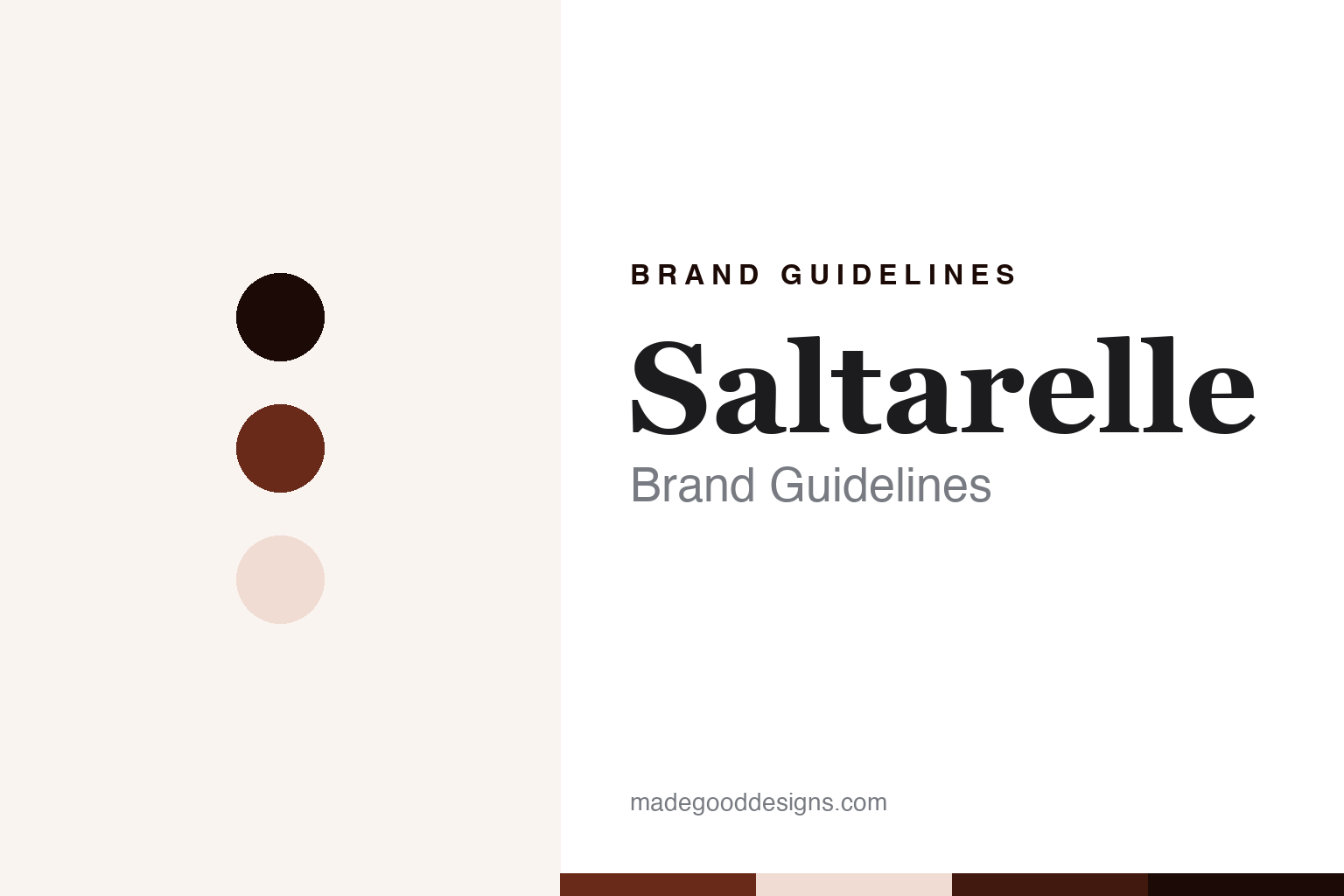
Saltarelle Brand Guidelines
French-designed diatonic accordions, built in Italy.
Aa
Two constants: a Saltarelle cherry and cream palette and a Folk serif register. Abstract homage — not a Saltarelle product or mark; no instrument, logo or nameplate is reproduced.
A model creator
A French brand with an Italian workshop.
Saltarelle is a French accordion brand based in Chenôve, beside Dijon in Burgundy. It describes itself, precisely, as an “Accordion Model Creator Since 1984” — a creator of models rather than a manufacturer. The current company, Saltarelle SARL, is registered as a wholesaler, and its manager is Vincent Roux; it was registered in 1997, after the brand’s 1984 start, and has filed its accounts every year, most recently in 2026.
Its owner has explained how the brand began. In a 2017 forum post he wrote that in 1984 his father, Georges Roux, saw “a lack of high quality and small diatonic accordions suited for French and Irish traditional music,” and went to Italy to find a maker. He found one in Dino Baffetti. We give this as the owner’s account; the 1984 story is not documented independently.
The owner was equally direct about the factory: “As many brands throughout the world we do not own the factory where our accordions are made. However there is only one factory.” After a brief dispute, he wrote, his father worked for a few months with another Italian maker, then returned to Baffetti, and “since then, all diatonics have been produced in the Baffetti factory.”
Colour
Built for French and Irish music.
Saltarelle’s range is organised around musical traditions rather than price. It describes more than forty models in three collections: Centre-Ville, stepped-keyboard diatonics for French traditional music; the Sterling Range, flat-keyboard diatonics for Irish and Celtic music; and Paris Melrose, two compact chromatics. It markets a trademarked “son Saltarelle” — the Saltarelle sound.
The making is Italian throughout. A Saltarelle dealer says “all parts are made in Italy (bellows, sound boxes, reeds, mechanics),” in solid cherry, sweet cherry and walnut, and the owner says every Saltarelle diatonic uses reeds from the Italian maker Cagnoni. The Baffetti factory is in Castelfidardo, according to an accordion dealer. Who makes the chromatic models is not confirmed. The owner adds that the Baffetti and Saltarelle ranges share no identical specifications, and that the same tuner, whom he names only as Giovanni, has tuned Saltarelle instruments for decades.
Its players are a large part of its story. The owner names Irish and British musicians including Sharon Shannon, Máirtín O’Connor, Phil Cunningham, Tim Edey and John Spiers, and says one model, the Aether 3, was made at Sharon Shannon’s request. Dealers list current models including Tethys, Epsilon, Agapanthe, Callimaque, Selkie, Elfique and Canopée, and one dealer sells the range under the line “Saltarelle – Faster than your fingers.”
Typography
Accordions, by the numbers.
The accordion is younger than most instruments. In Vienna, Cyrill Demian received a patent on 23 May 1829 for an instrument he called the Accordion: a box of free reeds sounded by a bellows.
Accordions still have their own line in the European customs code. Under CN code 9205 90 10, “Accordions and similar instruments,” Eurostat records that Italy exported €22.37 million of them in 2024 — 9,998 instruments, an average of about €2,240 each. In 2007 Italy exported 16,905, worth €14.47 million: fewer instruments now, but more money for each one.
The United States is Italy’s largest market for them, at €5.46 million in 2024, followed by Germany at €2.82 million and China at €2.56 million. Germany’s own exports that year were €3.91 million, about a sixth of Italy’s.
The same figures show the price gap at the bottom of the market. In 2024 the European Union imported 69,520 accordions and similar instruments from China for €2.56 million, about €37 each — against Italy’s average export price of more than €2,000.
The accordion has also lost ground in the tariff tables. Until 2007 the Harmonized System gave it its own heading, 9204, “Accordions and similar instruments; mouth organs”; since then it has been folded into heading 9205, among the wind instruments. In March 2022 the European Union banned exports to Russia of musical instruments worth more than €1,500 as luxury goods, accordions among them (Regulation 2022/428).
Many accordion makers cluster in and around Castelfidardo, in the Marche, but it was never the only accordion town. In Stradella, in Lombardy, Mariano Dallapè began series production in 1876, and the town says 44 accordion factories have existed there since. In 2026 Stradella is marking the 150th anniversary with a project called “Formazione armonica,” which includes a new accordion museum in the town’s former court building.
Outside Italy the trade has been fragile. France’s oldest maker, Maugein of Tulle, was placed in liquidation in September 2024 and revived by a former employee in 2025; in Germany, the Weltmeister manufactory in Klingenthal, a town that has made accordions since the nineteenth century, filed for insolvency in autumn 2023.
The instrument sits inside protected traditions, too. UNESCO’s 2015 inscription of the traditional vallenato music of Colombia’s Greater Magdalena region, on its list of heritage in need of urgent safeguarding (decision 10.COM 10.A.2), names the accordion alongside the caja drum and the guacharaca.
Saltarelle sits across these figures in an unusual way: a French brand whose instruments count, in the trade statistics, as Italian exports.
Aa
A folk serif — a French name over an Italian workshop. (Specimen set in Fraunces, a serif STAND-IN; NOT the Saltarelle logo.)
Saltarelle
A French name over an Italian workshop.
Saltarelle’s brand is a design and a sound rather than a factory. It is unusually open about that: it calls itself a model creator, its owner says plainly that it does not own the factory, and its dealers say the parts are Italian. The French name, the folk-music collections and the Irish players give it a clear identity; the Italian workshop gives it the instruments. Even its name points to music — a saltarello is an Italian dance — and its collections are named for places and moods, a city centre, sterling, Paris, rather than for keyboards or bass systems.
For a design guide, Saltarelle is a case study in honest sourcing: a brand built on specification and taste rather than ownership of a workshop. Compare Castagnari, a Castelfidardo maker of diatonic accordions, and Maugein, which makes its accordions in France.
For this guide we use a cherry red and a cream with a serif, an unofficial interpretation. No instrument or logo is reproduced.
Explore & save
Keep Saltarelle’s identity on hand — save it to a board in the Made Good inspiration library.
Saltarelle identity set
Pin the Saltarelle cherry and cream palette and the Folk serif register to your own board.