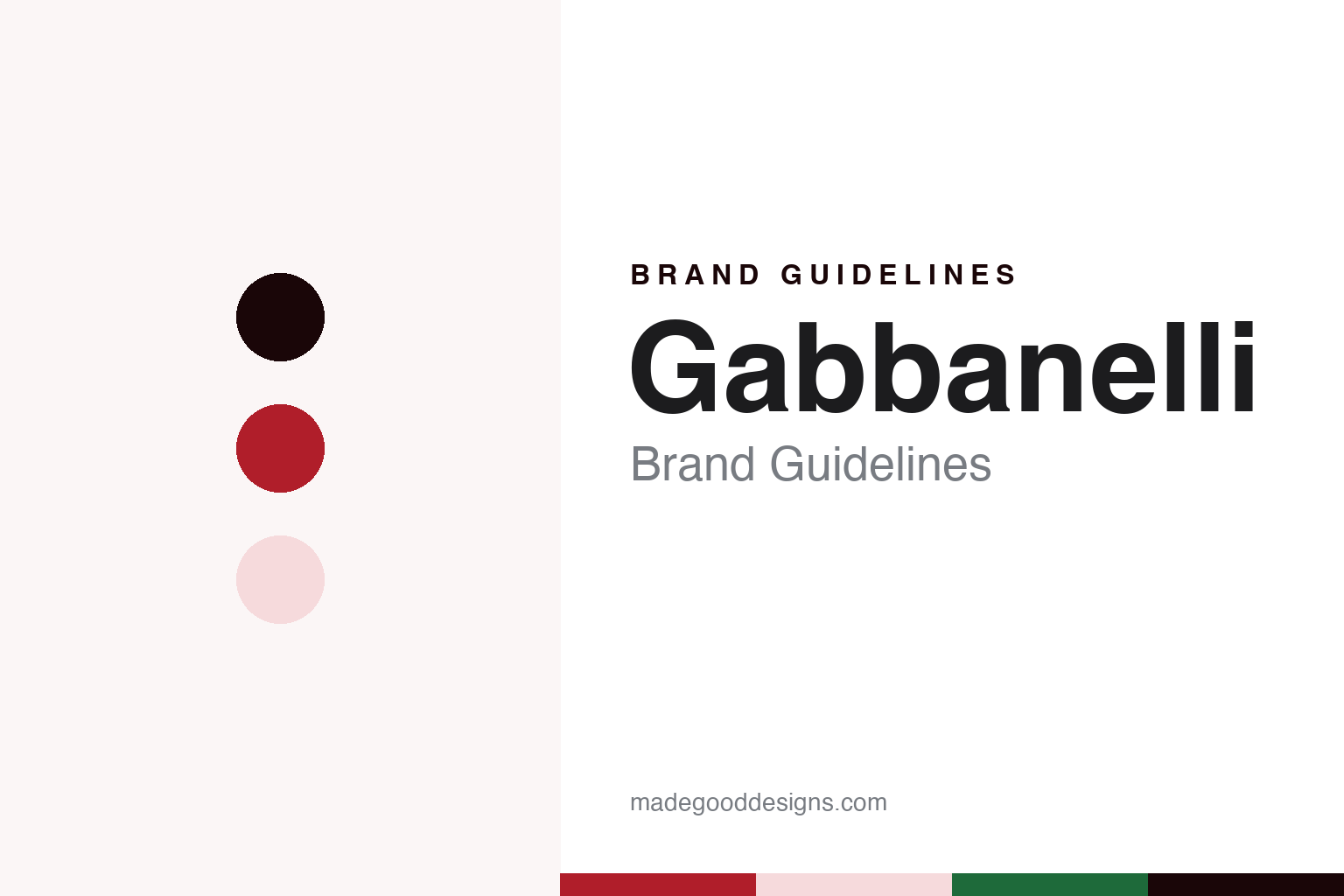
Gabbanelli Brand Guidelines
Houston’s accordions for Tejano and norteño music.
Aa
Two constants: a Gabbanelli red and green palette and a Showcase sans register. Abstract homage — not a Gabbanelli product or mark; no instrument, logo or nameplate is reproduced.
From Castelfidardo to Houston
A tuner who built a market.
Gabbanelli Accordions is a Houston family firm with Castelfidardo roots. Its founder, Gianfranco “John” Gabbanelli, born in 1937, was the son of an accordion maker in Castelfidardo; he arrived in Houston in 1961, the company says, and for years built and sold accordions from his home and garage. A 2009 federal appeals ruling described the American business as beginning “in the mid-1960s as the U.S. distributor” for the Italian family firm.
He died suddenly in Houston on 16 December 2003. His son Michael and daughter-in-law Elia have run the business since; the Houston Chronicle described Michael in 2010 as third-generation. The shop on West Bellfort Avenue is, the company says, the “original and sole” Gabbanelli store; the Chronicle counted about a thousand accordions in stock in 2010 and fifteen to twenty repairs a day. In 2003, Accordions Worldwide reported, the firm was importing up to 2,000 accordions a year.
Its customers are players of conjunto, norteño and Tejano music, where the button accordion is central. The Houston Chronicle wrote that the Gabbanelli name is “golden” among those players.
Colour
Colour as a legal asset.
Gabbanelli’s look is unusual enough to have been defined in court. In 2008 a federal judge in Chicago, ruling in a dispute with Italian relatives, wrote that its accordions “are wildly colorful, heavily ornamental and clearly distinctive–no one disputes that trademark and trade dress protection are fully justified.” The Seventh Circuit affirmed in 2009.
An earlier settlement with a rival importer defined Gabbanelli’s trade dress as “the color scheme, the location and design of the buttons and keys on the accordions, the engravings on the accordions, and the ornamentation.” In 2014 a Houston federal court found that Hohner had breached a settlement over grille designs and awarded Gabbanelli $60,000 plus $51,887.70 in fees. A 2018 suit alleged infringement of a registered red, white and green trade dress; we found no final outcome, so we report it as an allegation.
The Houston Chronicle described the instruments in 2010: celluloid with a “pearllike shell” and a “creamy candy-colored finish,” mirrored buttons, Swarovski crystals and a showroom that “looks like an exploding rainbow.” Elia Gabbanelli explained the appeal: “It’s like a rap video… These guys, it’s their accordion.”
Typography
Accordions, by the numbers.
The accordion is younger than most instruments. In Vienna, Cyrill Demian received a patent on 23 May 1829 for an instrument he called the Accordion: a box of free reeds sounded by a bellows.
Accordions still have their own line in the European customs code. Under CN code 9205 90 10, “Accordions and similar instruments,” Eurostat records that Italy exported €22.37 million of them in 2024 — 9,998 instruments, an average of about €2,240 each. In 2007 Italy exported 16,905, worth €14.47 million: fewer instruments now, but more money for each one.
The United States is Italy’s largest market for them, at €5.46 million in 2024, followed by Germany at €2.82 million and China at €2.56 million. Germany’s own exports that year were €3.91 million, about a sixth of Italy’s.
The same figures show the price gap at the bottom of the market. In 2024 the European Union imported 69,520 accordions and similar instruments from China for €2.56 million, about €37 each — against Italy’s average export price of more than €2,000.
The accordion has also lost ground in the tariff tables. Until 2007 the Harmonized System gave it its own heading, 9204, “Accordions and similar instruments; mouth organs”; since then it has been folded into heading 9205, among the wind instruments. In March 2022 the European Union banned exports to Russia of musical instruments worth more than €1,500 as luxury goods, accordions among them (Regulation 2022/428).
Many accordion makers cluster in and around Castelfidardo, in the Marche, but it was never the only accordion town. In Stradella, in Lombardy, Mariano Dallapè began series production in 1876, and the town says 44 accordion factories have existed there since. In 2026 Stradella is marking the 150th anniversary with a project called “Formazione armonica,” which includes a new accordion museum in the town’s former court building.
Outside Italy the trade has been fragile. France’s oldest maker, Maugein of Tulle, was placed in liquidation in September 2024 and revived by a former employee in 2025; in Germany, the Weltmeister manufactory in Klingenthal, a town that has made accordions since the nineteenth century, filed for insolvency in autumn 2023.
The instrument sits inside protected traditions, too. UNESCO’s 2015 inscription of the traditional vallenato music of Colombia’s Greater Magdalena region, on its list of heritage in need of urgent safeguarding (decision 10.COM 10.A.2), names the accordion alongside the caja drum and the guacharaca.
The button accordion’s place in Texas music is old. The Texas State Historical Association says Narciso Martínez, called the father of conjunto, bought his first new accordion, a Hohner, in 1930. A Smithsonian Folklife article in 2017 quoted Hohner’s product manager on the style of the market: “It’s all about bling.”
Aa
A showcase sans — colour, chrome and a family name. (Specimen set in Inter Tight, a sans STAND-IN; NOT the Gabbanelli logo.)
Gabbanelli
Colour, chrome and a family name.
Gabbanelli’s brand is its finish. Where many accordion makers lead with reeds and craftsmanship, Gabbanelli leads with colour, pearl and crystal — and has gone to court to defend it. The company says its accordions are “handmade in Italy by master craftsmen”; its own product pages say its lower-priced Cascabel line is made in China. Which Italian factory builds the main line today we could not confirm. Its registered marks include GABBANELLI, CASCABEL, PIERMARIA and the slogan THE BEST FOR THE BEST, and it offers in-house engraving and months-long artistic customisation.
The family story has a second branch. In 2012 Hohner launched an “Anacleto” collection made by Anacleto Gabbanelli, John’s brother, at his Castelfidardo factory; Hohner’s site states that the line is not connected to Gabbanelli Accordions & Imports of Houston.
For a design guide, Gabbanelli shows ornament as identity — and as property. Compare Hohner, the German maker whose button accordion Narciso Martínez bought in 1930, and Petosa, another American family brand built in Italy. For this guide we use a red, a pearl and a green with a sans, an unofficial interpretation; no instrument or logo is reproduced.
Explore & save
Keep Gabbanelli’s identity on hand — save it to a board in the Made Good inspiration library.
Gabbanelli identity set
Pin the Gabbanelli red and green palette and the Showcase sans register to your own board.