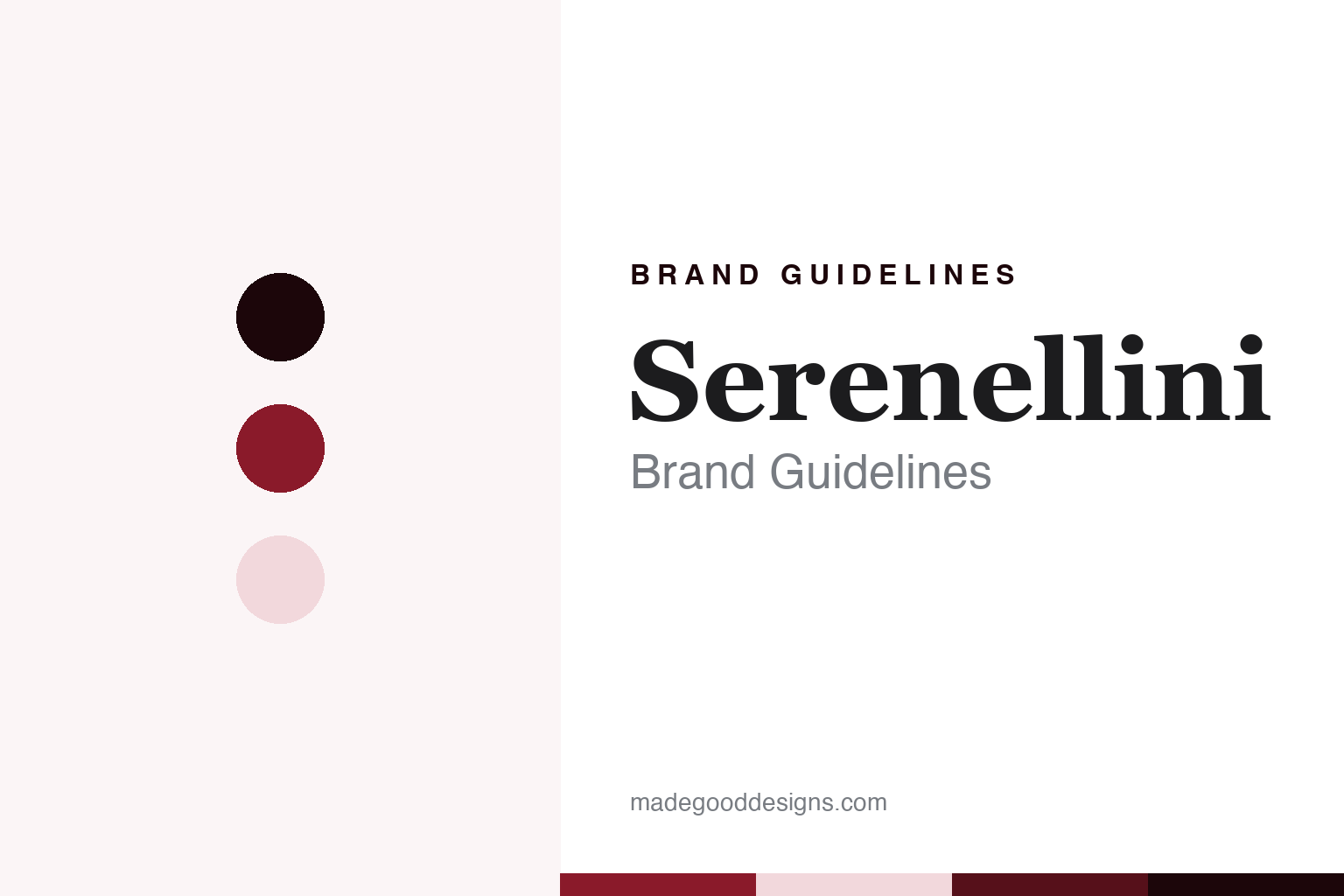
Serenellini Brand Guidelines
Accordions from Loreto, next door to Castelfidardo.
Aa
Two constants: a Serenellini pearl red and black palette and a Celluloid serif register. Abstract homage — not a Serenellini product or mark; no instrument, logo or nameplate is reproduced.
From toy instruments to accordions
Luciano Serenellini’s home workshop.
Serenellini is a family accordion maker in Loreto, the Marian pilgrimage town a few kilometres from Castelfidardo in the province of Ancona. Its company name is Campanari srl, at via Brecce in Loreto — not Castelfidardo, though it belongs to the same accordion district. A 2014 profile in the trade magazine Strumenti&Musica placed it within “la tradizione manifatturiera di Castelfidardo,” the town’s manufacturing tradition.
Its founder, Luciano Serenellini, told the trade site Accordions Worldwide how it began. As a young man, he said, he worked in a Castelfidardo factory “that produced toy musical instruments, first in wood and then in plastic.” Then: “So I started making accordions in 1978.”
At first he did not make complete instruments under his own name. “At the beginning I only produced accordion parts for other companies,” he said; he then built his own line, which he showed with his first catalogue at the Frankfurt music fair in 1982. “After working five years in my home workshop,” he added, “in 1983 I built my current company.” His daughter Sabrina now manages the firm, with Donatella handling exports, and the company’s home page says “Dal 1978 Serenellini realizza artigianalmente una vasta gamma di ottime fisarmoniche.”
Colour
One-off orders, not batches.
Serenellini’s founder described how the market has changed: “In the past, customers/shopkeepers would order as many as 20/30 pieces all the same, all the same model, all the same colour. Now the order is extremely personalised.” He also said that his first customer for the Serenellini brand was still a customer, for more than 35 years.
Its range reflects that personalisation. The company offers piano and chromatic accordions in cassotto, standard and wood versions; free-bass “convertor” models in B and C systems, such as the Cassotto 443, 454 CR and 373 CR; and diatonics with names such as Super Star, Annalisa, Dona, Lady, Sellì and Minù. Its professional models include the Imperator; four versions of the Zeus, numbered 41, 37, 46 and 44; and the Regina, Opera, Balkan and Maestro, listed together on the company’s information page.
Its decoration options read like a catalogue of accordion ornament: an “Eagle 3D” motif, metal logos in slim, golden and silver forms, engraved logos with or without rhinestones, and celluloid in pearl red, black, pearl white and pearl blue, with wood finishes in mahogany and cherry. Some diatonics are also offered in dull black and red, and the wood finishes include a shaded cherry. In 2014 it named its markets as Europe, the United States, Japan, Korea and Israel, and its website now lists distributors in about twenty-five countries; the company says its instruments are “100% Made in Italy.”
Typography
Accordions, by the numbers.
The accordion is younger than most instruments. In Vienna, Cyrill Demian received a patent on 23 May 1829 for an instrument he called the Accordion: a box of free reeds sounded by a bellows.
Accordions still have their own line in the European customs code. Under CN code 9205 90 10, “Accordions and similar instruments,” Eurostat records that Italy exported €22.37 million of them in 2024 — 9,998 instruments, an average of about €2,240 each. In 2007 Italy exported 16,905, worth €14.47 million: fewer instruments now, but more money for each one.
The United States is Italy’s largest market for them, at €5.46 million in 2024, followed by Germany at €2.82 million and China at €2.56 million. Germany’s own exports that year were €3.91 million, about a sixth of Italy’s.
The same figures show the price gap at the bottom of the market. In 2024 the European Union imported 69,520 accordions and similar instruments from China for €2.56 million, about €37 each — against Italy’s average export price of more than €2,000.
The accordion has also lost ground in the tariff tables. Until 2007 the Harmonized System gave it its own heading, 9204, “Accordions and similar instruments; mouth organs”; since then it has been folded into heading 9205, among the wind instruments. In March 2022 the European Union banned exports to Russia of musical instruments worth more than €1,500 as luxury goods, accordions among them (Regulation 2022/428).
Many accordion makers cluster in and around Castelfidardo, in the Marche, but it was never the only accordion town. In Stradella, in Lombardy, Mariano Dallapè began series production in 1876, and the town says 44 accordion factories have existed there since. In 2026 Stradella is marking the 150th anniversary with a project called “Formazione armonica,” which includes a new accordion museum in the town’s former court building.
Outside Italy the trade has been fragile. France’s oldest maker, Maugein of Tulle, was placed in liquidation in September 2024 and revived by a former employee in 2025; in Germany, the Weltmeister manufactory in Klingenthal, a town that has made accordions since the nineteenth century, filed for insolvency in autumn 2023.
The instrument sits inside protected traditions, too. UNESCO’s 2015 inscription of the traditional vallenato music of Colombia’s Greater Magdalena region, on its list of heritage in need of urgent safeguarding (decision 10.COM 10.A.2), names the accordion alongside the caja drum and the guacharaca.
Serenellini shows how close the Italian accordion district is: a maker that learned its trade in Castelfidardo and works a few kilometres away, counted in the same export figures.
Aa
A celluloid serif — pearl, chrome and a family name. (Specimen set in Fraunces, a serif STAND-IN; NOT the Serenellini logo.)
Serenellini
Pearl, chrome and a family name.
Serenellini’s brand is a family workshop that grew from parts to its own name. Its identity lives in finish rather than in a single icon: pearl celluloid, metal and engraved logos, an eagle in relief. Its founder’s account of the market — from twenty or thirty identical instruments to one-off orders — explains why the decoration menu is so long: each accordion is configured for one buyer. A player of its Imperator, Yana Fedoruk, won first prize in a jazz category at the Castelfidardo festival in 2010, the company’s interview notes.
For a design guide, Serenellini shows how a small maker can build a brand on customisation. Compare Bugari, a Castelfidardo house, and Beltuna, another maker of the same district.
For this guide we use a pearl red and a pearl white with a serif, an unofficial interpretation. No instrument or logo is reproduced.
Explore & save
Keep Serenellini’s identity on hand — save it to a board in the Made Good inspiration library.
Serenellini identity set
Pin the Serenellini pearl red and black palette and the Celluloid serif register to your own board.