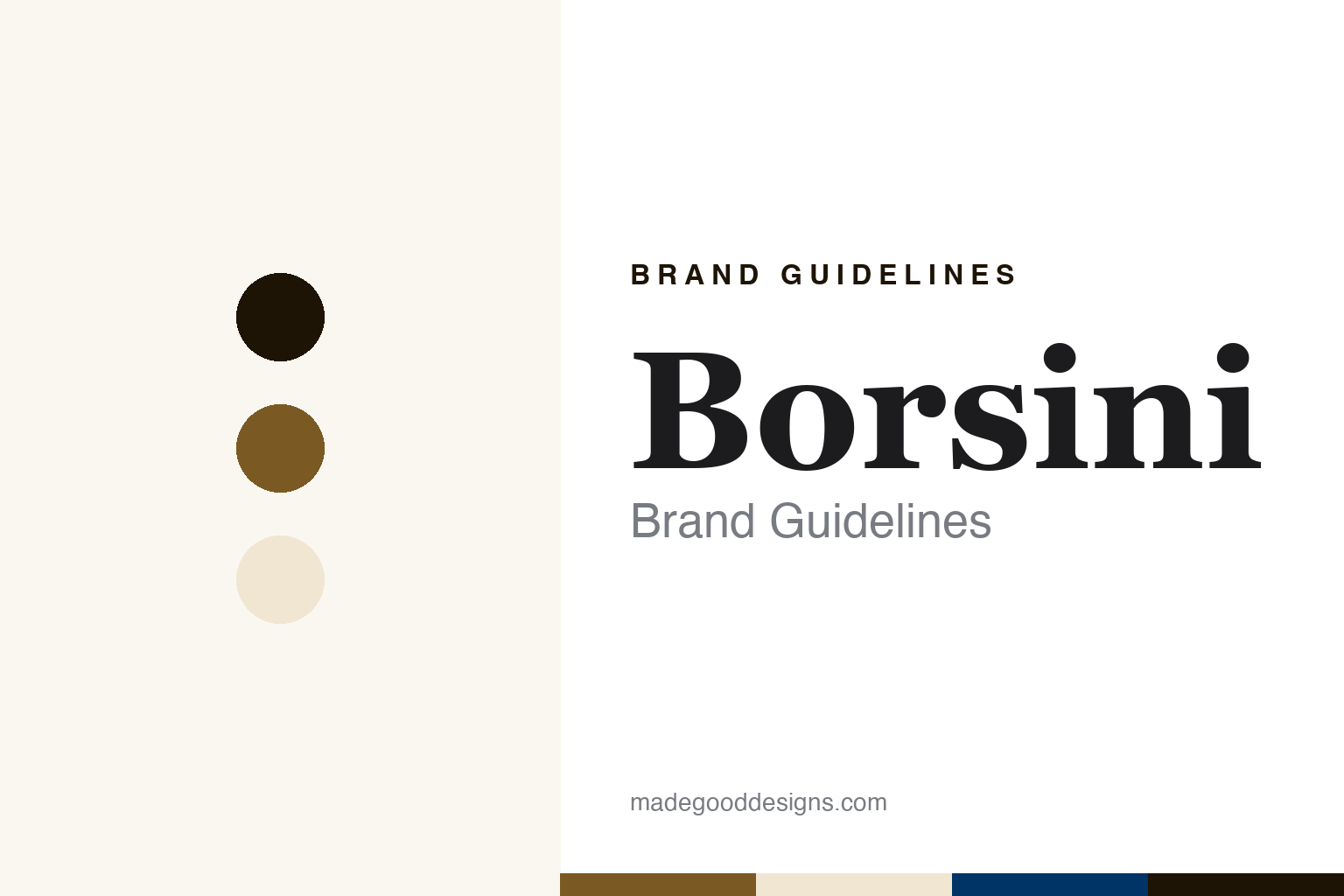
Borsini Brand Guidelines
The Castelfidardo accordion maker building in wood since 1922.
Aa
Two constants: a Borsini gold and navy palette and a Classic serif register. Abstract homage — not a Borsini product or mark; no instrument, logo or nameplate is reproduced.
Since 2 January 1922
A founding date to the day.
Borsini gives its founding date to the day: “Borsini has been creating accordions in Castelfidardo since 2 January 1922,” its website says. Italian Wikipedia’s table of Italian accordion makers also gives 1922 and lists the firm as still active. We did not find the founders’ names in the sources we checked, nor any independent source on Borsini’s output, staff or exports.
The company describes itself as a family business — “a family whose members work enthusiastically and lovingly together for their name.” We give that as its own description. The operator named in the footer of its website is a small company, SABOCA SRLS, at an address in Recanati, the neighbouring town; we could not confirm how it relates to the Borsini family.
Borsini makes strong claims about its method of building. It says that “90% of the work” is done by hand, that it holds a patent for an “interlocked truncated frame,” and that “accordions must be constructed in wood, and no other material.” We give those as the company’s claims; we have not checked the patent or its date.
Colour
Super Stars, Parisians and bayans.
Borsini’s range is broad. Its website lists the Super Star 2000 line, in piano and button versions with three, four and five sets of reeds; the Paris and Parisina; the Yugo 43; and several bayans — the Bayan P, the Bayanina and the G.C.S. Bayan — alongside Classic and Light & Compact lines. The site gives no launch dates.
The Super Star 2000 models are listed by reed sets and keyboard type — for example the III RS 41/120, the IV RS, the 41 IV SC and the V RS and SC — with CR versions as well. A bayan is the Russian form of the chromatic button accordion; Borsini lists several. The company does not explain its model names on the pages we read.
The company publishes a list of players it calls “Friends of Quality”: Natalino Marchetti, Joe Recchia, Vince Abbracciante, Jing Zhou, Sandi Jug, Miroslav Lelyukh and Vlada Raguzina. That is the company’s own list, and we have not checked each player’s use of its instruments.
Typography
The keyboard district.
In the 1960s and 1970s the accordion towns of the Marche became a centre for electronic keyboards. Farfisa, formed in 1946 from three accordion firms, made its Compact organs from 1964; Elka was founded in 1965 by members of the Crucianelli accordion family, and Orla the same year by Nazzareno Orlandoni; Crumar followed around 1970–71. Several older accordion houses, such as Welson, also turned to organs.
Orla’s own history shows the link: it says it began in 1965 by making parts for accordions and reed organs, and moved into electronic organs after Alfio Monaci joined. The district’s products ranged from home organs and portable combo organs to string machines, synthesizers and, later, arranger keyboards.
Some of the district’s instruments reached a wide audience. Farfisa launched its FAST organs at the 1968 NAMM show in the United States, English Wikipedia records; Elka’s Synthex was used by Jean-Michel Jarre on Rendez-Vous, according to Sound On Sound; and Crumar’s DS-2 of 1978 was, English Wikipedia says, one of the earliest synthesizers with digitally controlled oscillators.
The boom did not last. The industrial district of Recanati, Osimo and Castelfidardo went into crisis at the end of the 1970s, Italian Wikipedia says, under Asian competition. Crumar stopped trading in 1986 or 1987, and Welson ceased activity in 1981, according to the guitar historian Jack Marchal. Some names survive as revived brands or distributors’ labels; and Ketron, founded in Ancona in 1981, says it still designs and makes electronic instruments there.
Borsini is the other answer to that story: a firm that stayed with the wooden, hand-built accordion while its neighbours turned to circuits.
Aa
A classic serif — “where quality counts.” (Specimen set in Fraunces, a serif STAND-IN; NOT the Borsini logo.)
Borsini
“Where quality counts.”
Borsini’s brand is built on a single idea — quality, through wood and handwork. Its tagline, “Borsini where quality counts!”, says it directly, and its insistence that accordions be made of wood and nothing else is a statement of method used as a statement of identity. Its website uses a gold-tan and a deep blue; we do not know whether those are documented brand colours.
Borsini works in a district that has shrunk. In 2012 the business paper Il Sole 24 Ore put the peak output of Castelfidardo and Recanati at 240,000 accordions a year, and current output at no more than 30,000. A March 2000 trade report, quoted by the accordion writer Mario Bruneau, counted 29 accordion firms in the area and found that only two could make an entire accordion themselves; the rest relied on outside suppliers for parts such as buttons and bass mechanisms. Borsini’s claim to do most of the work by hand should be read against that background, as the company’s own account. Reeds are made by a small number of specialists: a 2021 study in the European Journal of Musicology by Raffaele Pinelli named four reed makers in the Marche — Voci Armoniche, Binci, Cagnoni and Artigiana Voci — and found that the Italian reed market had fallen sharply in the 2000s. Borsini does not name its reed supplier on the pages we read, and we make no assumption about it.
Readers should be careful with its current status. The website is still online, but it appears not to have been updated for some years — its latest news item refers to a 2013 tour, and some pages show software errors — so we cannot confirm from it how active the firm is today. We say that plainly. Readers searching online should also know that borsini.com is an unrelated Portuguese clothing and perfume shop, and that borsini.it does not resolve; the accordion maker’s site is borsiniaccordions.it, whose header still relies on Flash.
For a design guide, Borsini shows a maker whose brand rests on method. Compare Frontalini, a historic name revived by another firm, and Zero Sette, another Castelfidardo house. For this guide we use a gold and a navy with a serif, an unofficial interpretation; no instrument or logo is reproduced.
Explore & save
Keep Borsini’s identity on hand — save it to a board in the Made Good inspiration library.
Borsini identity set
Pin the Borsini gold and navy palette and the Classic serif register to your own board.