Binci Brand Guidelines
The Castelfidardo reed makers inside the accordion.
Aa
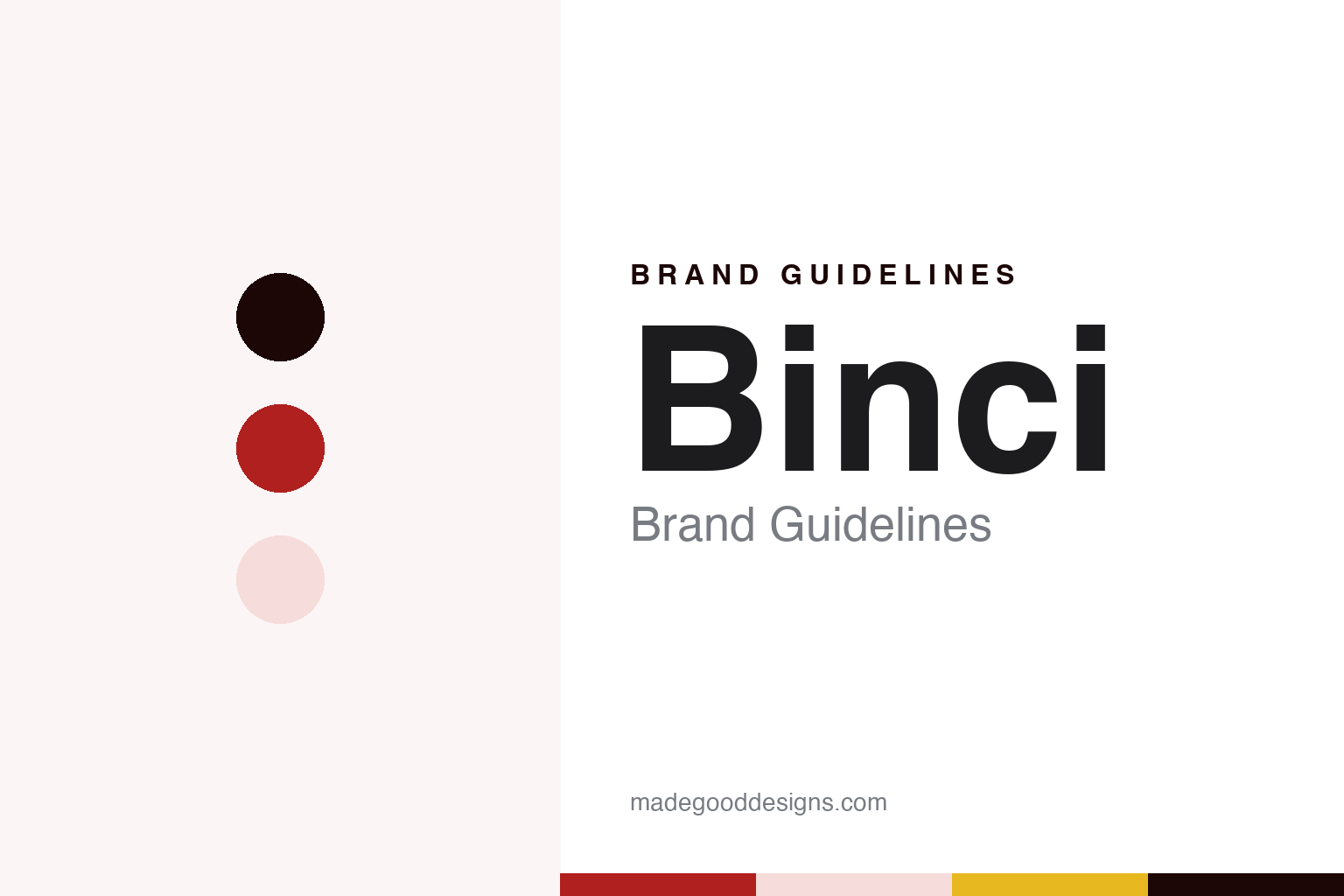
Two constants: a Binci reed red and brass yellow palette and a Bold sans register. Abstract homage — not a Binci product or mark; no instrument, logo or nameplate is reproduced.
Nazareno and his brothers
A reed workshop and its own machines.
Binci makes the part of the accordion that sounds: the reeds. The company says Nazareno Binci founded it in the early 1950s — it gives no exact year — and that he designed his own precision machinery. His brothers Marino, Adelmo and Gino assembled reeds for him as outside collaborators. Nazareno Binci’s workshop was described in a study by Giannattasio published in 1979, on pages 28 to 32, Pinelli notes.
The firm passed through the family. The company says Gino died in 1978 and his son Claudio joined Nazareno; in 1988 Nazareno handed the business to Claudio, who ran it with his younger brother Paolo. Claudio’s sons Luca and Nicola joined later, and in 2020 Valeria, Paolo’s eldest daughter, and Riccardo, Claudio’s third son, joined too. The company calls this three generations and “over half a century.” Claudio and Paolo are Gino’s sons, so the business passed from one brother to the children of another.
It works from Via della Stazione in Castelfidardo, the town that calls itself the home of the Italian accordion. Its website, vocibinci.com — in the Marche a reed is a voce, a voice — went online in 2024; binci.it, which showed a parked page in 2009, now redirects to it, and binci.com is an unrelated domain for sale.
Colour
One of four.
Binci is part of a very small trade, and a relatively late one. In the 1930s, Pinelli writes, the big Soprani firms still made their reeds in-house; the independent reed makers came later. Binci, founded in the early 1950s by the company’s account, belongs to that later wave. A 2021 study in the European Journal of Musicology by Raffaele Pinelli — “Discovering Italian Free Metal Reeds: A Fieldwork Enquiry,” based on visits to the makers — found that “nowadays there are four reeds constructors in the Marches region: Voci Armoniche, Binci, Cagnoni, Artigiana voci.”
Pinelli describes Claudio Binci’s workshop as a “small atelier” following a “low-intensity production model”: a family workshop making “only one range of reeds.” He contrasts it with Voci Armoniche, which he says employs 30 to 40 craftsmen and makes five ranges. Pinelli also found that the Italian reed market had fallen sharply in the 2000s.
The other Marche reed makers show the range of the trade. Voci Armoniche of Osimo was formed in 2002 by merging two older firms, the Antonelli business founded in 1935 and Salpa, founded in 1946; Cagnoni, also of Osimo, was founded in 1946 by Muzio Cagnoni and now also makes electrical commutators and metal parts. Binci, by Pinelli’s account, makes a single range of reeds.
Binci’s products are described on its website. Its Voce a Mano, or hand-made reed, has an aluminium plate and a harmonic-steel tongue; a Doppio Chiodo version, with two rivets — chiodi — is offered for treble reed sets only; and there is a brass-bodied Voce a Mano. The trade’s terms help here: as Voci Armoniche explains, an “a mano” reed is fully handmade, while “tipo a mano” means hand-finished; Binci’s Voce a Mano carries the first name. Customers can ask for the “Bombatura alla Binci,” the firm’s own curving of the reed tongue. The reeds are stamped “BINCI” and “PROFESSIONAL,” and the company says they are made “from A to Z in Italy.”
Typography
The other badge.
Italian electronic instruments of the 1960s to the 1980s often reached the world under other names. English Wikipedia records that Siel’s 1979 Orchestra was sold in the United States by ARP as the Quartet, and that its OR400 of 1982 was sold by Sequential Circuits as the Prelude; that the Logan String Melody, designed by the engineer Giuliano Costantin, was also sold under the Hohner name; and, according to the guitar historian Jack Marchal, that Welson’s guitars were sold in Germany under the Dynacord name.
Some Italian names did become famous in their own right. Farfisa, formed in 1946 from the accordion makers Settimio Soprani, Scandalli and Frontalini, made Compact organs that English Wikipedia says were used by Pink Floyd, Sly Stone, Blondie and Philip Glass. Elka’s Synthex, designed by Mario Maggi, was made in about 1,850 units between 1981 and 1985, according to the same source.
Many of these firms did not survive the 1980s. Siel’s life, by English Wikipedia’s account, ran from 1976 to 1986; Crumar stopped trading in 1986 or 1987; Generalmusic, owner of LEM and Elka, was declared bankrupt in 2011. Their names have since been revived, sold or left dormant — and the guides below say which.
Reed makers are the most hidden badge of all: their reeds sit inside accordions that carry other makers’ names.
Aa
A bold red sans laid over a reed plate. (Specimen set in Inter Tight, a sans STAND-IN; NOT the Binci logo.)
Binci
A bold red sans laid over a reed plate.
Binci’s logo, as its website and its Instagram profile show it, is a bold red sans-serif BINCI laid over a diagonal drawing of a reed plate in grey and white, with a yellow tongue. It shows the product itself — a reed — rather than a finished accordion.
Readers should know the limits of the record. We found no figures for Binci’s output, no list of the accordion makers it supplies, and no record of any change of ownership; the family history comes from the company. Pinelli’s study is the main independent source, and it confirms the workshop’s small scale.
The trade Binci serves has shrunk. In 2012 the business paper Il Sole 24 Ore put the peak output of Castelfidardo and Recanati at 240,000 accordions a year, and current output at no more than 30,000. A March 2000 trade report, quoted by the accordion writer Mario Bruneau, counted 29 accordion firms in the area and found that only two could make an entire accordion themselves; the rest depended on outside companies for components. Reed makers such as Binci are among those outside companies.
For a design guide, Binci shows a supplier brand that most players never see. Compare Voci Armoniche and Cagnoni, two of the other reed makers Pinelli names. For this guide we use a red and a yellow drawn from the logo with a bold sans, an unofficial interpretation; no instrument or logo is reproduced.
Explore & save
Keep Binci’s identity on hand — save it to a board in the Made Good inspiration library.
Binci identity set
Pin the Binci reed red and brass yellow palette and the Bold sans register to your own board.