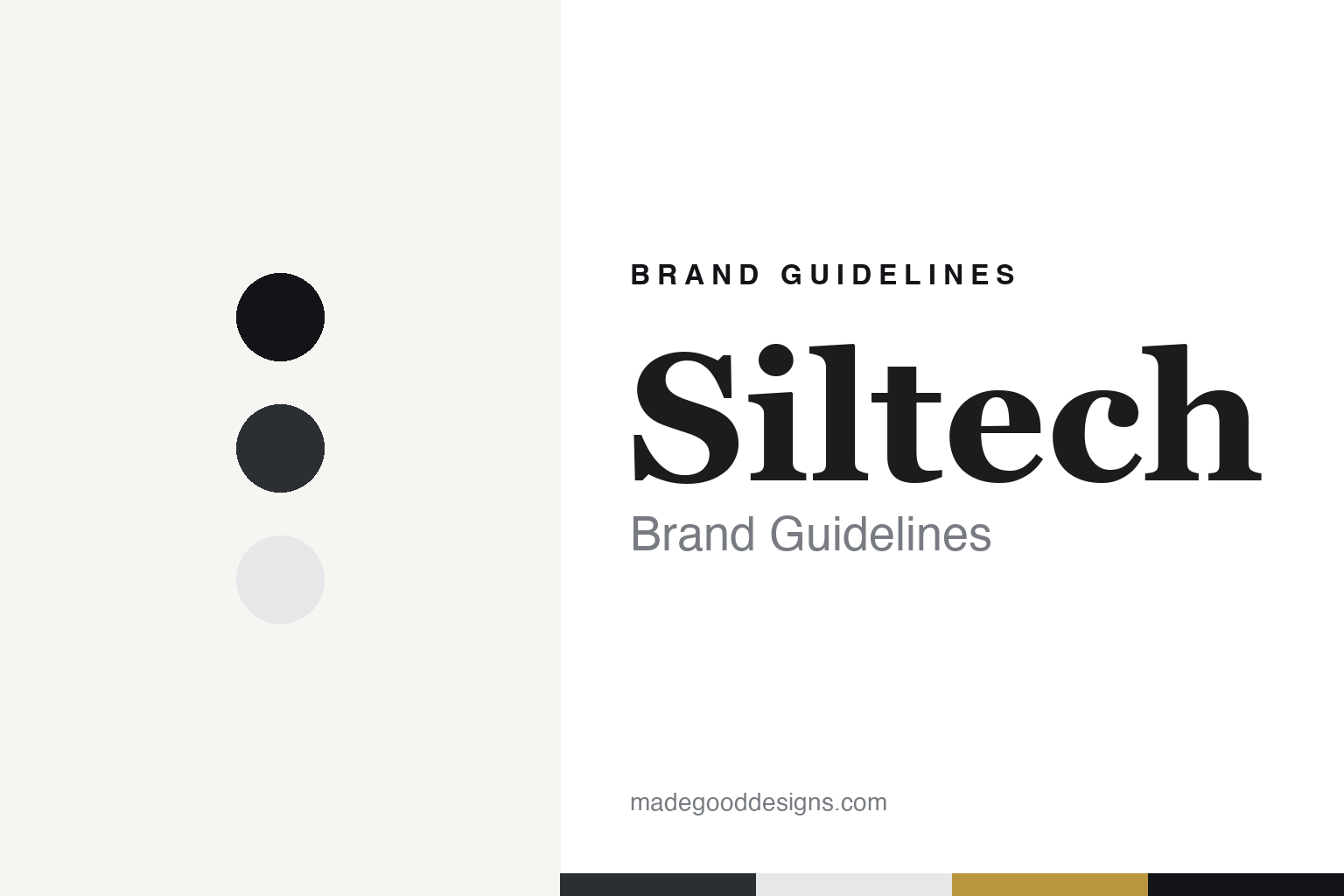
Siltech Brand Guidelines
The Nijmegen silver-cable maker built up in Elst.
Aa
Two constants: a Siltech silver, graphite and gold palette and a Classic serif register. Abstract homage — not a Siltech product or mark; no cable, logo or nameplate is reproduced.
Silver technology
Two founders in Nijmegen, then a takeover.
Siltech began in 1983 in Nijmegen, the old Roman city on the Waal in the east of the Netherlands. The company says so on its own website, and a 40th-anniversary history that it hosts, written for a Dutch hi-fi magazine in 2023, explains the name as short for “SILver TEChnology” and names the founders as Hans de Ligt and Michel de Goey.
The early idea was the conductor. At a time when most audio cables were made of copper, Siltech used pure silver, which the anniversary history calls its first generation, or G1; a second generation, G2, with longer crystals, followed in 1988, and in 1993 some models added 24-carat gold wires to the silver and carried “Gold” in their names. Sources differ on the first date: the anniversary history places G1 at the start, while the Dutch site FWD, in a 2024 report, says the first G1 cable appeared shortly after the 1992 takeover. Siltech’s first cable, made in 1983–84, was the TIL, for “The Inevitable Link,” according to a 2020 interview in Enjoy the Music.com; flat silver ribbons insulated in Teflon, in the FT-12 loudspeaker cable, came a few years later.
The company did not stay with its founders. In 1992 the electronics engineer Edwin van der Kley Rynveld took it over. Siltech’s website says he “acquired the company in 1992”; FWD, interviewing him and his wife, describes the Siltech he bought as bankrupt and says he had to put up his house as security. He is sometimes called Siltech’s founder, including in the headline of that 2020 interview, but his own account there is different: he had co-founded a separate firm, Audio Service, in February 1983, which designed amplifiers for Siltech among other clients, and in 1992 he “acquired the existing brands Siltech and Sphinx.” Before that he had worked at Philips and Exxon, by his account and the company’s.
Colour
From Nijmegen to Elst.
Under Rynveld, Siltech moved a few kilometres north to Elst, in the Betuwe between Nijmegen and Arnhem, into a new building on a business park, FWD reported. SoundStage! Global, visiting in 2025, said the company had been at that site for about 30 years and that the building was expanded in 2019. Siltech’s website gives its address as Edisonweg 8 in Elst, which it shares with the parent company, International Audio Holding BV, and its other brands.
The cable line grew in “generations.” The anniversary history dates a G3 conductor to 1997, the first to use the silver-gold alloy that became Siltech’s hallmark, along with the first SQ Classic series; the current conductors are called G9, a silver-gold alloy, and S10, a monocrystal silver. The Classic Legend series, launched in May 2021, sits below the Royal Crown, Triple Crown and Master Crown ranges. Siltech says the alloy is patented and credits its conductors with lower distortion; those are the company’s claims, and we have not tested them.
Siltech also builds electronics and loudspeakers. Its first amplifier was the SEPA of 1998, a limited-edition valve design that Rynveld described in 2020 as an 80-watt mono triode amplifier. The Pantheon loudspeaker followed for the company’s 25th anniversary; the online magazine 6moons described it as an exclusive edition of 39 pairs at €75,000 a pair, designed with COMSOL simulation software. Today the company lists the SAGA amplifier system and the Symphony loudspeaker.
Typography
Design and documentation.
The Low Countries have a long record in consumer audio. Philips, founded in Eindhoven in 1891 by Gerard Philips and his father Frederik to make light bulbs, introduced the Compact Cassette in August 1963 — developed, English Wikipedia says, by a team led by Lou Ottens in Hasselt, Belgium — and co-developed the compact disc with Sony; the first CDs went on sale in Japan in October 1982.
Philips is also part of the story of Dutch class-D amplification. The Belgian engineer Bruno Putzeys spent ten years at Philips’s Applied Technologies lab in Leuven, where he invented the “UcD” circuit, which Philips patented. Hypex, a Dutch company formed in 1996, began producing it in the early 2000s after Philips declined to use it, and in 2005 Putzeys left Philips to divide his time between Hypex and Grimm Audio, according to English Wikipedia.
The makers in this guide are spread across the Netherlands: Kharma in Breda; Grimm Audio in Veldhoven, beside Eindhoven; Siltech and Crystal Cable at the same address in Elst, in Gelderland; Hypex and Mola Mola at the same address in Groningen; and Dutch & Dutch in Capelle aan den IJssel, next to Rotterdam, according to their own websites.
A Dutch address does not always mean Dutch manufacture. Hypex has its own production facility in Malaysia, English Wikipedia says, and Dutch & Dutch buys its drivers and amplifiers from outside suppliers, The Absolute Sound reported in 2024.
This guide sets out what can be checked about each brand — who founded it, who owns it, and what it says about where its products are made — and marks clearly what rests only on the company’s own word.
Aa
A classic serif for a brand built on precious metals. (Specimen set in Cormorant Garamond, a serif STAND-IN; NOT the Siltech logo.)
Siltech
A family firm with outside shareholders.
Ownership has been less simple than the family story suggests. 6moons, in a feature on the Pantheon from around 2008, wrote that Rynveld had partnered with shareholders Ajay Shirke of Cadence Audio and Prakash Chhabria of Finolex Industries “for development capital and technology.” In December 2016 hi-fi+ described the Cadence Group, an Indian-based company, as holding controlling interests in Spendor, Siltech and Crystal Cable when it bought the British turntable maker SME. More recent reports describe a family-led business: FWD in 2024 said both brands sit under International Audio Holding in Elst, led by Edwin and Gabi Rynveld, after a period with an outside chief executive that Rynveld called “one of the few wrong judgements”; SoundStage! Global in 2025 named Viktor de Leeuw as managing director, with Rynveld in a technical role. We could not confirm whether Cadence still holds shares.
On manufacturing, the claims are specific. Siltech says “every aspect of production is done in-house” at its Elst factory, which combines manufacturing, warehousing, design and laboratories. On the 2025 visit, de Leeuw told SoundStage! Global that the company sources about 90% of its parts from the European Union, mostly from the Netherlands, and that its conductors come from a European partner company whose metallurgists work with Siltech. The magazine’s reporter saw soldering, braiding, testing and packing on site.
For a design guide, Siltech shows how a material — silver, then silver and gold — can carry a brand for four decades. Compare Crystal Cable, the sister brand made in the same building, and Philips, where Rynveld worked before Siltech. For this guide we use silver, graphite and a gold tone with a serif, an unofficial interpretation; no product or logo is reproduced.
Explore & save
Keep Siltech’s identity on hand — save it to a board in the Made Good inspiration library.
Siltech identity set
Pin the Siltech silver, graphite and gold palette and the Classic serif register to your own board.