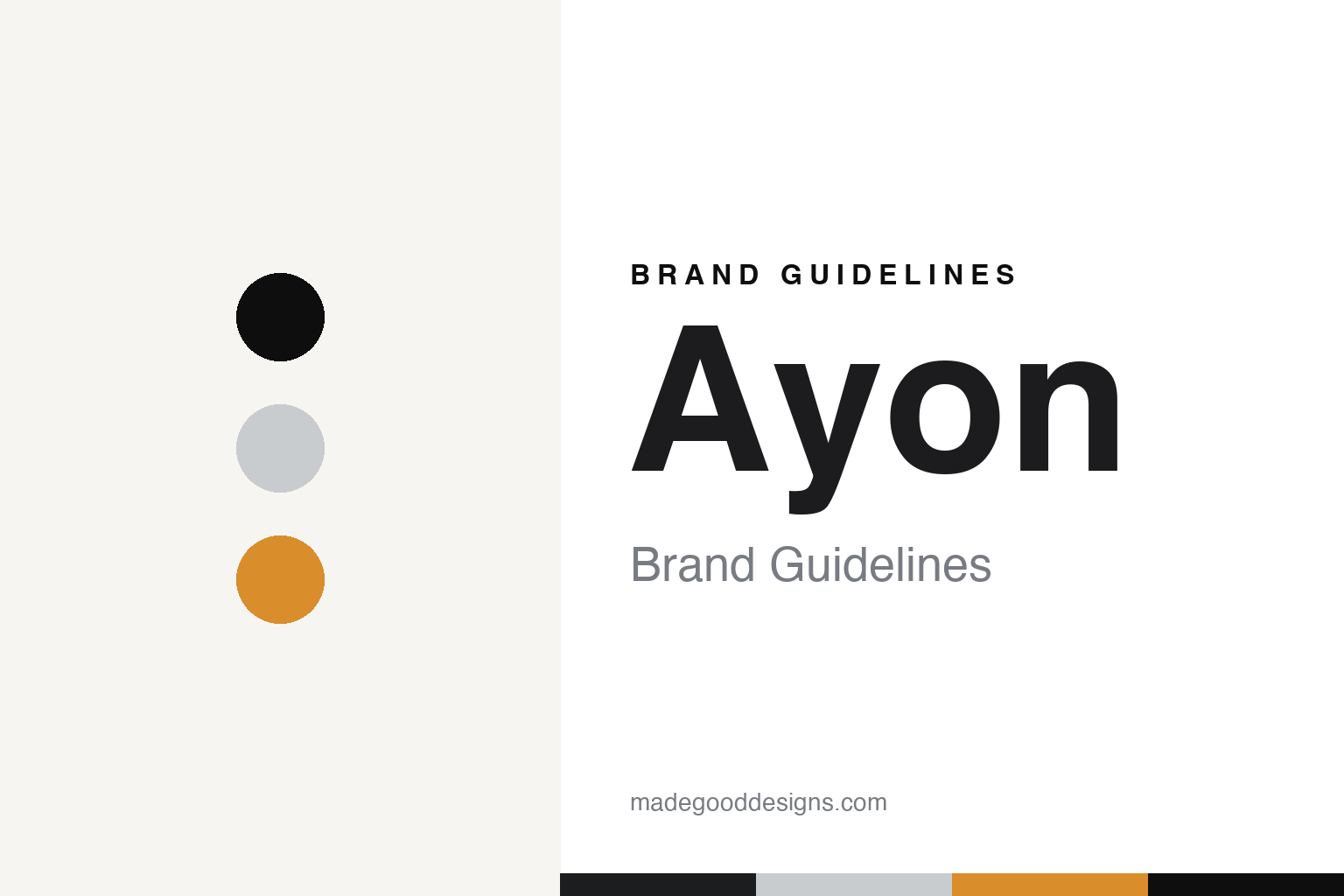
Ayon Brand Guidelines
The Styrian valve-amplifier maker that began as Vaic Audio.
Aa
Two constants: an Ayon black, chrome and valve amber palette and a wide sans register. Abstract homage — not an Ayon product or mark; no amplifier, logo or nameplate is reproduced.
Vaic Audio
An Austrian distributor, Czech valves and an Italian workshop.
Ayon Audio is an Austrian maker of valve amplifiers, CD players, streamers and loudspeakers, run by Gerhard Hirt. Its address is Hart 18 in Gratkorn, a market town just north of Graz in Styria, according to the company’s contact page. The Austrian Economic Chamber’s company directory lists the same address and telephone number for Living Sound HIFI-Vertriebsgesellschaft m.b.H., a hi-fi distribution company whose trade licence there dates from September 1993. The Polish reviewer HiFi Knights described Ayon in 2019 as one of several brands under the Living Sound banner, with Hirt as its owner, and the Polish magazine High Fidelity called him “the owner of Ayon and their head constructor.”
The brand grew out of an earlier one, Vaic Audio. Its best-known product was the Reference 52B, a single-ended triode monoblock built around power tubes from AVVT, the small Czech tube works of the engineer Aleša Vaic. Those amplifiers were not made in Austria. When Stereo Times reviewed the 52B in May 2001, it listed the maker as Vaic Audio of Blumau, also in Styria, with “Mastersound, Vicenza, Italy” beside it, and wrote that the amplifiers were “designed (with input from the parent company in Austria) and built by Mastersound in Vicenza” — the Italian valve-amplifier workshop — with the driver and output tubes made by Vaic in the Czech Republic. The pair cost $19,800, each monoblock weighed 121 pounds, and the magazine’s writers counted the Vaic room at CES 2001, playing through Lumen White loudspeakers, among the best sound they heard there.
Accounts of the dates differ, so we give them side by side. Ayon’s North American distributor told 6moons, in an interview published around 2008, that the firm “began with Vaic in 1995” and that “in 2001, Vaic merged to Ayon Audio,” founded in Austria, adding that Hirt still owned the Vaic trademark. HiFi Knights wrote in 2019 that the 52B was developed in 1994 in Vicenza and that the Ayon trademark was registered in 1999, when production outgrew its Italian line and moved to Austria. In a 2013 interview republished by Positive Feedback, Hirt dated the first amplifiers to 1993, “only intended for our home market here in Austria,” and Ayon’s website now says the company “began life four decades ago as VAIC.” We could not reconcile these.
Colour
Valves, chrome and a magazine cover.
The range Hirt built on that base is broad. In the 2013 interview he said the first Ayon preamplifier arrived in 2005, with a “re-generator” tube power supply; the first CD player followed in 2006, loudspeakers in 2007 and a new generation of CD players and DACs in 2009. The distributor’s answers to 6moons named the first Ayon product as a 300B stereo integrated amplifier and said the company then had 20 employees and sold in 26 countries; by 2013 Hirt put exports at more than 55 countries, with the EU, the USA and Russia as the main markets. The current website lists the Spark V and Spirit V integrated amplifiers, the Vulcan, Conquistador, Epsilon and Orthos Evo monoblocks, the Crossfire and Triton Evo amplifiers, the Spheris preamplifiers, the CD-35 II player, the Iris streamer, the Kronos DAC and a family of loudspeakers named after birds: BlackRaven, BlackHeron, BlackFalcon, BlackEagle and BlackCrane.
Ayon’s best-known claim to recognition is a magazine cover. The company says The Absolute Sound nominated its Vulcan II monoblocks, Polaris II preamplifier and CD-5s player as “the Bugatti of Audio” on its front cover in 2011, and its website quotes the magazine’s reviewer J. Valin: “If Steve Jobs had been an audio designer, I reckon he’d have been Gerhard Hirt.” The distributor also listed a 2002 Golden Ear award from the same magazine for the Reference monoblock. We give these as the company’s and its distributor’s statements; we did not see the magazine pages.
The look is consistent. HiFi Knights described the Scorpio integrated amplifier in 2019 as a heavy anodised-aluminium case with slightly rounded edges, valves in labelled sockets and resin-filled transformer cans behind them — powder-coated black on the cheaper models, chromed on the upper ones. The company’s slogan, as Hirt gave it in 2013, is “timeless design – magic sound.”
Typography
Central Europe’s audio record.
Central Europe’s audio industry has a long state-era record. In Poland, Unitra, the association of consumer-electronics makers, was set up in 1961 and kept its original structure until 1989, English Wikipedia says; the Tonsil loudspeaker works in Września, founded in 1945, ran as a state enterprise until 1990, according to Polish Wikipedia. In Czechoslovakia, Tesla was the state conglomerate that monopolised electronic appliances and components from 1946 until its privatisation in 1991.
The region has since become a workshop for Western brands as well as its own. Pro-Ject, founded in 1991 in Mistelbach, Austria, designs at home and makes its products in Germany, the Czech Republic and Slovakia, English Wikipedia says; the German magazine lowbeats reported after a factory visit that Canor’s plant in Prešov makes all of Pro-Ject’s electronic components, and those of IsoTek and Musical Fidelity.
The trade meets in Warsaw, where the Audio Video Show holds its 28th edition in October 2026; its organisers call it the world’s second-largest audio show.
The seven makers in this guide are spread across the region, according to their websites and business listings: Pylon Audio in Jarocin and Fezz Audio near Białystok, in Poland; Ancient Audio in Kraków; Mytek, founded in New York in 1992, with a European branch in Warsaw; Xavian at Hostivice, outside Prague; Canor in Prešov, in eastern Slovakia; and Ayon at Gratkorn, near Graz, in Austria.
This guide sets out what can be checked about each brand — who founded it, who owns it, and what it says about where its products are made — and marks clearly what rests only on the company’s own word.
Aa
A wide sans for a heavy, chromed chassis. (Specimen set in Michroma, a wide-sans STAND-IN; NOT the Ayon logo.)
Ayon
Austria, Hong Kong and a valve works in Prague.
Where the products are made is the most interesting part of Ayon’s record, because the trade press has checked the company’s answer more than once. In 2013 Hirt told Positive Feedback that making his amplifiers in China “would be impossible,” because the work needs “very experienced tube technicians here on-site.” But the metalwork has not always been European. In its review of the CD-2s player, published around 2010, High Fidelity reported Hirt’s account that the cases and circuit boards of the first Ayon CD players were made by the Chinese firm Raysonic; when Raysonic copied the designs and sold them under its own name, Hirt ended the arrangement and bought a factory in Hong Kong, setting up Ayon Audio Hong Kong Ltd. The magazine said the products themselves were made in Austria, as stickers on their backs stated, with the casings made in Hong Kong; its later review of the CD-5s Special described the chassis as “made in the Ayon factory in Hong Kong.”
HiFi Knights gave a somewhat different account in 2019: some semi-finished parts were made in Taiwan from 2000 to 2005, the Asian company was later sold, the metalwork returned to Europe, and “key assembly and QC happens on the Austrian soil.” The same review said Hirt had acquired part of AVVT’s valve factory in Prague and hired Tesla’s former chief tube engineer, so some Ayon models use the company’s own power triodes while others use valves from Electro-Harmonix and Tung-Sol. The distributor said in 2008 that Ayon also made its own audio transformers. In the sources we checked, we found no record of Ayon production in Slovakia.
For a design guide, Ayon shows how a small company can make one chassis language recognisable across some forty products. Compare Vienna Acoustics, another Austrian audio maker, and Canor, a valve-amplifier maker in Slovakia. For this guide we use black, chrome and valve amber with a wide sans, an unofficial interpretation; no product or logo is reproduced.
Explore & save
Keep Ayon’s identity on hand — save it to a board in the Made Good inspiration library.
Ayon identity set
Pin the Ayon black, chrome and valve amber palette and the wide sans register to your own board.