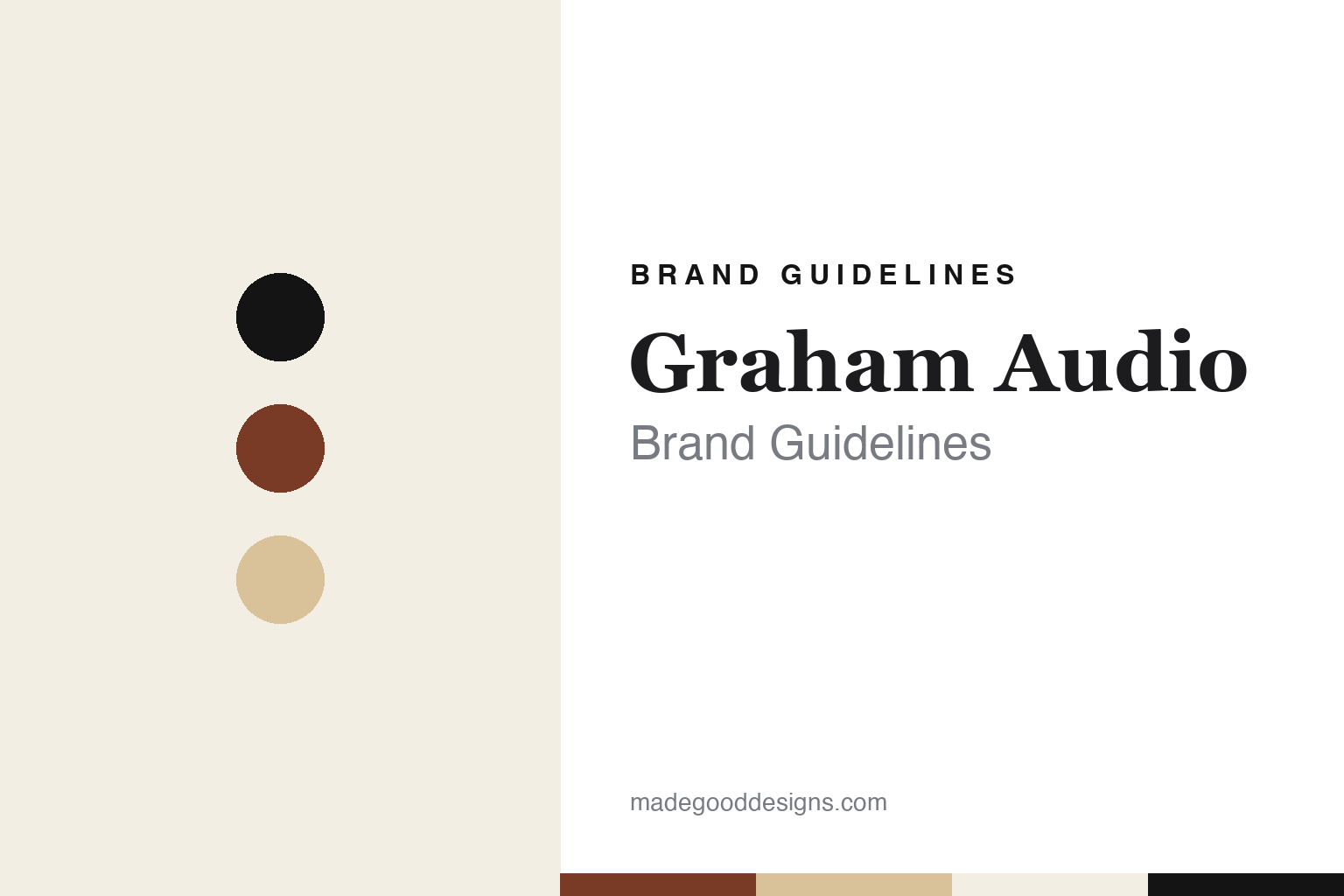
Graham Audio Brand Guidelines
The Devon workshop building BBC-licensed monitors.
Aa
Two constants: a cherry, birch and baffle-black palette and a broadcast serif register. Abstract homage — not a Graham Audio product or mark; no loudspeaker, logo or BBC badge is reproduced.
Newton Abbot
A pro-audio engineer and the BBC sound.
Graham Audio is a small loudspeaker maker in Newton Abbot, a market town in Devon, in south-west England. It was founded by Paul Graham, who, the company says, spent more than 20 years in professional audio — in recording and broadcasting, and in live sound — before starting it; Sound On Sound adds theatre sound to that list. Companies House records Graham Audio Limited as incorporated on 3 March 2011, with Paul Graham as its sole director and majority shareholder. The company describes itself as family-owned.
Its founding idea was preservation. The company says Paul Graham had always favoured the “BBC sound” but feared that the classic designs “would be lost forever” as surviving examples failed after decades of use, and that after “a couple of chance meetings and some long conversations” he decided to seek the BBC’s approval to build them himself. The BBC is a broadcaster, not a manufacturer: its engineers designed monitor loudspeakers for its own studios, many at the Kingswood Warren research labs, and outside firms built them under licence, as What Hi-Fi? and Sound On Sound explain.
The first product was the BBC LS5/9, a two-way studio monitor that What Hi-Fi? dates to eight years after the 1975 LS3/5A. Mark Hennessy, whose website documents Rogers and BBC loudspeakers, says Graham Audio launched it in late 2013, returning to the original BBC research specification rather than the version later altered by the BBC’s Designs Department, and that BBC R&D approved the result. hi-fi+ marked the company’s tenth anniversary in 2024.
Colour
Derek Hughes and the licensed range.
The designs are the work of Derek Hughes, whose father, Spencer Hughes, was a BBC loudspeaker engineer at Kingswood Warren when the original LS3/5 was developed, according to Sound On Sound; hi-fi+ says Spencer Hughes was, with Dudley Harwood, “heavily involved in the design process of those original BBC designs.” After the LS5/9 came a passive LS5/8, then the LS3/5 — the original version of the BBC miniature monitor, of which Sound On Sound says about 20 prototype pairs were made before it was revised as the LS3/5A — an LS3/5A, and the larger LS5/5. Graham Audio says the LS5/5 brought slot loading, a technique the BBC used to smooth the off-axis output of large drivers, to home hi-fi “for what we believe is the first ever” time; we give that as its claim.
Alongside the licensed designs sit its own models: the Chartwell LS6, which the company places between the LS3/5 and the LS5/9; the Swisstone LS3, a lower-cost small monitor sold direct; a live-sound monitor, the System 3D; and a floor-standing speaker, VOTU. Its current range also lists further LS-numbered models under a “Derek Hughes LS Series” heading. Hennessy writes that Graham Audio holds “the record for the most licences granted to a single licensee”; we could not confirm that with the BBC.
The cabinets follow the BBC’s thin-wall method. What Hi-Fi?, reviewing the LS5/9 in June 2026, describes 9mm birch-ply panels damped to move resonances away from the midrange; a new 20cm polypropylene mid/bass driver developed with Volt Loudspeakers, because the original unit can no longer be bought, each “hand-assembled and tested by Volt”; and the official 34mm tweeter, still made by Audax. Sound On Sound reported in 2016 that the Chartwell LS3/5 used a SEAS tweeter from Norway and a bass unit designed by Hughes and built by Volt, in Dorset, to replicate the original B110.
Typography
British turntables and loudspeakers.
Britain’s loudspeaker tradition owes much to the BBC. The LS3/5A, a small monitor for outside-broadcast vans, was developed by the BBC Research Department at Kingswood Warren, and the BBC licensed a handful of British firms that began making it in 1975, English Wikipedia says; sales estimates run from 60,000 to 100,000 pairs.
That licensing model survives: Graham Audio says it hand-builds BBC-licensed models, including the LS3/5 and LS5/9. PMC was formed by Peter Thomas, formerly of the BBC, and Adrian Loader, and sold its first BB5 monitors to the BBC and Metropolis Studios; ATC, founded by Billy Woodman in 1974, counts Abbey Road Studios and the BBC among its users, English Wikipedia says.
Smaller regional makers grew alongside. Castle was started in Skipton in 1973 by engineers from Wharfedale, the company says, and Michell Engineering, the turntable maker founded by John Michell, worked from Borehamwood from 1968 until it moved to Stevenage in 2019, SoundStage! reported.
Ownership is not always British. Castle has belonged since 2007 to IAG, a Chinese group based in Shenzhen, and Epos, founded in 1983 by Robin Marshall, says it was bought in 2020 by the loudspeaker designer Karl-Heinz Fink; its website gives an address in Essen, Germany.
The others are spread across England: PMC at Biggleswade in Bedfordshire, ATC near Stroud in Gloucestershire, Neat Acoustics at Barnard Castle in County Durham, Graham Audio at Newton Abbot in Devon, and Castle, today, at IAG’s address in Huntingdon.
This guide sets out what can be checked about each brand — who founded it, who owns it, and what it says about where its products are made — and marks clearly what rests only on the company’s own word.
Aa
A broadcast serif for a monitor maker. (Specimen set in Libre Baskerville, a serif STAND-IN; NOT the Graham Audio logo.)
Chartwell and Swisstone
Reviving the names as well as the designs.
Graham Audio has revived old brand names as well as old designs. Sound On Sound reported in 2016 that Paul Graham chose “Chartwell” for his LS3/5 to acknowledge one of the original licensed makers of the LS3/5A, and in 2019 that the Swisstone name is “a nod to the company of the same name, who owned the Rogers and Chartwell brands in the 1970s and 1980s.” hi-fi+ says Graham Audio acquired both names. In 2024 the company issued 10th Anniversary editions of the LS3/5A, LS6 and LS5/9 in eucalyptus veneer with black baffles, limited, it says, to 100 pairs of each.
On manufacturing, the company says its speakers are “hand-assembled on site” in Newton Abbot, with one person responsible for every step, including testing and listening, and a second person repeating the tests; finished speakers are compared with master reference samples. Hennessy, who has visited, also describes them as hand-assembled in Devon. The drive units come from suppliers including Volt, SEAS and Audax, built to Hughes’s specification, according to the reviews above. We found no published source for where the cabinets are made, and no documented logo designer or house typeface, so we state neither.
One domain trap: grahamaudio.com belongs to an unrelated professional sound and video company; the loudspeaker maker’s site is grahamaudio.co.uk.
For a design guide, Graham Audio shows a brand built on a licence and a lineage rather than a new look — the BBC’s LS numbers carry much of its identity. Compare Harbeth and Spendor, two other British makers with roots in BBC monitor design. For this guide we use cherry veneer, birch ply and baffle black with a serif, an unofficial interpretation; no product or logo is reproduced.
Explore & save
Keep Graham Audio’s identity on hand — save it to a board in the Made Good inspiration library.
Graham Audio identity set
Pin the Graham Audio cherry, birch and baffle-black palette and the broadcast serif register to your own board.