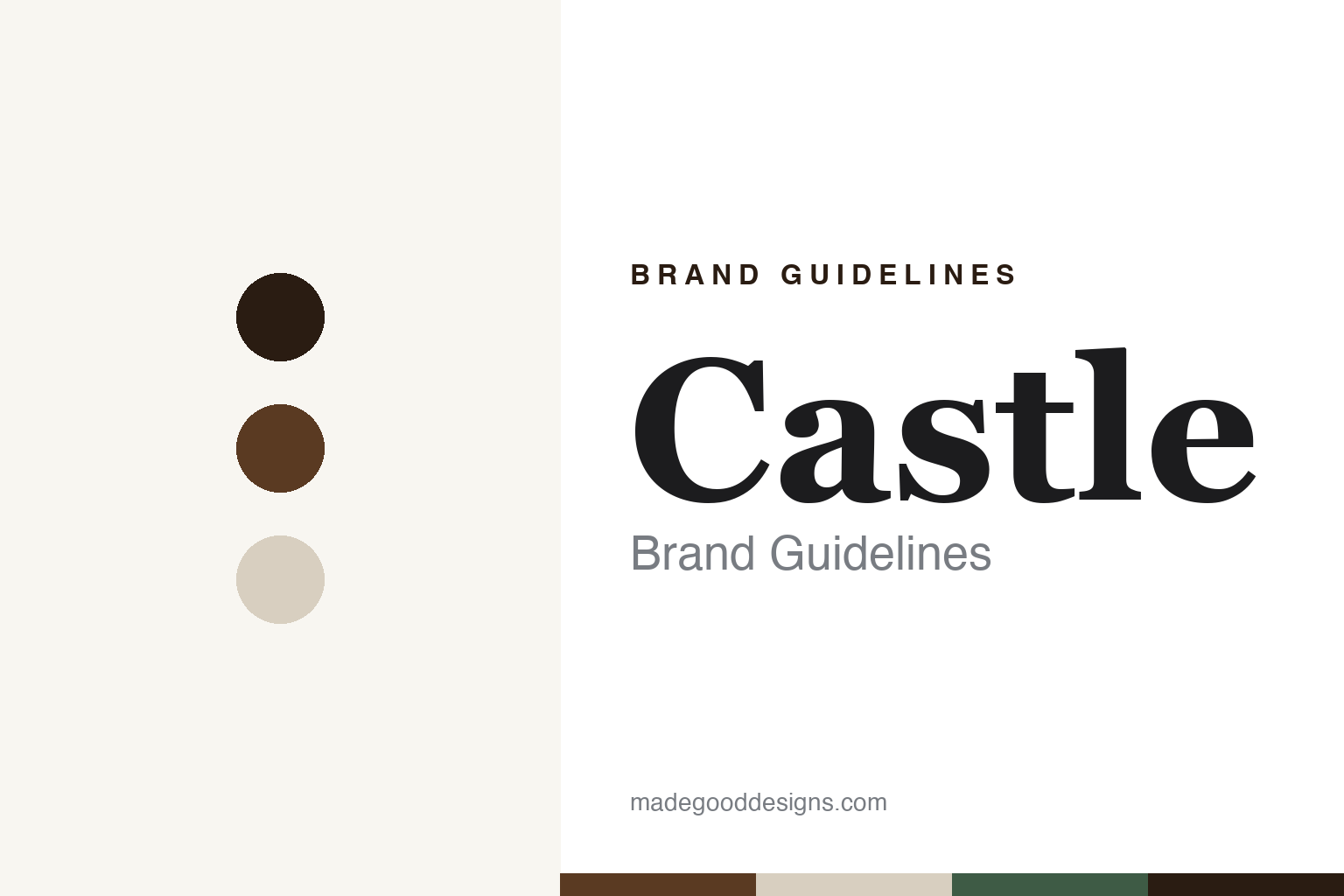
Castle Brand Guidelines
The Skipton loudspeaker maker that outlived its company.
Aa
Two constants: a walnut, green and gritstone palette and a bookish serif register. Abstract homage — not a Castle product or mark; no speaker, logo or badge is reproduced.
Skipton, 1973
Wharfedale engineers in a Yorkshire mill.
Castle Acoustics began in Yorkshire in 1973. Companies House records show that Castle Acoustics Limited was incorporated on 29 June 1973; the company itself dates its start to 3 September 1973. It took its name, and the idea for its logo, from Skipton Castle, the medieval castle in the North Yorkshire market town, and set up in an old woollen mill in Skipton, English Wikipedia says. Its filings give the address as Park Mill, on Shortbank Road.
The founders came from Wharfedale, the loudspeaker maker Gilbert Briggs started in Bradford in 1932. Castle’s website names William “Bill” Escott, formerly of Wharfedale, and John Collinson, formerly of Wharfedale and Quad. IAG, which owns Castle today, describes the founding team differently, as six senior engineers who had worked for Wharfedale; the two accounts can both be true, but neither source lists the others. Escott appears on the Companies House register as a director from before 1992, when its online records begin. We could not find Collinson there, but those records start too late to settle the question either way.
The founding idea, the company says, was to make everything itself: the drive units, the crossovers and the real-wood veneered cabinets, all under one roof in Skipton. Its first range, it says, was the Richmond, Kendal, Conway and Howard, and for decades afterwards its models took the names of British towns, castles and rivers. The Richmond, the smallest of them, has been revived several times since.
Colour
Rivers, castles and receivership.
Through the 1970s and 1980s Castle built its name on compact, furniture-like speakers finished in wood veneer. Its own history lists a “River” series by 1981 — the Clyde, Dover and Tyne — then the Pembroke, developed from the original Kendal, and the Lincoln and Warwick later in the decade. In 1990 came the Winchester, which the company says was developed by Colin Walker and was its first model to use a quarter-wave tapered-pipe design for the bass, an idea Castle has returned to in different forms since.
The founders did not stay for ever. In the early 1990s, English Wikipedia says, with the original team approaching retirement, a second group of senior executives from Wharfedale proposed to buy out the founding management; Castle’s website calls it a management “buy in” in 1993. The register fits that date: four new directors were appointed on 25 March 1993. The decade brought the York, a new flagship Howard, the Durham, the Severn of 1995 and, in 1999, the Inversion models, Castle’s move into home cinema. The Conway 3 followed in 2003.
Then the business failed. Companies House filings show a receiver appointed in October 2006, and in November that year the registered office moved from Park Mill in Skipton to the receivers’ office in Leeds. No accounts were filed after those for the year to March 2005. The receivers reported in March 2007 and stopped acting in 2009. Castle’s own history puts it plainly: the company “fell upon hard times,” struggling in “a world of global supply chains and globalised manufacturing.” Skipton had been Castle’s home from its foundation to 2006, English Wikipedia says. The original company did not survive; the name did.
Typography
Monitors, mills and small makers.
Britain’s loudspeaker tradition owes much to the BBC. The LS3/5A, a small monitor for outside-broadcast vans, was developed by the BBC Research Department at Kingswood Warren, and the BBC licensed a handful of British firms that began making it in 1975, English Wikipedia says; sales estimates run from 60,000 to 100,000 pairs.
That licensing model survives: Graham Audio says it hand-builds BBC-licensed models, including the LS3/5 and LS5/9. PMC was formed by Peter Thomas, formerly of the BBC, and Adrian Loader, and sold its first BB5 monitors to the BBC and Metropolis Studios; ATC, founded by Billy Woodman in 1974, counts Abbey Road Studios and the BBC among its users, English Wikipedia says.
Smaller regional makers grew alongside. Castle was started in Skipton in 1973 by engineers from Wharfedale, the company says, and Michell Engineering, the turntable maker founded by John Michell, worked from Borehamwood from 1968 until it moved to Stevenage in 2019, SoundStage! reported.
Ownership is not always British. Castle has belonged since 2007 to IAG, a Chinese group based in Shenzhen, and Epos, founded in 1983 by Robin Marshall, says it was bought in 2020 by the loudspeaker designer Karl-Heinz Fink; its website gives an address in Essen, Germany.
The others are spread across England: PMC at Biggleswade in Bedfordshire, ATC near Stroud in Gloucestershire, Neat Acoustics at Barnard Castle in County Durham, Graham Audio at Newton Abbot in Devon, and Castle, today, at IAG’s address in Huntingdon.
This guide sets out what can be checked about each brand — who founded it, who owns it, and what it says about where its products are made — and marks clearly what rests only on the company’s own word.
Aa
A bookish serif — for a brand of veneered cabinets and castle names. (Specimen set in Cormorant Garamond, a serif STAND-IN; NOT the Castle logo.)
Castle
A Yorkshire name, rebuilt in Cambridgeshire.
In 2007 the brand was bought by IAG, the International Audio Group, which says it acquired Castle Acoustics that year; English Wikipedia describes it as a rescue from bankruptcy. IAG is a Chinese manufacturer based in Shenzhen, founded and owned by the brothers Michael and Bernard Chang, What Hi-Fi? reported in 2011, and it also owns Wharfedale, Quad, Audiolab and Mission. Production moved to China. On a visit to IAG’s Shenzhen factory in 2011, What Hi-Fi? photographed the line where, it said, “drivers for Wharfedale, Quad and Castle speakers are made.” The Knight series of 2010, the Richmond Anniversary of 2011 and the Avon of 2013, with what Castle calls Twin Drive Transmission Line bass, belong to that period.
In 2023 Castle came home, at least in part. The Windsor Earl and Windsor Duke standmounts were “the first Castle speakers for many years to be UK-made,” What Hi-Fi? reported in March 2023, built at IAG’s new 9,000 sq ft production facility in Huntingdon, Cambridgeshire, and designed with the loudspeaker engineer Karl-Heinz Fink and his team; the Earl cost £3,850 a pair. The magazine said every critical part was developed and manufactured in-house; since IAG also manufactures in China, that phrase alone does not say which parts are made in Britain. In 2026 Castle added the Tintagel and Walmer ranges, four models priced from £1,999 to £4,999 a pair, which ecoustics reported in October 2026 are built and finished in the UK. The company now describes a complete family of “Made in the UK” loudspeakers. Its address is IAG’s office in Huntingdon, not Skipton.
For a design guide, Castle shows how a brand can outlive the company that made it, and how a name tied to one Yorkshire town can be rebuilt somewhere else. Compare Wharfedale, where Castle’s founders had worked and which IAG also owns, and Quad, another British name in the same group. For this guide we use walnut, a deep green and a gritstone grey with a serif, an unofficial interpretation; no product or logo is reproduced.
Explore & save
Keep Castle’s identity on hand — save it to a board in the Made Good inspiration library.
Castle identity set
Pin the Castle walnut, green and gritstone palette and the bookish serif register to your own board.