Shanling Brand Guidelines
The Shenzhen maker of the valve-styled CD-T100 and the M-series players.
Aa
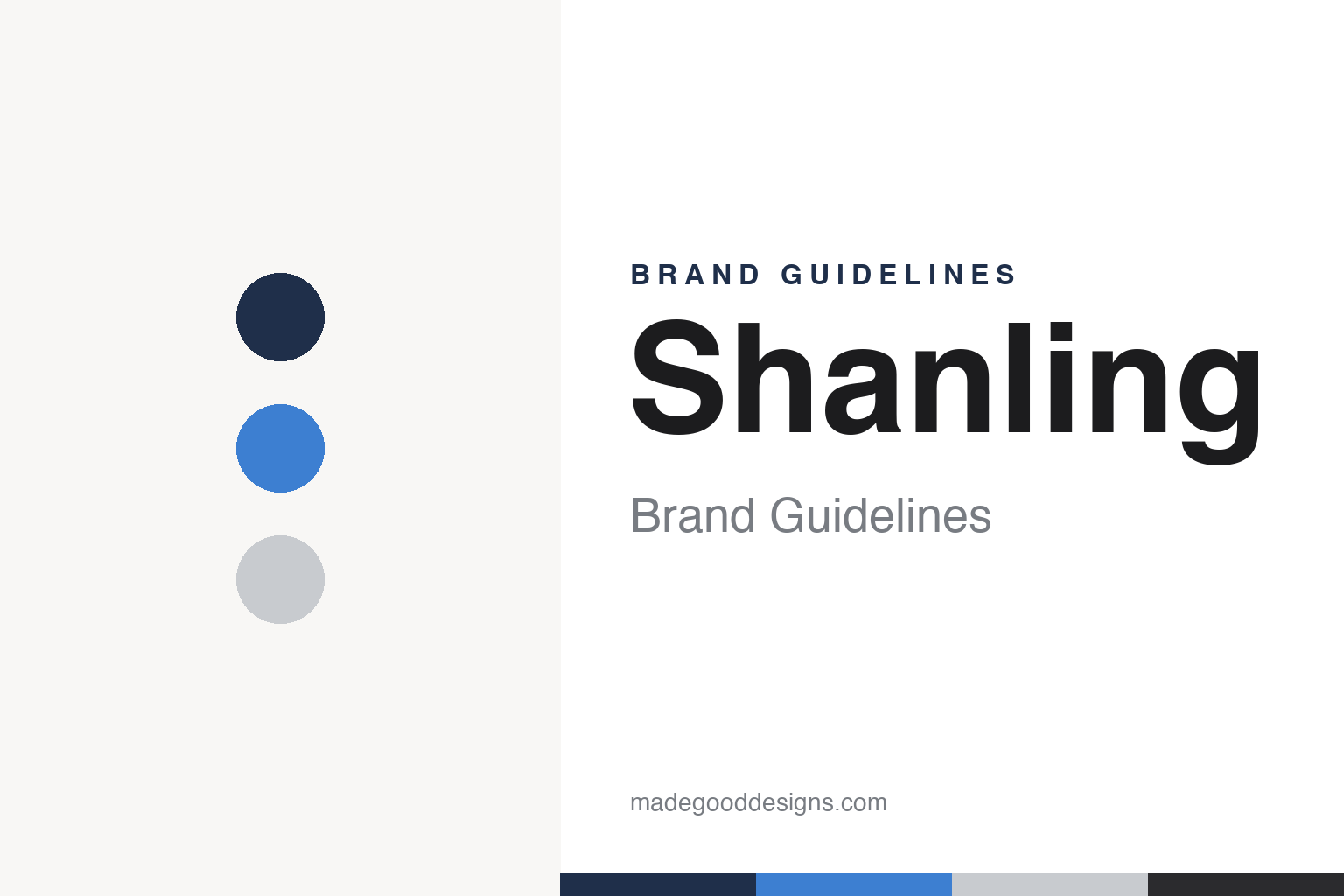
Two constants: a Shanling navy, blue and silver palette and a Geometric sans register. Abstract homage — not a Shanling product or mark; no player, logo or nameplate is reproduced.
From Jieyang to Shenzhen
A 1988 start in eastern Guangdong.
Shanling (山灵 in Chinese) dates itself to 1988. Its English website says it “began to develop audio products and launched their first Hi-Fi stereo amplifier in the same year”; its Chinese timeline adds that the first products were graphic equalisers with LED spectrum displays and integrated hi-fi amplifiers. The company’s website does not name a founder, and we could not confirm one in the sources we checked, so we leave the name out.
According to the company’s timeline, in 1990 it set up an audio-equipment factory attached to the Jieyang Radio and TV University (揭阳市电大音响设备厂), in Jieyang in eastern Guangdong, and launched the EQ9000 equaliser with a vacuum-fluorescent display. Through the early 1990s it made karaoke amplifiers and processors — the A-938 of 1992, a remote-controlled 2×100-watt integrated, and the MAA series built on Mitsubishi echo chips — and, in 1994, its first CD player, the SCD-939, using Philips’s CDM4 swing-arm mechanism.
In 1996 it moved to Shenzhen and founded Shenzhen Shanling Electronics; in 1997, it says, it gained ISO 9001 certification through the auditor DNV. In 2002 it formed a Sino-foreign joint venture, Shenzhen Shanling Digital Technology Development Co., Ltd. (深圳山灵数码科技发展有限公司) — the company that trades today — and began its own precision metalwork; the timeline does not name the foreign partner. In 2004 the new company absorbed the old one by merger and bought a factory building at Chiwan, in Shenzhen’s Shekou area.
Colour
The valve-styled CD player.
Shanling’s breakthrough abroad was the CD-T100 of 2001, a CD player with a valve output stage, styled like a valve amplifier. The company’s English timeline calls it “Shanling’s first Tube based CD player” and says that with it Shanling “officially entered international market”; its Chinese timeline goes further, calling it the world’s first CD player styled as a valve amplifier — a claim we have not verified. Its first SACD player, the SCD-T200, followed in 2002, and all-aluminium versions of both arrived in 2003.
Through the 2000s it built a wide catalogue of CD players, amplifiers and compact systems. In Stereophile in March 2008, Art Dudley reviewed the MC-30 Music Center, a one-box CD receiver with an iPod input and a 3-watt single-ended valve output stage, which he described as “designed and manufactured in the People’s Republic of China” and as quite possibly “the most remarkable attempt at bringing high-quality playback gear within the reach of the average music enthusiast.” The magazine listed the maker as Shenzhen Shanling Digital Technology Development, with Music Hall as its US distributor. For its 25th anniversary the company launched the 600 series flagship — a DAC, a transport, a valve preamplifier and mono power amplifiers — announced in 2012 and on sale in 2013.
In 2014 Shanling entered portable hi-fi with its first player, the M3, followed by the M2 in 2015 and the flagship M5 and compact M1 in 2016. Players have since become its best-known products, from the touchscreen M0 of 2018 to Android-based models including the M6, M8 and M9, alongside earphones, Bluetooth receivers and portable DAC-amplifiers. Valves and discs have not gone away: the timeline lists the T35 CD player in 2023 and the M8T, a portable player with a valve stage, in 2024, and the Chinese site’s 2026 news includes the EC Play, a portable CD player. Its English site lists licences including Sony’s LDAC, Hi-Res Audio, HDCD, SACD and Dolby Digital.
Typography
Design and documentation.
The seven brands in this guide come from one corner of southern China: the Pearl River Delta in Guangdong, around Guangzhou, Shenzhen, Zhuhai and Dongguan. English Wikipedia notes that the delta’s industrial cities have been called the “Factory of the World” and describes the region as a major manufacturing base for electronics. Shenzhen became one of China’s first special economic zones in 1980; Zhuhai is another.
Much of that output carried other companies’ names. Darko.Audio reported in 2020 that the Dutch brand PrimaLuna’s products were built at Cayin’s factory, and the German magazine stereoplay wrote in 2021 that Cayin’s German distributor had created the Cayin brand in the late 1990s. The makers here now sell under their own names.
Valve amplifiers remain a speciality. Cayin and Line Magnetic, both Zhuhai companies, list them prominently in their ranges, and Shanling’s company history records a valve power amplifier in 2002.
Shanling, which began in Jieyang in eastern Guangdong, moved to Shenzhen in 1996; the city is also home to iBasso, which says it was founded there in 2006, and Questyle, founded in 2012. Cayin, founded in 1993, and Line Magnetic are in Zhuhai; Denafrips and Musician Audio are in Guangzhou, according to their own websites.
Much of the debate about them happens online — in reviews on Headfonics, Soundnews and Darko.Audio, and on the Audio Science Review forum, where a member posted measurements of Musician Audio’s first converter in 2020.
This guide sets out what can be checked about each brand — who founded it, who owns it, and what it says about where its products are made — and marks clearly what rests only on the company’s own word.
Aa
A geometric sans for a maker of players and CD machines. (Specimen set in Manrope, a sans STAND-IN; NOT the Shanling logo.)
Shanling
A Chinese stake in a French name.
Shanling’s reach extends to Europe through YBA, the French amplifier maker founded in 1981 by Yves-Bernard André, an electronics professor. YBA’s own website says that in 2009 “one of China’s leading high end audio equipment manufacturers purchased a significant shareholding stake in YBA,” names that company as Shanling, and says André kept a shareholding and continued to design products. YBA describes Shanling as already manufacturing for “some of the most iconic and well respected UK and European companies,” without naming them; we give that as YBA’s description, and the size of the stake is not stated. The domain yba.fr now belongs to an unrelated French lifestyle blog; YBA’s own site is ybahifi.com.
On where its products are made, Shanling’s English site says that its main offices “are located in Shenzhen and factory is in Dongguang” — meaning Dongguan, the manufacturing city between Shenzhen and Guangzhou. Its head office is listed at Times Plaza on Taizi Road, in Shenzhen’s Nanshan district. We could not establish when production moved from the Chiwan building to Dongguan. The company describes itself as combining research, production, processing and sales, and says it has “established close relationship with many international top hi-end manufacturers.” Its 2026 show calendar includes the HIGH END show in Vienna.
Two naming traps are worth knowing. On English Wikipedia, “Shanling” leads not to the audio company but to the Taiwanese metal band Chthonic, whose Chinese name, 閃靈, is also romanised as Shanling; the audio maker’s characters are 山灵. And the company counts its history from 1988 even though its present legal entity dates from 2002, which is why its 25th-anniversary series appeared in 2012.
For a design guide, Shanling shows how a maker can carry one name from karaoke amplifiers through valve CD players to pocket music players. Compare Cayin, another Guangdong maker that added portable players to a home hi-fi range, and FiiO, a fellow Chinese portable-player brand. For this guide we use navy, display blue and anodised silver with a sans, an unofficial interpretation; no product or logo is reproduced.
Explore & save
Keep Shanling’s identity on hand — save it to a board in the Made Good inspiration library.
Shanling identity set
Pin the Shanling navy, blue and silver palette and the Geometric sans register to your own board.