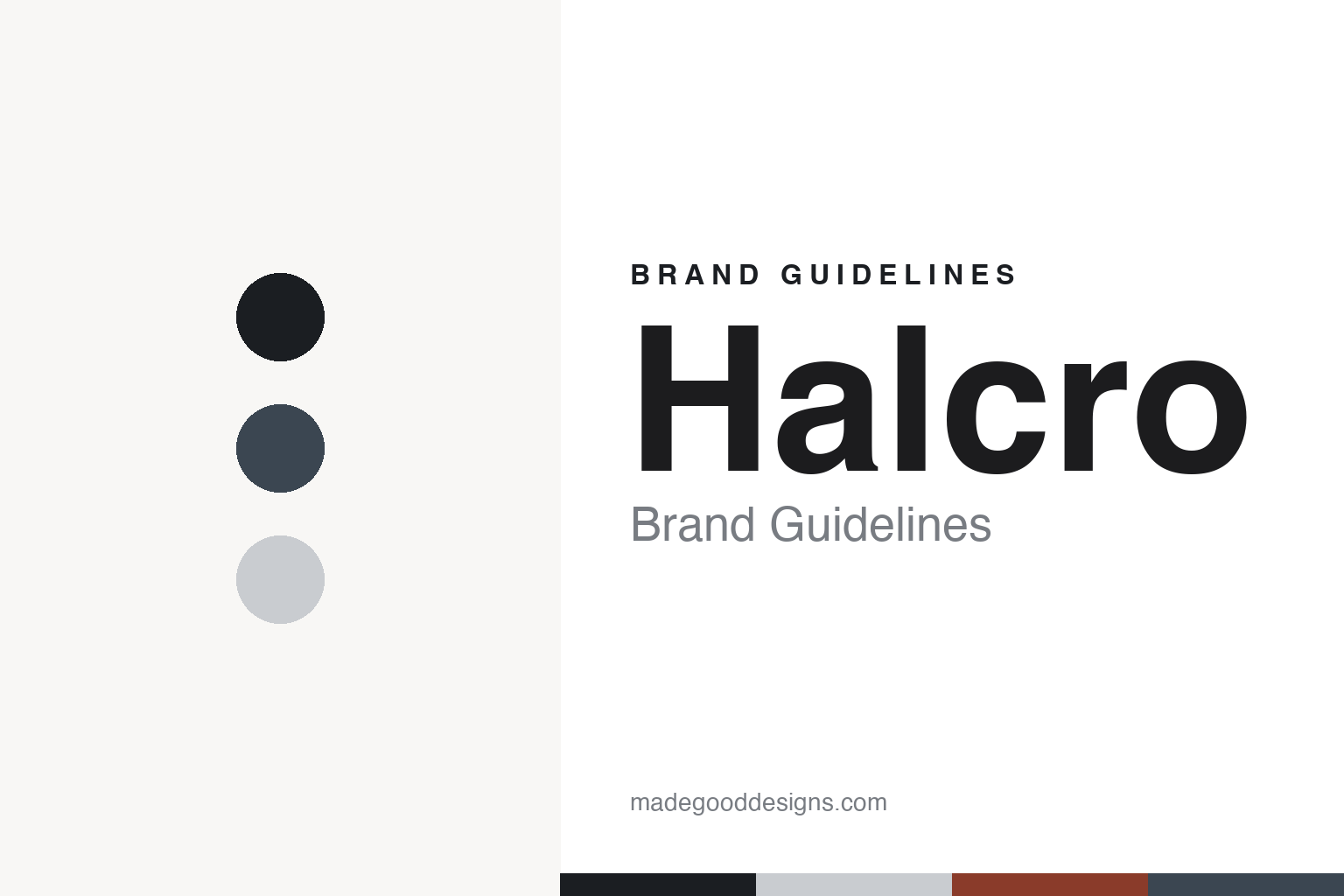
Halcro Brand Guidelines
The Adelaide amplifier shaped like an H.
Aa
Two constants: a Halcro graphite, silver and redgum palette and a geometric sans register. Abstract homage — not a Halcro product or mark; no amplifier, logo or nameplate is reproduced.
A middle name
A metal-detector inventor and his amplifier.
Halcro is named after its founder. Bruce Candy — Halcro is his middle name, as both Hi-Fi News and SoundStage! Australia note — is a physicist and inventor best known for metal detectors. Hi-Fi News described him in 2023 as South African-born, Cambridge-educated and an adopted Australian; SoundStage! Australia wrote in 2021 that he studied maths and physics at Cambridge and settled in Adelaide in the late 1980s, where he built Minelab Electronics, the maker of hand-held metal detectors. English Wikipedia gives Minelab’s founding year as 1985.
Halcro grew out of that business. The company’s own history says Candy invented an audio power supply and amplifier topology “which all but eliminates distortion,” and that Halcro became a subsidiary of Minelab. Hi-Fi News wrote that the amplifiers were inspired by his work on detection devices for the gold industry, and that he believed amplifier distortion created “ghost tones” the ear could detect even when they could not be heard as sound.
Lance Hewitt, a Minelab engineer who worked with Candy on the first amplifier before Halcro existed as a company, became its first employee, the company says. SoundStage! Australia reported that the first prototype was put together in a garage, and quoted an early Candy white paper in which he claimed to hear up to 23kHz in one ear.
Colour
The dm58 and the letter H.
The first product, the dm58 monoblock power amplifier, made Halcro’s name. Stereophile’s John Atkinson wrote in 2004 that Paul Bolin had reviewed the dm58 in October 2002 and that the magazine’s reviewers then voted it the “Amplification Component of 2002”; Halcro says the magazine’s cover called it “The Best Amplifier Ever.” Atkinson also described show demonstrations Halcro staged with Wilson Audio loudspeakers. The company claimed distortion measured in parts per billion at full power, and for the later dm38 claimed “better than 99.9997% purity of all tones” — figures Hi-Fi News greeted by noting that Candy “was never less than assertive in his claims.”
The range grew: the dm88 monoblocks, which became the flagship; the dm38, which Atkinson called the company’s first two-channel design, at $18,790 in 2004; the dm8 and dm10 preamplifiers; multichannel MC amplifiers for home cinema; and, by 2009, a lower-priced Halcro Logic line, whose $4,995 MC20 digital amplifier Stereophile reviewed that June.
The look mattered as much as the measurements. A Halcro power amplifier stands in the shape of a letter H: two tall finned uprights, which hold the output stages and act as heatsinks, with the power supply and the input circuits in two boxes slung between them, on wooden plinths. SoundStage! Australia reported that the silhouette won an industrial-design award from the Chicago Athenaeum Museum of Architecture and Design in 2002, and quoted the Australian turntable maker Mark Doehmann calling it “the Sydney Opera House of amplifier design.” The current owners say the original mandate was that “there must be no visible screws anywhere that detract from the sculpture.”
Typography
Hi-fi from the far side of the world.
Hi-fi making in Australia and New Zealand has largely been the work of small firms a long way from their biggest markets. Plinius says it was founded in 1980 to serve “local customers in New Zealand,” and that its amplifiers are assembled at a Christchurch facility shared with other manufacturing work. Krix says it was established in Australia in 1974.
Ownership has often followed the fortunes of a parent. Halcro, its website says, was created by the physicist Bruce Candy inside his metal-detector company, Minelab; when Codan bought Minelab in 2008, Halcro was shelved, until Longwood Audio, set up by the owners of an Australian hi-fi importer, bought its assets — in 2014 or 2023, as different pages of the same site say.
South Korea’s best-known hi-fi names are digital specialists. Astell&Kern began as the premium player brand of iriver, which SK Telecom bought in 2014 and which renamed itself Dreamus in 2019; English Wikipedia says bemyfriends became Dreamus’s largest shareholder in 2025. Aurender makes music servers, and HiFi Rose belongs to Citech, a listed company that made its name with kiosks; Citech says 87% of HiFi Rose’s 2024 sales were exports.
The makers in this guide are Krix and Halcro in Australia, along with Redgum, which stopped manufacturing at the start of 2025; Plinius, in Christchurch, and Perreaux in New Zealand; Aurender, whose head office is at Anyang, just south of Seoul; and HiFi Rose, run from Citech’s offices in Seoul, according to their websites and filings.
This guide sets out what can be checked about each brand — who founded it, who owns it, and what it says about where its products are made — and marks clearly what rests only on the company’s own word.
Aa
A geometric sans for an amplifier built like a sculpture. (Specimen set in Jost, a sans STAND-IN; NOT the Halcro logo.)
Halcro
Shelved, stored and brought back.
The original company did not last. Codan, the Adelaide communications and detection group, bought Minelab in March 2008, according to English Wikipedia. Halcro’s history says Codan had no interest in the amplifier business, so Halcro was kept by the original shareholders and shelved; a brief licensing deal for manufacture by Vivid Audio ended with the global financial crisis, and the stock and tooling went into storage. Lance Hewitt’s company biography dates the end of activity to 2010.
The revival came through an Adelaide distributor. Mike Kirkham of Magenta Audio told SoundStage! Australia that he met Hewitt by chance in a record shop in Stirling, in the Adelaide Hills, and learned that Halcro’s stock, tooling and manufacturing equipment were in a storage facility in Port Adelaide whose lease was about to expire. His business partner, the laser physicist Dr Peter Foster, negotiated with the owners, and a new company, Longwood Audio, bought the brand, stock and intellectual property; “the deal was done in April of 2014,” Kirkham said, and Hewitt was given a third of the business. Halcro’s own history page places the revival in 2023, while Foster’s biography on the same site gives 2014; we follow the 2014 date given by both Kirkham and Foster.
The first new product, the Eclipse power amplifier in stereo and mono versions, was reviewed by SoundStage! Australia in November 2021 at A$59,995 and by Hi-Fi News in June 2023 at £46,000. It keeps the H, with softer curves, machined-from-solid aluminium casework, multi-layer paint and feet carved by a local luthier — mahogany, or Australian redgum from old fence posts. The company says every amplifier is individually handcrafted in Adelaide, and Hi-Fi News lists the maker as Halcro (Longwood Audio), Adelaide. Halcro is trading today as “a division of Longwood Audio,” its website says, with Foster as chief executive and Kirkham as managing director.
For a design guide, Halcro shows how a strong silhouette can keep a brand recognisable through years on the shelf. Compare Krell and Mark Levinson, two American amplifier names. For this guide we use graphite, anodised silver and redgum with a sans, an unofficial interpretation; no product or logo is reproduced.
Explore & save
Keep Halcro’s identity on hand — save it to a board in the Made Good inspiration library.
Halcro identity set
Pin the Halcro graphite, silver and redgum palette and the geometric sans register to your own board.