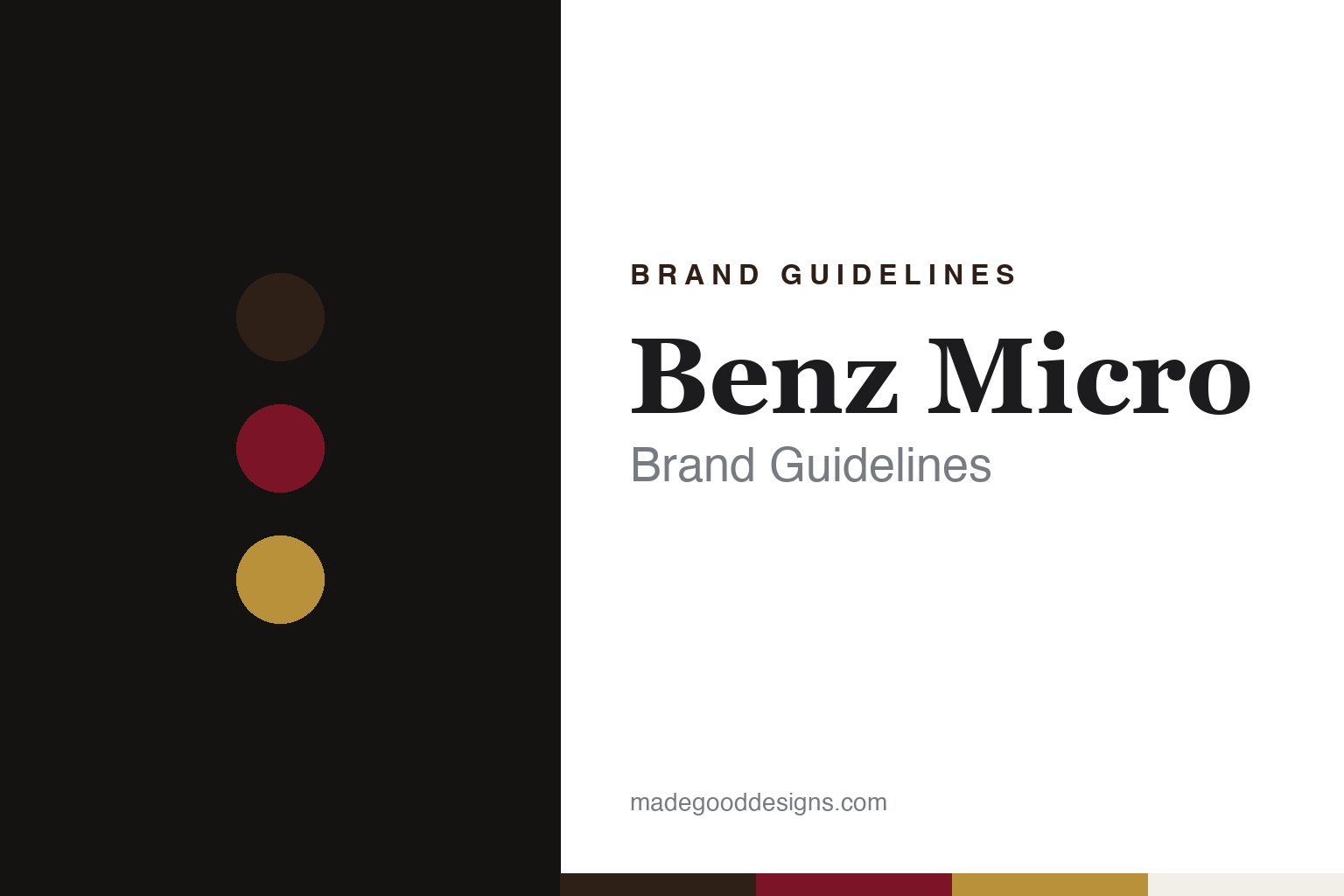
Benz Micro Brand Guidelines
The Swiss moving-coil maker known by its model names.
Aa
Two constants: a Benz Micro ebony, ruby and brass palette and an Instrument serif register. Abstract homage — not a Benz Micro product or mark; no cartridge, logo or nameplate is reproduced.
Ernst Benz
A thinly documented Swiss brand.
Benz Micro is a Swiss maker of moving-coil phono cartridges, and its history is thinly documented. There is no Wikipedia article on it in English or German, and its websites, benz-micro.com and benzmicro.ch, have shown a single holding page with a contact address since at least 2010, according to copies kept by the Internet Archive; today the page reads “This Website is under construction!” The similar address benzmicro.com, without the hyphen, has nothing to do with the company: it was a parked domain in 2004 and is listed for sale today. Much of what follows therefore comes from the trade press and from the brand’s long-time American distributor.
The most detailed account is a review of the LP-S cartridge by Steve Marsh in the online magazine 6moons, published in 2011. It says that Ernst Benz developed a line of moving-coil cartridges in the 1980s “in conjunction with Sony in Japan and AJ van den Hul of the Netherlands,” sold under the Benz Micro name and also as the Madrigal Carnegie 1; that the Carnegie 2 was the first Benz-made cartridge with a ruby-core generator; and that in the early 1990s Benz launched its own Ruby. We found no founding year in the sources we checked, and do not give one.
Switzerland’s central business-name index, Zefix, lists a company called Benz-Micro AG, with its seat at Andelfingen in the canton of Zürich, which went into liquidation and was deleted from the register in October 1997. The British maker Wilson Benesch says it first developed cartridges in collaboration with Benz-Micro in the early 1990s, according to a 2024 news item in the German online magazine hifistatement.
Colour
Ruby, Glider, Ebony and Gullwing.
The person most associated with the brand is Albert Lukaschek. 6moons describes him as an electrical and mechanical engineer, a record collector and a friend of Ernst Benz, who first designed a high-gain phono stage for the low-output Ruby, sold as the Benz Lukaschek PP-1. In 1994, it says, Benz retired, sold his other businesses — including diamond tools and high-temperature vacuum ovens — and sold the cartridge division to Lukaschek, who built a new factory. Musical Surroundings, which distributed Benz in the United States, marked his tenth anniversary as “owner/designer” of the brand in about 2004, consistent with that date.
The range grew in series. 6moons dates the Ruby 2 and Ruby H to 1997, a Series 2 range to 2000, Series 3 to 2004 and an S class to 2008. A Musical Surroundings price list from 2006 runs from the MC Gold and MC Silver at $350, through the ACE — colour-coded red, clear or blue by output — and the Glider, which it called “the price/performance king,” to the wood-bodied H2, M2 and L2, the Ruby 3 and the LP, with a body of aged ebony, at $4,700. Later came the LP-S and the Gullwing SLR. The distributor called the cartridges “Swiss hand-made” and said Fritz Geiger styli were bonded to boron cantilevers “at the Benz factory”; we give those as its claims. 6moons added that the company built cartridges and sub-assemblies for more than ten other turntable and audio brands, which it did not name.
Reviewers were warm. Hi-Fi News reviewed the LP-S in 2009 and The Absolute Sound tested the Glider SM the same year; Musical Surroundings listed the ACE S, Glider S, Gullwing SLR and LP S among The Absolute Sound’s Editors’ Choice selections for 2013, and the ACE SL among Stereophile’s 2012 Recommended Components. Steve Marsh wrote in 6moons that the LP-S “was such a revelation that I cannot resist buying one.” The Glider in particular became a long-term reference: a hifistatement reviewer has listed one in his own system in tests over several years.
Typography
Switzerland’s cartridge makers.
These seven makers belong to a small trade. A phono cartridge is a few grams of magnet, coil and diamond, largely assembled by hand, yet only a few of these brands say who does the work.
Goldring, which traces its roots to Berlin in 1906, belongs to Armour Home Electronics of Bishop’s Stortford, a subsidiary of Q Acoustics Limited, Companies House records show. It says its cartridges are “designed and handmade in the UK,” though its own history says it outsourced much component manufacturing in the 1990s. Soundsmith says every product is “hand-crafted” at its factory in Peekskill, New York.
Sumiko, the cartridge brand of a Berkeley, California, distributor bought by Fine Sounds of Milan in 2011, Stereophile reported, says all its cartridges are hand-built by Excel Sound in Yokohama.
Three are Japanese. Nagaoka, a family stylus maker based in Higashine, Yamagata, makes an MP-700 that is “still completely built by hand in Japan,” Hi-Fi News reported in 2025. ZYX works from Nagara in Chiba; its founder says he managed OEM cartridges for several makers at Namiki Precision Jewel before 1986. My Sonic Lab gives a Tokyo address; its US distributor, quoted by Stereophile in 2018, said founder Yoshio Matsudaira had earlier made cartridges for Air Tight.
Benz Micro, the Swiss name, is hardest to place: its website is a holding page, and the Swiss business-name index lists a Benz-Micro AG as deleted in 1997.
This guide sets out what can be checked about each brand — who founded it, who owns it, and what it says about where its products are made — and marks clearly what rests only on the company’s own word.
Aa
A warm, finely cut serif for a hand-made instrument. (Specimen set in Fraunces, a serif STAND-IN; NOT the Benz Micro logo.)
Benz Micro
An owner, a factory and an open question.
Lukaschek was still described as the man in charge for years afterwards. hifistatement called him “head and owner” of Benz Micro Systems in 2014 and its head in 2016, recalling earlier conversations with him about how heat affects cartridges, and in 2023 called him “owner and developer of Benz Micro Switzerland” when recalling a conversation in 2006. Zefix lists a sole proprietorship in his name, Lukaschek HiFi-Elektronik, at Neuhausen am Rheinfall in the canton of Schaffhausen, for the trade in and development of electronic equipment; we could not confirm that the cartridges are made there.
The current picture is less clear. Musical Surroundings no longer lists Benz among its brands: its brands page did not include it in an archived copy from July 2020, nor does it today. Benz Micro was listed as an exhibitor at the Audio Video Show in Warsaw in 2017 and 2018 and at the Norddeutsche HiFi-Tage in 2019, according to hifistatement, and its cartridges are still in use: Positive Feedback reported a Benz Micro Gullwing, priced at $3,900, in a show system in 2025, and a Gullwing SLR at $4,200 in 2026. We could not establish who distributes the brand today, whether it is still in production, or who owns it now, and we do not guess.
For a design guide, Benz Micro shows how a small brand can be carried by its model names — Ruby, Glider, Ebony, Gullwing — and by its distributors and reviewers more than by its own publicity. Compare Lyra, another specialist moving-coil maker, and Clearaudio. For this guide we use an ebony brown, a ruby red and a brass gold with a serif, an unofficial interpretation; no product or logo is reproduced.
Explore & save
Keep Benz Micro’s identity on hand — save it to a board in the Made Good inspiration library.
Benz Micro identity set
Pin the Benz Micro ebony, ruby and brass palette and the Instrument serif register to your own board.