Exposure Brand Guidelines
The Sussex amplifier maker that took on Naim in matt black.
Aa
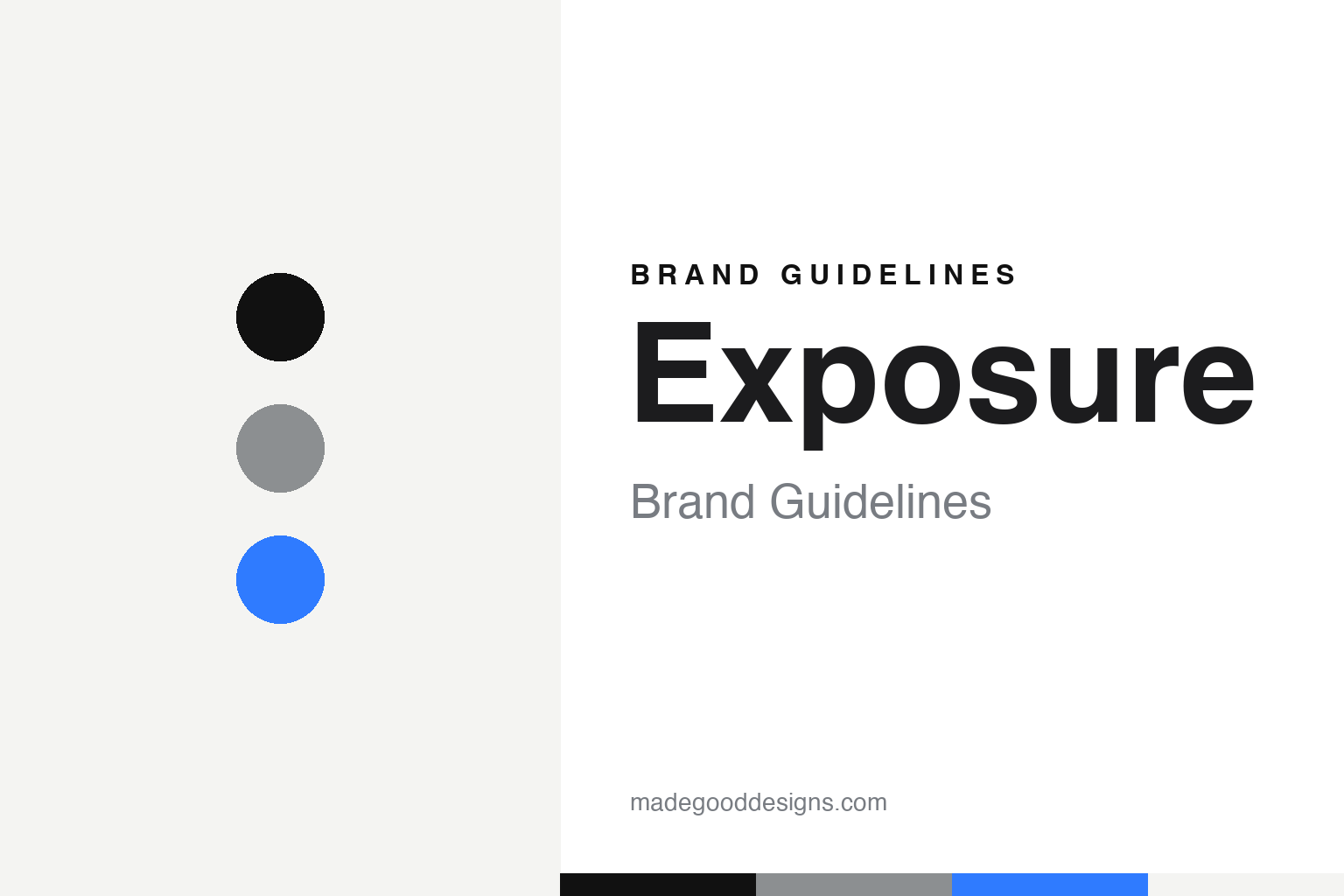
Two constants: an Exposure matt black, titanium and display blue palette and a plain industrial sans register. Abstract homage — not an Exposure product or mark; no amplifier, logo or nameplate is reproduced.
Real world hi-fi
From Pink Floyd’s sound rigs to the Sussex coast.
Exposure Electronics dates itself to 1974 and to one founder, John Farlowe. Both points are backed up outside the company’s own pages: a 1997 Stereophile profile by Martin Colloms says Farlowe founded Exposure “some 20 years” earlier, and a 2021 history panel in Hi-Fi News gives 1974 outright. Colloms describes Farlowe as an electronic-engineering graduate of the University of Sussex who worked at HiWatt, the valve guitar-amplifier maker, and then at Midas, where he designed and built mixing desks and worked with the late Dave Martin of Martin Audio on sound systems for Pink Floyd. The company’s website has said since at least 2007 that Farlowe worked in studios “with the likes of David Bowie and Pink Floyd”; the Bowie link appears only in Exposure’s own telling.
Exposure has stayed on the Sussex coast, though not at one address. Colloms placed it in Brighton in 1997; the company’s website in 2001 gave a works on North Street in Portslade, an address Stereophile still printed in 2008; today it is at a business centre in Lancing, West Sussex, which Hi-Fi News called its “design and manufacturing base” in 2021. We found no date for the move to Lancing.
The first products, on the company’s own timeline, were two loudspeakers, the I and II, and an amplifier pair, the III preamplifier and IV power amplifier, all listed under 1977. Hi-Fi News dates its review of the I speaker to July 1977 and of the III and IV to October 1978, and says the brand set out to make “real world hi-fi at real world prices,” putting audiophile circuits into “basic but sturdy matt-black casework.”
Colour
Roman numerals and a rivalry with Naim.
For its first quarter-century Exposure named its products with Roman numerals, from the I loudspeaker to the XXV integrated amplifier the company dates to 1996, and the habit carried on into the 2000s with the XXII CD player and XXXV integrated amplifier. The X integrated amplifier, dated 1988 on the company timeline, made its name abroad: Stereophile’s Art Dudley wrote in 2019 that one of the most musical systems he had heard at a show, in the late 1980s, paired a then-new X with a Linn LP12 turntable and Linn’s Kan loudspeakers.
The comparison everyone made was with Naim. Hi-Fi News says the III and IV went “head-to-head” with the black boxes coming out of Salisbury. Dudley wrote that Exposure’s amplifiers were seen as “worthy alternatives,” that the company followed Naim’s lead on outboard power supplies and built into aluminium cases of “superficially similar appearance and size,” but that it kept complementary pairs of bipolar output transistors rather than Naim’s quasi-complementary design. Colloms called Farlowe’s electronics “essentially handcrafted,” built around oversized toroidal transformers wound to his own specification.
Exposure came late to digital. Colloms described it as “perhaps the last of the classic audio companies to embrace digital technologies” when Stereophile published his review of its first CD player in November 1997, the year the company’s timeline also gives. In 2000 Tony Brady became the designer, and Hi-Fi News credits him with the 2010 series and the long-running 3010 series. Later came the half-width XM range — Stereophile described the XM5 integrated in 2019 as 8.6 inches wide, with a 60-watt-per-channel amplifier, a phono stage and a DAC inside — then the 5010 and 3510 series, and the 5510 series the company lists for 2025 and 2026. What Hi-Fi? described the 2010S2 CD player in 2014 as silver or black aluminium with an “electric-blue-on-black display.”
Typography
The second tier.
Britain’s second-tier amplifier makers are mostly small and founder-led. Sugden is in Heckmondwike, West Yorkshire; Creek in north London; Icon Audio in Leicester; Leema in Welshpool, mid-Wales; Exposure in Lancing, West Sussex. Musical Fidelity gives its Austrian owner’s Vienna address. Croft, found in Wolverhampton by Hi-Fi Answers in 1984, names no town on its now-lapsed website.
Several have changed hands. Musical Fidelity was sold in May 2018 to the Austrian group Audio Tuning. Creek was sold to Mordaunt-Short in 1988 and bought back in 1993 by Mike Creek and overseas distributors; its website now names Step Deeper Ltd as the brand’s owner. Companies House and Hi-Fi News show Exposure in Malaysian ownership for about two decades.
Sugden says the Miller family has run it since 1981. The original Leema company entered creditors’ voluntary liquidation in 2014; in February 2026 its successor registered a Dutch investment company as holding more than half its shares. Icon Audio says its founder, David Shaw, owns it outright.
Where products are made is mostly self-reported. Sugden says it makes cases and circuit boards in-house; Leema says it designs and manufactures in Wales; Exposure says it manufactures in Britain. Icon Audio says chassis are assembled at its own factory in China and finished in Leicester. Creek said in 2019 that it was moving production away from the Far East, and in 2020 that it had a new partner in Eastern Europe, without naming the country. Stereophile’s 2024 specifications for the reissued Musical Fidelity A1 read “Manufactured in Taiwan.”
This guide sets out what can be checked about each brand — who founded it, who owns it, and what it says about where its products are made — and marks clearly what rests only on the company’s own word.
Aa
A plain industrial sans for numbered black boxes. (Specimen set in Archivo, a sans STAND-IN; NOT the Exposure logo.)
Exposure
British-built, by its own account; Malaysian-owned, by the record.
The ownership record is at Companies House. The present company, Exposure Electronics Limited, was incorporated in October 1996 with Farlowe as a director. Malaysian directors joined its board from June 2000, and Farlowe resigned as a director in March 2002. Since the register began recording controlling owners in 2016, it has named a Malaysian company, Irama Sejahtera Sdn Bhd, as holding 75% or more of the shares. Hi-Fi News put it plainly in 2021: Exposure “has been in Malaysian ownership for the last 20 years.” We found no published account of the date or terms of that sale.
On manufacturing, the company says all its products are “designed, engineered and proudly manufactured in Britain”; in 2007 its website said “Designed in the United Kingdom.” Stereophile called the 2010S “British-built” in 2008, and Hi-Fi News describes Lancing as the design and manufacturing base. We found no independent account of where components are sourced.
No logo designer, typeface or official colour is documented. The visual record is the hardware: low aluminium boxes in black, silver or titanium, a short model number, and little else on the fascia. Exposure’s own 2007 website called the look “understated,” and Hi-Fi News’s Ken Kessler wrote in 2021 that the full-width 3510 integrated “looks like it escaped from the 1980s.”
For a design guide, Exposure shows how a small maker can keep one look for half a century — plain boxes, numbered models, a dark face — while the company behind it changes hands. Compare the black boxes of Naim and the slimline amplifiers of Creek. For this guide we use matt black, titanium grey and a display blue with a plain sans, an unofficial interpretation; no product or logo is reproduced.
Explore & save
Keep Exposure’s identity on hand — save it to a board in the Made Good inspiration library.
Exposure identity set
Pin the Exposure matt black, titanium and display blue palette and the plain industrial sans register to your own board.