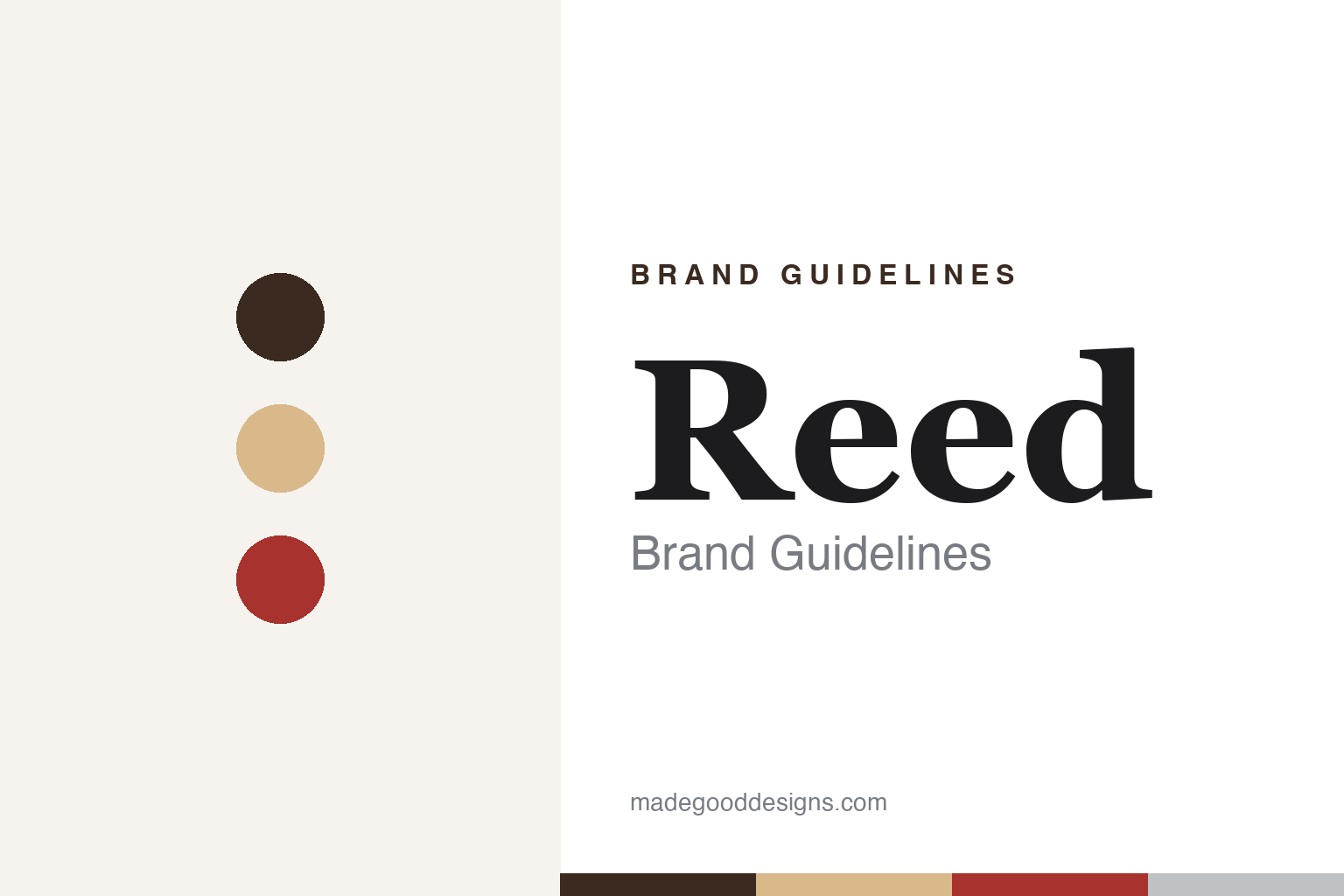
Reed Brand Guidelines
The Lithuanian workshop that made wood its tonearm signature.
Aa
Two constants: a wenge, birch and Carnelian red palette and a warm serif register. Abstract homage — not a Reed product or mark; no tonearm, turntable, logo or nameplate is reproduced.
Tonearms.lt
A radio engineer’s second career.
Reed is the brand name of Tonearms.lt, a small Lithuanian company based in the village of Naujųjų Muniškių, in the Kaunas district outside the country’s second city, according to its contact page. Its founder, designer and owner is Vidmantas Triukas, whom the company describes as a radio engineer who has worked with hi-fi equipment since 1985. It says it has only five employees. Red Dot’s award listing likewise names Tonearms.lt of the Kaunas District as both maker and in-house designer, with Triukas as designer.
Triukas’s story, as the company tells it, begins in Soviet-era science. A 2010 version of its website said he had researched “acoustical noise of plasma in long-range ballistic missiles” and held three patented inventions in the field; the current site says, more briefly, that some of his work “was a rocket science, literally.” In 1987, the company says, he and a few friends built a turntable, loudspeakers and an amplifier that won a bronze medal at what it calls the USSR’s largest technical-achievement show in Moscow, for features including automatic motor speed control. He also studied art history in Leningrad, now Saint Petersburg, from 1980 to 1982. We give all of this as the company’s own account; we have not checked the patents or the medal.
After the 1990s, the company says, Triukas worked in another business. In 2007 he decided to start an audio business and, “after a year of continuous research, prototyping, design and testing,” offered the first Reed tonearm — a timeline he repeated in a 2011 interview with the Singapore blog Hifi.com.sg. Part-Time Audiophile, reviewing the Reed 2B in 2024, gave a different date, saying the company was founded in 2010 and that its first product, the Reed 2A, appeared that year. Archived pages show the Reed tonearm at two shows in Portugal in June 2010 and announced for the Rocky Mountain Audio Fest in Denver that September, and Triukas named an earlier model, the Reed L, before the 2A; so we give the company’s 2007 start and note the 2010 date. Its first domain, tonearms.lt, was redirected to reed.lt in 2011.
Colour
Wooden wands, lasers and Thales’s theorem.
Reed’s signature is the wooden arm wand. In the 2011 interview Triukas said tests against carbon fibre, fibreglass and aluminium had convinced him that wood best suppresses parasitic vibration, and that wood had become “the only material for armtubes.” The company’s technical pages still say its armwands are made of different kinds of wood; hi-fi+ listed wenge, Macassar ebony, cocobolo and light and dark teak for the 5A. Early arms — the Reed L, the 2A, the 2P with on-the-fly height adjustment and the 3Q with a laser for setting tracking angle and azimuth — were followed by the 3P, which won a Red Dot product design award; the award’s page carries a 2012 badge. Its jury called the 3P “an impressive example of how innovative technologies can revolutionise the playback of supposedly outdated media.”
Reed’s most unusual arms track the record tangentially while still pivoting. The 5T, reviewed by Michael Fremer in Stereophile in 2020 at $21,500, uses a laser and sensor to follow the arm’s sideways movement and a small battery-powered motor to shift its pivot in real time. The 5A, first shown as a prototype at the Audio Gourmet show in Vilnius in 2019, according to hi-fi+, does a similar job mechanically, using what the company calls “Double Birch/Thales” geometry, after the theorem of the Greek mathematician Thales of Miletus; the magazine gave its UK price as £7,798.
Reed also makes turntables. Fremer described the Muse 1C, at $15,000, as sharing the bearing and drive of the costlier Muse 3C, at $20,000: an aluminium sub-platter driven by two opposing DC motors through friction wheels, with belt drive as an option, and four speeds including 16 2/3 rpm and an adjustable 78. He called them “Lithuanian-made products.” In 2023 TechRadar reported the Muse 3A, a “Bauhaus-style” deck made entirely of birch plywood in Carnelian Red, white or black, able to take two tonearms, at €15,000. The current range also includes an optical cartridge, a phono equaliser and power supplies.
Typography
European analogue, documented.
The seven brands in this group are small. Each makes turntables, tonearms or both, and several are still closely tied to the engineer who designed the first product. Between them they work from seven countries: the United States, Britain, Denmark, Poland, Lithuania, Switzerland and New Zealand.
In Britain, AVID Hifi Ltd has its registered office on an industrial park in Kimbolton, Cambridgeshire, Companies House shows. In Denmark, Bergmann Audio, which makes air-bearing turntables and linear-tracking arms, gives its address as Hobro. J.Sikora lists a street address in Lublin, in eastern Poland.
Reed tonearms come from Tonearms.lt, a Lithuanian company whose address is a village in the Kaunas district. Thales is made by HiFiction AG, which the Swiss commercial register places in Turbenthal, in the canton of Zurich.
Two brands need more care. Spiral Groove’s 2015 press releases were datelined Berkeley, California, but its website returned an error when we checked in October 2026, and its present status is unclear. Well Tempered Lab sells the designs of William Firebaugh. Its website gives a New Zealand phone number and says Opera Audio of Beijing makes the products, and TNT-Audio reported in 2016 that the brand is owned by a New Zealand company.
Small makers often say more about themselves than outsiders can confirm, from founding dates to materials to claims of hand assembly at home. Company registers, dated reviews and press releases settle some of this. The rest is the company’s word.
This guide sets out what can be checked about each brand — who founded it, who owns it, and what it says about where its products are made — and marks clearly what rests only on the company’s own word.
Aa
A warm serif for wood, craft and an art-history education. (Specimen set in Fraunces, a serif STAND-IN; NOT the Reed logo.)
Reed
A small company with a long dealer list.
Reed sells through distributors in about two dozen countries, according to its contact page, including Absolute Sounds in Britain and AXISS Audio in the United States, and in 2025 and 2026 it reported showing its products at audio shows in Taipei and Hong Kong. Its most recent product news, in June 2026, was a battery power supply for the 5T tonearm and its turntables. We found no record of outside ownership in the sources we checked; the company presents itself as Triukas’s own business. It says the 5T has 196 parts, took 5,472 hours to design and involved 11 countries — figures we give as its own.
The identity is as quiet as the company. The website uses the plain word “Reed” and a line about hoping its products will “paint a silence in your room in all colors of the orchestra”; we found no published logo or colour specification. The products supply the look instead: dark and figured woods, machined aluminium, Karelian birch on the Muse 1C, and on the Muse 3A, a Bauhaus red.
For a design guide, Reed shows how a small engineering workshop can turn a material choice — wood where rivals use metal and carbon — into its signature. Compare Thales, a tonearm maker named after the same Greek mathematician, and Kuzma, another tonearm and turntable maker from a smaller European country. For this guide we use wenge brown, birch and a Carnelian red with a serif, an unofficial interpretation; no product or logo is reproduced.
Explore & save
Keep Reed’s identity on hand — save it to a board in the Made Good inspiration library.
Reed identity set
Pin the Reed wenge, birch and Carnelian red palette and the warm serif register to your own board.