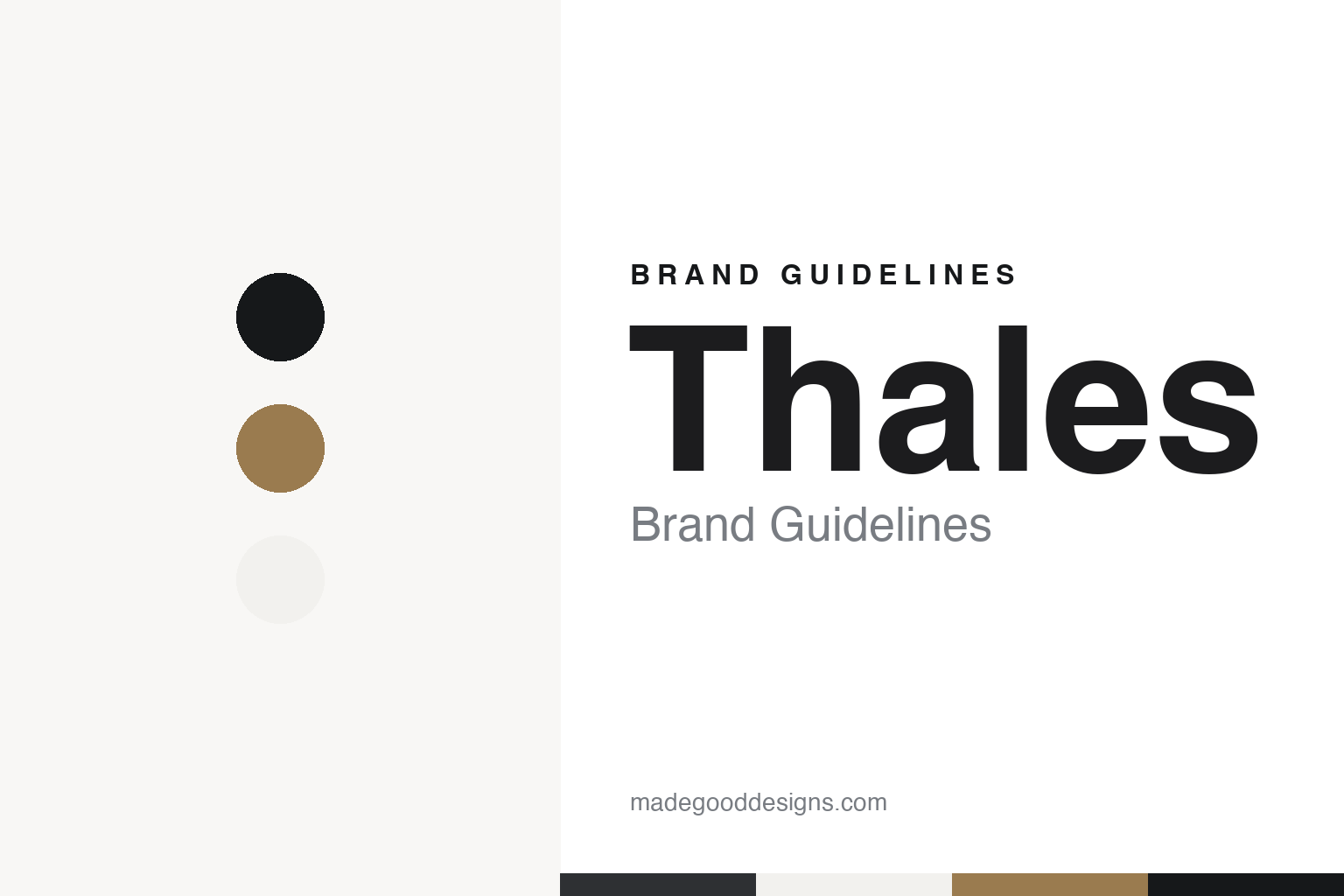
Thales Brand Guidelines
The Swiss tonearm built on a school geometry theorem.
Aa
Two constants: a Thales anthracite, bronze and white palette and a precision sans register. Abstract homage — not a Thales product or mark; no tonearm, turntable, logo or nameplate is reproduced.
The Thales circle
A schoolroom theorem turned into a tonearm.
Thales is a Swiss brand of tonearms and turntables, and it has nothing to do with the French defence and aerospace group of the same name. It takes its name from the Greek mathematician Thales of Miletus, whose theorem says that any triangle drawn inside a semicircle, with the diameter as one side, has a right angle opposite it. Stereophile’s Art Dudley explained the link in 2019: the arm moves so that the headshell always sits at a right angle to the record’s radius, as the cutting head did when the master was cut.
The idea belongs to Micha Huber. The company says he trained both as a mechanical engineer and as a professional musician, worked for five years developing fine Swiss watch movements, studied music and taught it. Dudley called him an “engineer and former watchmaker”; Wojciech Pacuła of HighFidelity.pl, in a 2014 review republished by Positive Feedback, described him as a mechanical engineer, musician and watchmaker.
The patent came first. The company lists Swiss patent CH 694567, “Tangential Pivoted Tonearm,” announced in May 2004, and Dudley wrote that Huber patented the design that year. The company says Huber founded HiFiction AG in 2008 to make it; its own product archive dates the first arm, the Thales Original, from 2008 to 2018. So both dates appear in print: 2004 for the invention, 2008 for the business. We could not see the company’s founding date in the Swiss register, so 2008 is the company’s figure.
Colour
Two arm tubes, no anti-skating.
Making a pivoted arm keep the stylus at the right angle to the groove is an old problem. Dudley traced the idea back to the Garrard Zero 100 of the 1970s, and in a 2017 email quoted by Positive Feedback’s Marshall Nack, Huber named that deck and the Burne-Jones arm as the earlier commercial attempts. He told Nack that what was new about Thales was that its geometry was the first pivoted design to be “100% tangential.”
The Original was costly and did not suit every deck, Pacuła wrote, so a smaller arm followed: the Simplicity, sold from 2010 to 2014, then the Simplicity II. It uses what Thales calls a tetragon geometry, with two aluminium arm tubes that move against each other and a headshell that turns as the arm crosses the record. Dudley noted that the arm has no anti-skating control. Thales now gives a maximum tracking error of 0.006°, its own figure. Its bearings use a design it calls TTF, for Thales Tension Free; Pacuła reported it had been in development since 2012. The current range has three arms: the Statement, the Simplicity II and the cheaper Easy.
Turntables came next, built to carry the arms. The archive lists the TTT (2011–2014), the TTT-Compact, the TTT-Slim, and the TTT-Compact II and TTT-Slim II, which ran until 2025 and 2024. All of them run on internal batteries. The present decks are the Reference, with a mechanical centrifugal speed governor the company says it patented in 2024, and the Elegance, which uses an eddy-current brake. Reviewers have been warm. After using a TTT-Slim II and Simplicity II, Dudley wrote that in 34 years he had “seen no products better made than the Thales turntable and tonearm.”
Typography
Small makers, checkable facts.
The seven brands in this group are small. Each makes turntables, tonearms or both, and several are still closely tied to the engineer who designed the first product. Between them they work from seven countries: the United States, Britain, Denmark, Poland, Lithuania, Switzerland and New Zealand.
In Britain, AVID Hifi Ltd has its registered office on an industrial park in Kimbolton, Cambridgeshire, Companies House shows. In Denmark, Bergmann Audio, which makes air-bearing turntables and linear-tracking arms, gives its address as Hobro. J.Sikora lists a street address in Lublin, in eastern Poland.
Reed tonearms come from Tonearms.lt, a Lithuanian company whose address is a village in the Kaunas district. Thales is made by HiFiction AG, which the Swiss commercial register places in Turbenthal, in the canton of Zurich.
Two brands need more care. Spiral Groove’s 2015 press releases were datelined Berkeley, California, but its website returned an error when we checked in October 2026, and its present status is unclear. Well Tempered Lab sells the designs of William Firebaugh. Its website gives a New Zealand phone number and says Opera Audio of Beijing makes the products, and TNT-Audio reported in 2016 that the brand is owned by a New Zealand company.
Small makers often say more about themselves than outsiders can confirm, from founding dates to materials to claims of hand assembly at home. Company registers, dated reviews and press releases settle some of this. The rest is the company’s word.
This guide sets out what can be checked about each brand — who founded it, who owns it, and what it says about where its products are made — and marks clearly what rests only on the company’s own word.
Aa
A precision sans for a watchmaker’s tonearm. (Specimen set in Manrope, a sans STAND-IN; NOT the Thales logo.)
HiFiction AG
From Winterthur to an 1833 spinning mill.
Thales is the brand of HiFiction AG. Its website says Thales and its logo are registered trademarks owned by HiFiction, and names Micha Huber as chief executive. The Swiss commercial register lists him on the board of directors. That register does not show who holds the shares of a Swiss AG, so who owns the company cannot be checked there.
The company has moved twice. Pacuła wrote in 2014 that HiFiction was in Winterthur and had moved in May 2012 into a large industrial building in Hegi, a district of the city. A register notice of February 2019 records that its registered office moved from Winterthur to Turbenthal, a village in the canton of Zurich. The company says its workshop there is in a former spinning mill built in 1833.
HiFiction does more than make Thales. On the EMT website, which HiFiction runs, a timeline says Huber began helping the pickup maker EMT with precision engineering in 2009. From 2014, the timeline says, the making of EMT cartridges moved step by step from Mahlberg, in Germany, to HiFiction. HiFiction took over the whole EMT cartridge business in 2018 and EMT development in 2021. The EMT trademarks belong to a separate Swiss company, EMT International GmbH. A 2023 press release from MoFi Distribution, Thales’s US importer since April that year, said the Turbenthal factory builds Thales, EMT and X-quisite products as well as work for other brands. The company website says it has ten staff in two places, with a small workshop in Wimmis where it makes its moving-coil generators.
On where things are made, Thales says every part is machined in Switzerland by local suppliers and assembled by hand in its own workshop. That is the company’s word; the reviews we read repeat it but did not check the supply chain. One award is reported by others: Mono & Stereo reported in May 2025 that the Voro cartridge won an iF Design Award 2025, and PIM International described it in September 2025 as the first moving-coil cartridge with a skeletonised zirconia body made by ceramic 3D printing.
For a design guide, Thales shows how one geometric idea can shape a whole brand: its name, its arms and its compact, low-key decks. Compare SME, another maker that began with the tonearm, and the Lithuanian Reed. For this guide we use anthracite, bronze and a warm white with a sans, an unofficial interpretation; no product or logo is reproduced.
Explore & save
Keep Thales’s identity on hand — save it to a board in the Made Good inspiration library.
Thales identity set
Pin the Thales anthracite, bronze and white palette and the precision sans register to your own board.