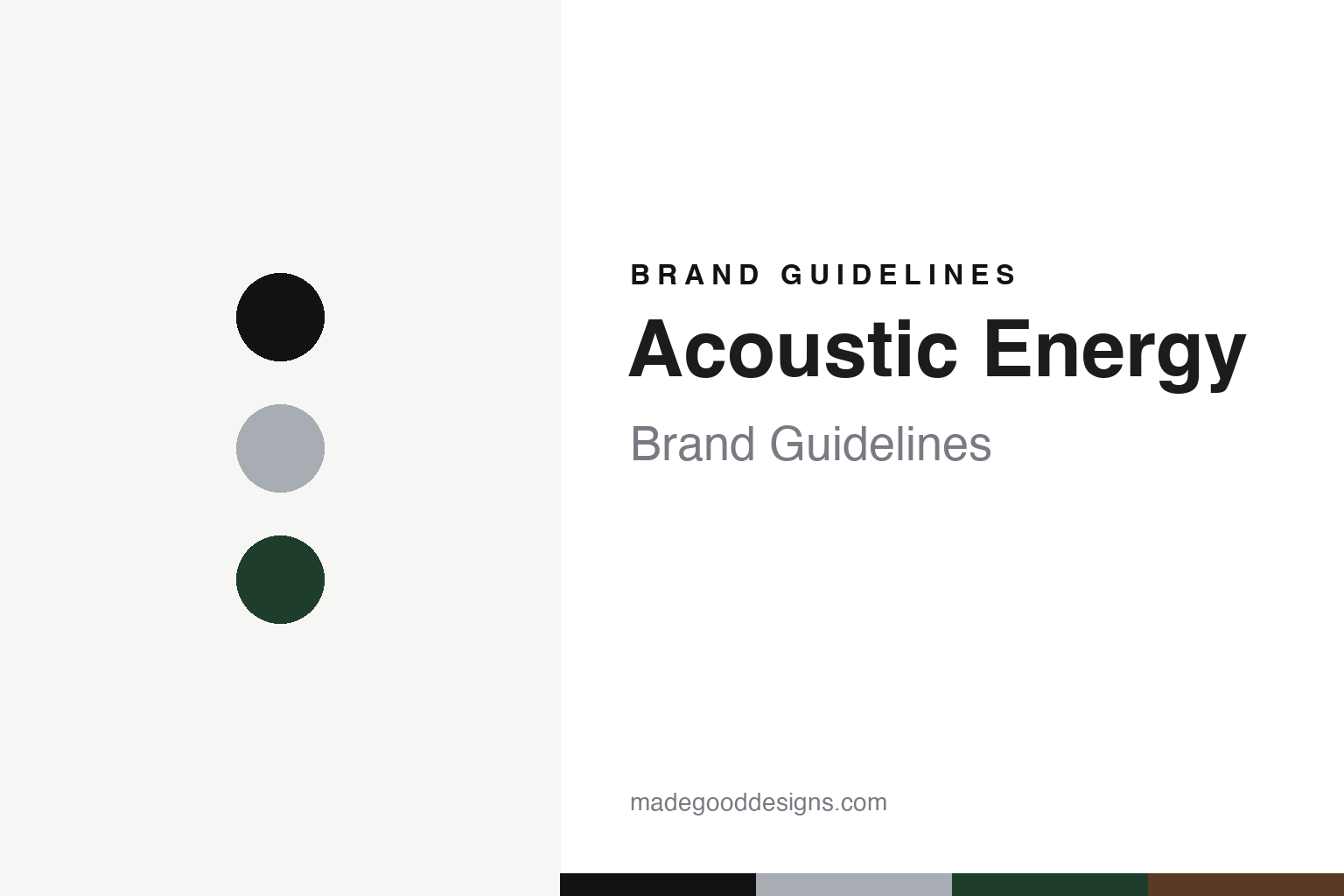
Acoustic Energy Brand Guidelines
The metal-coned AE1 and the Cotswolds speaker maker.
Aa
Two constants: an Acoustic Energy silver, black and racing green palette and an engineered sans register. Abstract homage — not an Acoustic Energy product or mark; no loudspeaker, logo or nameplate is reproduced.
The AE1
A studio monitor with metal cones.
Acoustic Energy began with one loudspeaker. Its founder, Phil Jones, was a bass player and recording engineer who, Hi-Fi News wrote in January 2026, began work on the original AE1 “seeking an ‘accurate monitor’ for his recording studio” and “certainly wasn’t intending to launch a consumer audio company.” The company dates its founding to 1987, when, its timeline says, Acoustic Energy Limited opened for business in Ealing, in west London. Companies House records show that the limited company was incorporated in April 1987 under another name, Eldonfield Limited, and renamed Acoustic Energy Limited that June.
In his own account on the company website, Jones describes running a PA hire business and a 24-track studio in South London in the 1980s, and making the AE1’s drivers himself, with aluminium cones made and hard-anodised by outside firms and advice on crossover design from the audio writer Martin Colloms. He says it was a comparison in a hi-fi shop, suggested by the managing director of the French driver maker Audax, that persuaded him to sell the AE1 as a home speaker, and that its first review, in Hi-Fi Answers in 1988, made the magazine’s cover.
The design was unusual. Hi-Fi News calls the AE1 a compact two-way “groundbreaking in its use of metal diaphragms for both bass/mid and treble drive units”; its editor Paul Miller notes that the first production model paired an ELAC-sourced 25mm alloy dome tweeter with a 110mm spun aluminium-alloy cone in a KEF B110 chassis. The magazine reviewed the AE1 alongside the AE2 and AE4 in January 1989, and Stereophile’s archive carries measurements of it from 1988 and a follow-up from 1992. English Wikipedia lists the AE1 among the products in What Hi-Fi?’s Hall of Fame.
Colour
Formosa Prosonic, then a management buyout.
The range grew quickly: the company lists the AE2, AE3 and AE4 in 1988, Signature editions in 1994 and the 43kg AE5 floorstander in 1996. Its ownership changed in the mid-1990s. Acoustic Energy’s timeline says that in 1994 it formed “a strategic partnership with Formosa Prosonic Berhad,” which it calls “a world class speaker factory based in Malaysia,” and that in 1995 it moved to a larger factory in the Cotswolds. Companies House records show two directors with a correspondence address in Port Klang, Malaysia, in the same industrial park as the address Companies House gives for Formosa Prosonic, joining the board in April 1995, and list Formosa Prosonic Industries, a Malaysian listed company, as holding three-quarters or more of the original company when such ownership was first recorded, in 2016. We did not find the date of the acquisition itself.
Through the 2000s the range broadened. The company lists the Aego 2 sub-and-satellite system of 2002, an internet radio and a Bluetooth speaker made with the mobile network Orange, the AE22 Pro studio monitor of 2006, the Radiance series of 2009 and the Reference Series of 2011, the first with what it calls Resonance Suppression Composite cabinets. An AE1 MkIII special edition followed in 2008, and the AE1 Classic LE in 2016.
In 2017, the company says, “AE’s longstanding management team take the business into private UK ownership once again,” establishing Acoustic Energy Loudspeakers Ltd. Companies House records show that this company was incorporated in February 2017 with Mat Spandl as a director, joined by three more directors in January 2018; since 2022 it has reported no shareholder with more than a quarter of its shares. The original 1987 company was dissolved in February 2022.
Typography
British loudspeakers and documentation.
Britain’s smaller loudspeaker makers draw on a tradition set by the BBC, whose Research Department at Kingswood Warren in Surrey designed monitors and licensed others to build them. Sound On Sound names the first three LS3/5A licensees as Rogers, Audiomaster and Chartwell; English Wikipedia says Falcon Acoustics now holds the licence for the 15-ohm version.
Their websites and Companies House place the makers in this guide across Britain: Kudos at Willington, County Durham; Acoustic Energy at Trull, near Tetbury, Gloucestershire; Fyne Audio at Bellshill, North Lanarkshire; Russell K at a registered address in Dunstable, Bedfordshire; Falcon Acoustics at Stanton St John, near Oxford; Stirling Broadcast near Carmarthen in Wales, though Stereophile listed it in Somerset in 2007; and the Chartwell name with Graham Audio in Newton Abbot, Devon.
Several have changed hands. Chartwell was sold from receivership to Rogers’ owner in 1978; Graham Audio revived the name by 2016. Falcon says its founder, Malcolm Jones, transferred the business to Jerry Bloomfield in 2009. Companies House shows Acoustic Energy’s original 1987 company, dissolved in 2022, was controlled by the Malaysian-listed Formosa Prosonic Industries; a Tetbury company that calls itself British owned and run now trades as Acoustic Energy.
On manufacturing, the makers speak for themselves. Kudos says each loudspeaker is assembled by hand in its factory in North East England; Fyne Audio says its F700 series is built in the UK; Graham Audio says its loudspeakers are hand-assembled on site.
This guide sets out what can be checked about each brand — who founded it, who owns it, and what it says about where its products are made — and marks clearly what rests only on the company’s own word.
Aa
A firm, engineered sans for a brand built on metal cones. (Specimen set in Archivo, a sans STAND-IN; NOT the Acoustic Energy logo.)
Acoustic Energy
Corinium, and the AE1 again.
Today Acoustic Energy is based in the Cotswolds, at Trull Farm near Tetbury in Gloucestershire, and calls itself “British owned and run.” Mat Spandl, its managing director, is also named as the designer of its flagship, the Corinium, a curved three-way floorstander that the company says took its in-house team three years. Reviewing it in 2026, Hi-Fi News explained the name — Corinium was the Roman name for Cirencester, “where the brand is based” — and priced it from £6,000, or £7,000 in British Racing Green. The rest of the range is numbered — the 100, 300 and 500 Series, the AE1 Active and a subwoofer — and, Hi-Fi News notes, uses carbon-fibre or paper woofers rather than metal.
The exception is the AE1 itself. In 2025 the company revived it as the AE1 40th Anniversary, at £1,499, with a 29mm anodised aluminium dome and a 125mm hand-spun aluminium cone. Spandl told Hi-Fi News that because the original parts had long been out of production, “we had to start from scratch.” On where its speakers are built, the company speaks of “British design and engineering”; the pages we checked do not say where current models are made, though its FAQ notes that the earlier Reference 3 was “Made in the UK.” No official typeface or colour values are published.
For a design guide, Acoustic Energy shows how a single product can carry a brand through changes of owner: the AE1’s metal cones remain its signature almost forty years on. Compare ProAc, another British maker of compact monitors, and Mission, another long-running British loudspeaker brand. For this guide we use anodised silver, gloss black and a racing green with a sans, an unofficial interpretation; no product or logo is reproduced.
Explore & save
Keep Acoustic Energy’s identity on hand — save it to a board in the Made Good inspiration library.
Acoustic Energy identity set
Pin the Acoustic Energy silver, black and racing green palette and the engineered sans register to your own board.