Russell K Brand Guidelines
The Bedfordshire speaker maker behind the red-baffled Red series.
Aa
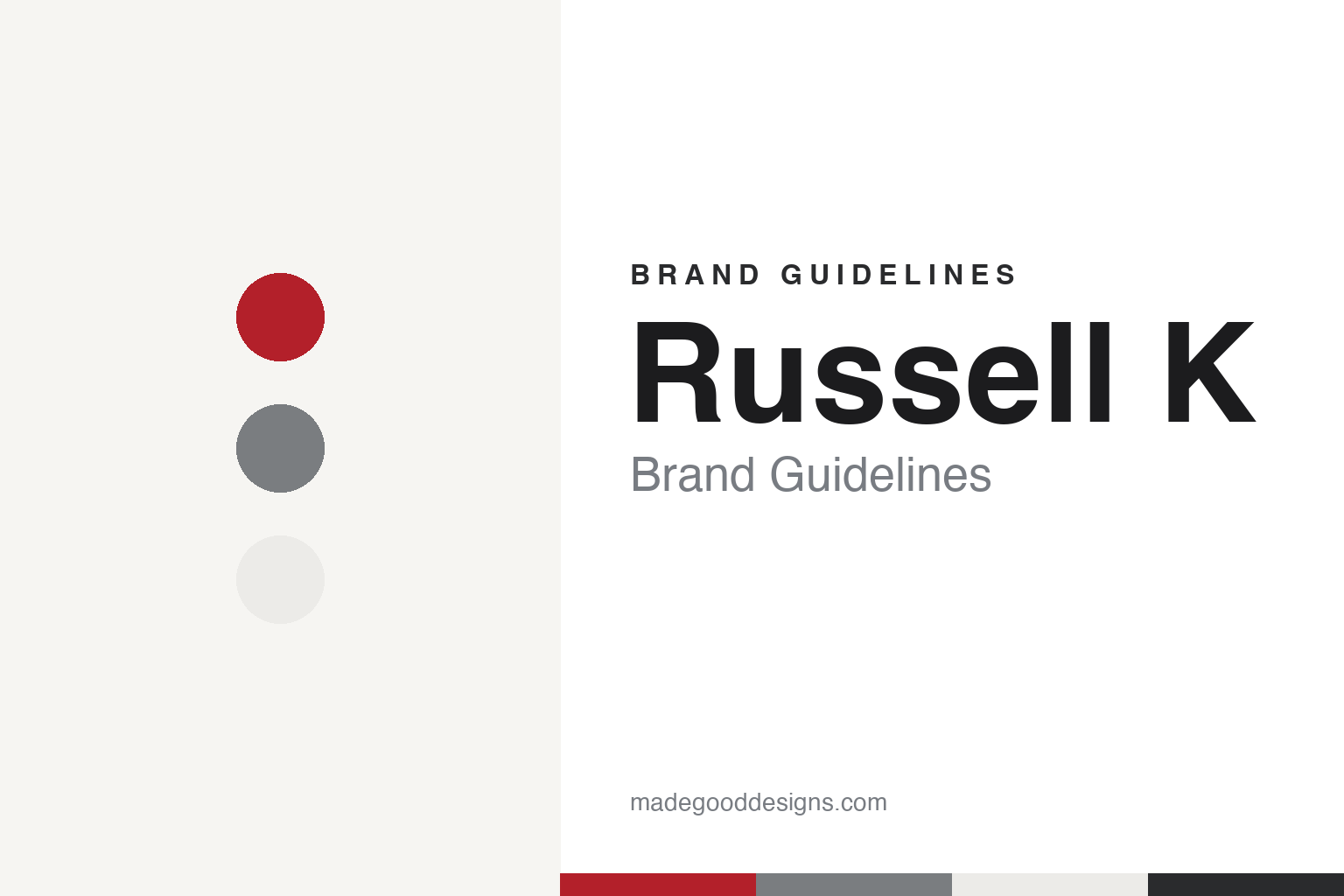
Two constants: a Russell K red and grey palette and a plain grotesque sans register. Abstract homage — not a Russell K product or mark; no loudspeaker, logo or nameplate is reproduced.
Russell Kauffman
A long career in the trade, then a brand of his own.
Russell K is a small English loudspeaker company named after its founder, Russell Kauffman. Companies House records Russell K Limited as incorporated on 12 June 2008, with its registered office in Dunstable, Bedfordshire; Kauffman has been its director since that day and is registered as holding more than three-quarters of its shares. The brand uses his first name and the initial of his surname. The company’s own website spells the surname both “Kauffman” and “Kaufman”; we follow the spelling on the official register and in most reviews.
Kauffman came to the brand after a long career in the hi-fi trade, though sources describe that career a little differently. Writing in Hi-Fi+ in 2019, Jason Kennedy said Kauffman had “worked for Bowers & Wilkins, Morel,” had been “a regular on Paul Messenger’s legendary blind listening tests in the 1990s,” and that his role had “generally been in sales and marketing.” In 2015 Alan Sircom, also in Hi-Fi+, said that Kauffman’s most recent client had been Morel, the Israeli loudspeaker maker, for which he worked as designer, and that his best-known design there was the Fat Lady, a three-way, four-driver flagship tower. That relationship ended, Sircom wrote, partly because Morel was based in Israel and Kauffman in the Home Counties of England.
The Ear put his motive simply in 2015: after many years in the industry, Kauffman decided it was time to make his own loudspeakers “rather than making a living by selling other people’s.” Reviewers have also linked him to Epos. Sircom described the original Epos designer, Robin Marshall, and Kauffman as old friends, and Kennedy wrote that Kauffman named Marshall as someone who liked to talk about technical matters.
Colour
Thin walls, no damping and a red baffle.
Although the company was registered in 2008, its first loudspeaker reached reviewers in 2014. That was the Red 100, a two-way standmount that the company calls “the first loudspeaker designed by” its founder. The Ear reviewed it in August 2014 and noted that Kauffman “paints the baffles red”; Kennedy later wrote that he first came across the brand that year. The website as archived in 2014 offered a customiser in which the standard finish was a red front baffle on a grey cabinet, with black, white and real-wood options.
The ideas behind the speaker go against common practice. Sircom wrote that Kauffman’s design drew on BBC research of the kind that produced the LS3/5a, which found that thick, heavy cabinet walls colour the sound. The Red 100 uses 16mm MDF with a 19mm front baffle, and instead of the BBC’s bitumen damping pads it uses two internal shelves with apertures, above and below the woofer, to control the cabinet and load the driver. The cabinet contains no damping material at all: Kauffman argues, as Steve Dickinson put it in Hi-Fi+ in 2016, that damping materials “store energy and then release it, out of time from the music.” The crossover is a 12dB-per-octave design at 2.2kHz with a single component in the signal path for each driver, both drivers connected in positive phase, and the company says the Red 100’s port is tuned to 35Hz.
The range grew in steps. The Ear reported in 2015 that a smaller Red 50 and a twin-woofer floorstander, the Red 150, were following the Red 100. Hi-Fi+ reviewed a slimmer floorstander, the Red 120, in 2019, and upgraded “Se” editions followed: the Red 150Se, reviewed by Hifi Pig in 2019; the Red 120Se, launched at the UK Audio Show in 2021; and the Red 50Se, which the company launched at the Bristol Hi-Fi Show in 2024. The company says the Red 120Se was named floorstanding speaker of the year in the Hi-Fi+ awards for 2022, and it has posted a five-star Hi-Fi Choice review of the same model.
Typography
Design and documentation.
Britain’s smaller loudspeaker makers draw on a tradition set by the BBC, whose Research Department at Kingswood Warren in Surrey designed monitors and licensed others to build them. Sound On Sound names the first three LS3/5A licensees as Rogers, Audiomaster and Chartwell; English Wikipedia says Falcon Acoustics now holds the licence for the 15-ohm version.
Their websites and Companies House place the makers in this guide across Britain: Kudos at Willington, County Durham; Acoustic Energy at Trull, near Tetbury, Gloucestershire; Fyne Audio at Bellshill, North Lanarkshire; Russell K at a registered address in Dunstable, Bedfordshire; Falcon Acoustics at Stanton St John, near Oxford; Stirling Broadcast near Carmarthen in Wales, though Stereophile listed it in Somerset in 2007; and the Chartwell name with Graham Audio in Newton Abbot, Devon.
Several have changed hands. Chartwell was sold from receivership to Rogers’ owner in 1978; Graham Audio revived the name by 2016. Falcon says its founder, Malcolm Jones, transferred the business to Jerry Bloomfield in 2009. Companies House shows Acoustic Energy’s original 1987 company, dissolved in 2022, was controlled by the Malaysian-listed Formosa Prosonic Industries; a Tetbury company that calls itself British owned and run now trades as Acoustic Energy.
On manufacturing, the makers speak for themselves. Kudos says each loudspeaker is assembled by hand in its factory in North East England; Fyne Audio says its F700 series is built in the UK; Graham Audio says its loudspeakers are hand-assembled on site.
This guide sets out what can be checked about each brand — who founded it, who owns it, and what it says about where its products are made — and marks clearly what rests only on the company’s own word.
Aa
A plain grotesque sans for a name printed simply on a tweeter faceplate. (Specimen set in Archivo, a sans STAND-IN; NOT the Russell K logo.)
Russell K
Designed in England; built in Poland, then, the company says, in England.
Where the speakers are built has changed, according to the sources. In 2015 Sircom wrote that “the design stays in the UK, although manufacture moves to Poland,” and The Ear called the Red 50 a “British designed, Polish built speaker” the same year. The company’s later material says otherwise for the newer models: its launch text for the Red 120Se in 2021, published by Hi-Fi+, called it “designed and manufactured in England,” and its website describes the Red 150Se as “Designed and Manufactured in the UK.” We give those as the company’s claims and could not independently confirm where each model is made today.
The company remains small and owner-run. Companies House lists Kauffman as its only current director, and its contact address is in Dunstable. Its website’s most recent news items date from 2024, when it announced the Red 50Se, an appearance at the High End show, then held in Munich, and a new distributor for China, Hong Kong and Macao. Beware the near-identical domain russellk.com, which redirects to an unrelated page; the company’s own site is russell-k.com. No official brand colours or typeface are published, but the look is easy to describe: Hifi Pig noted in 2016 that Kauffman’s name is screen-printed in white on each tweeter, and the red baffle has been the brand’s most recognisable feature since the first reviews.
For a design guide, Russell K shows how one colour on one surface can carry a small brand. Compare Epos, the brand whose founder reviewers linked to Kauffman, and Bowers & Wilkins, where Kauffman once worked. For this guide we use a baffle red and cabinet grey with a sans, an unofficial interpretation; no product or logo is reproduced.
Explore & save
Keep Russell K’s identity on hand — save it to a board in the Made Good inspiration library.
Russell K identity set
Pin the Russell K red and grey palette and the plain grotesque sans register to your own board.