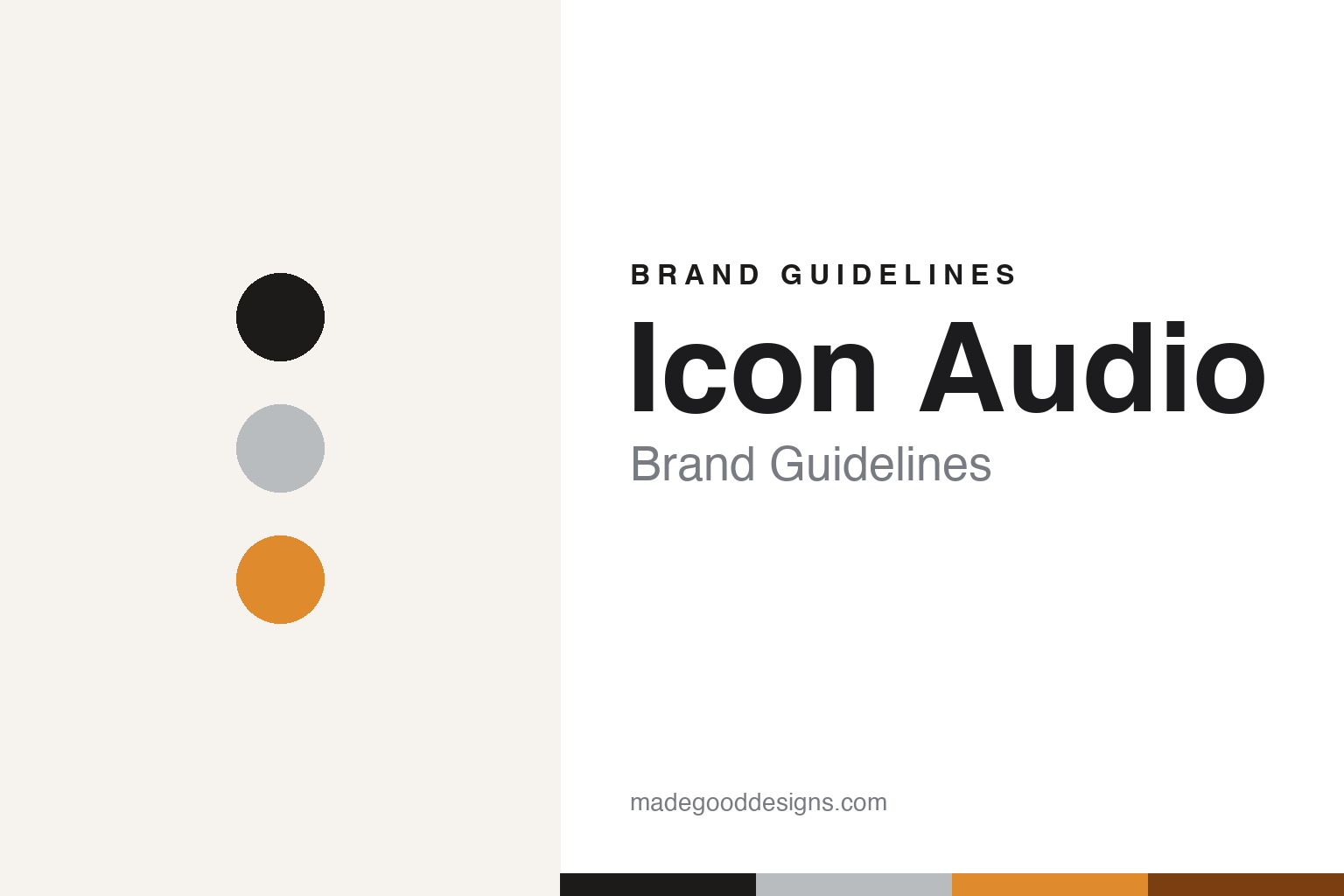
Icon Audio Brand Guidelines
The Leicester valve-amplifier maker that says where its chassis are built.
Aa
Two constants: an Icon Audio stainless, crackle black and valve amber palette and a geometric sans register. Abstract homage — not an Icon Audio product or mark; no amplifier, logo or nameplate is reproduced.
A family radiogram
Twenty-five years in the hi-fi trade before a brand of his own.
Icon Audio is a small valve-amplifier maker in Leicester, in the English Midlands. The company says it was established in 2000 by David Shaw, who “wholly owns” it, and that Shaw had spent the years from 1972 to 1997 in the hi-fi trade — in sales, marketing, service and installation — after studying electronic engineering. Its account of how he started is domestic: a family radiogram, a collection of 78s and a valve system he built as a teenager. Shaw told Noel Keywood, the publisher of Hi-Fi World, that it was a World Audio Design KT88 amplifier — a design from the magazine’s own kit venture — that “set him off along the valve path,” Keywood wrote in the magazine’s October 2011 issue.
The paper trail starts a little after the founding date the company gives. An Icon Audio website at iconaudio.co.uk was archived from August 2002, and the limited company, Icon Audio (UK) Ltd, was incorporated on 22 December 2006, according to Companies House, which lists Shaw as a director and company secretary from that day and as its person with significant control. In 2004 the iconaudio.com address was a parked domain offered for sale; the brand used the .co.uk address then and has used iconaudio.com since at least 2008.
The company says it admires older British and American valve amplifiers, naming Leak, Quad, McIntosh and Dynaco, and its range reads like a list of classic output valves: the EL34 and KT88, the KT120 and KT150, the 300B, the 845 and 805, and the Russian GU81. It trades from 351 Aylestone Road in Leicester, the address its website already gave in 2008.
Colour
The Stereo 40 and a magazine’s test bench.
The amplifier that made the name is the Stereo 40, an integrated push-pull design. Hi-Fi News reviewed it in February 2004, when it cost £900. Tony Bolton described EL34B output valves, a switch between 37-watt ultralinear and 17-watt triode operation, a polished stainless-steel chassis and a black crackle-finished transformer cover with “more than a little flavour of ‘art deco’,” and told readers to audition it “at the first opportunity.” The standard valves were made by the Chinese maker Shuguang, the review noted. The model is now in its fourth version, the KT88-based Stereo 40 MkIV, which the company says won Hi-Fi World’s best valve amplifier award for 2019; it also says Hi-Fi News reviewed a cheaper 6L6 version in January 2023.
Around it, the current catalogue lists integrated amplifiers from the Stereo 20PP to the Stereo 845PP; power amplifiers such as the MB90 and the MB845 monoblocks; the LA4 line preamplifier; the PS1, PS2 and PS3 phono stages; the HP8 and HP205D headphone amplifiers; and loudspeakers including full-range designs and a replica of the BBC-designed LS3/5A. Its shop also sells valves, cartridges and turntables from other brands.
Hi-Fi World has been its most consistent champion. The magazine’s reviewers have used Icon Audio’s PS3 phono stage, Stereo 30SE amplifier and MB845 MkII monoblocks in their own test systems, according to its online archive. It has also been open about the relationship. When a reader accused it in 2011 of “almost sycophantic praise” for advertisers, Icon Audio among them, editor David Price replied that “those that get good reviews tend to advertise with us,” and Keywood wrote that the magazine had given Icon Audio “mediocre reviews for some years” until Shaw improved transformer quality “by changing supplier.”
Typography
Design and documentation.
Britain’s second-tier amplifier makers are mostly small and founder-led. Sugden is in Heckmondwike, West Yorkshire; Creek in north London; Icon Audio in Leicester; Leema in Welshpool, mid-Wales; Exposure in Lancing, West Sussex. Musical Fidelity gives its Austrian owner’s Vienna address. Croft, found in Wolverhampton by Hi-Fi Answers in 1984, names no town on its now-lapsed website.
Several have changed hands. Musical Fidelity was sold in May 2018 to the Austrian group Audio Tuning. Creek was sold to Mordaunt-Short in 1988 and bought back in 1993 by Mike Creek and overseas distributors; its website now names Step Deeper Ltd as the brand’s owner. Companies House and Hi-Fi News show Exposure in Malaysian ownership for about two decades.
Sugden says the Miller family has run it since 1981. The original Leema company entered creditors’ voluntary liquidation in 2014; in February 2026 its successor registered a Dutch investment company as holding more than half its shares. Icon Audio says its founder, David Shaw, owns it outright.
Where products are made is mostly self-reported. Sugden says it makes cases and circuit boards in-house; Leema says it designs and manufactures in Wales; Exposure says it manufactures in Britain. Icon Audio says chassis are assembled at its own factory in China and finished in Leicester. Creek said in 2019 that it was moving production away from the Far East, and in 2020 that it had a new partner in Eastern Europe, without naming the country. Stereophile’s 2024 specifications for the reissued Musical Fidelity A1 read “Manufactured in Taiwan.”
This guide sets out what can be checked about each brand — who founded it, who owns it, and what it says about where its products are made — and marks clearly what rests only on the company’s own word.
Aa
A geometric sans — a nod to the “art deco” flavour Hi-Fi News saw in the Stereo 40. (Specimen set in Josefin Sans, a sans STAND-IN; NOT the Icon Audio logo.)
Icon Audio
Designed in Leicester, assembled in China, finished at home.
Where Icon Audio’s amplifiers are made is unusually well documented, largely because the company says so itself. Its 2008 website stated that it made “no secret of the fact that our amplifiers are made in China,” and insisted that they were “not just a branded OEM product but the result of a lot [of] work here in Leicester.” In 2011 Keywood reported in Hi-Fi World that Shaw now had “his own engineering team and factory in China” and no longer used subcontractors.
The company’s current account is more detailed. It says it has a small factory in China where chassis are assembled with its own transformers, “which are in-house designed and wound,” before final assembly in Leicester, where its head office and laboratory handle research, commissioning and quality checks; every amplifier, it says, is tested in its listening room by Shaw or his assistant. We give that as the company’s description; we have not seen either site. Its 2008 website also warned buyers about look-alike amplifiers sold from Hong Kong as if they were Icon Audio products.
The business remains small. It files micro-company accounts at Companies House, and a second director was appointed in April 2024. Its range has nonetheless spread from amplifiers into loudspeakers, phono stages and headphone amplifiers, while the Stereo 40 MkIV remains, in the company’s words, its best-selling integrated amplifier.
For a design guide, Icon Audio shows how a small brand can be candid about a split supply chain and still build its identity on old-school valve hardware — stainless steel, crackle black and glowing glass. Compare Leak and Quad, two of the British valve names it says it admires. For this guide we use stainless grey, crackle black and a valve-glow amber with a geometric sans, an unofficial interpretation; no product or logo is reproduced.
Explore & save
Keep Icon Audio’s identity on hand — save it to a board in the Made Good inspiration library.
Icon Audio identity set
Pin the Icon Audio stainless, crackle black and valve amber palette and the geometric sans register to your own board.