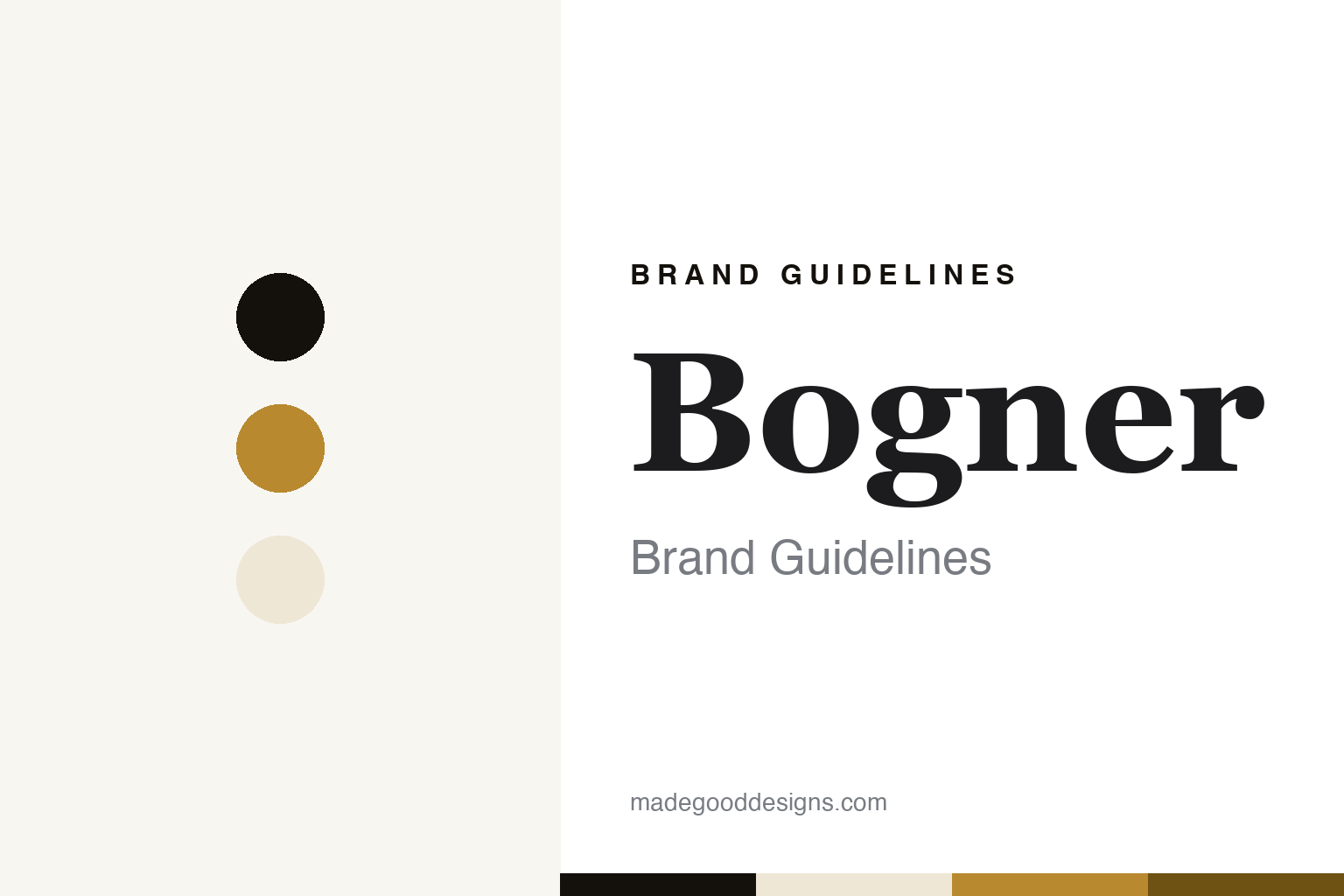
Bogner Brand Guidelines
The German amp doctor who built the Ecstasy in Los Angeles.
Aa
Two constants: a Bogner black and plexi gold palette and a Classic serif register. Abstract homage — not a Bogner product or mark; no amplifier, logo or nameplate is reproduced.
The amp doctor
A Marshall, $600 and a bus to North Hollywood.
Reinhold Bogner began building amplifiers as a teenager in Germany because he could not afford to buy one, LA Weekly reported in a 2017 profile. His father was an engineer who collected old tube radios, and the young Bogner built his first amp from parts he found around the house, chasing the sounds of Rory Gallagher, Gary Moore and Angus Young. The company’s own biography, archived in 2015, names his home town as Ulm, in southern Germany, and says his father worked as an engineer for Telefunken.
Local players began bringing him their amplifiers to modify. In his early twenties, on the advice of the Kansas guitarist Rich Williams, he moved to Los Angeles in 1989 with a modified Marshall as a demonstration piece and about $600, LA Weekly said. The company says the amp was a heavily modified JCM 800 and that he took three city buses to Andy Brauer’s Studio Rentals in North Hollywood, a gear-rental business that supplied many of the city’s session and touring guitarists.
Brauer hired him to tweak amps. There Bogner worked on rigs for Billy Idol’s guitarist Steve Stevens, the session player Michael Landau and the producer Dave Jerden, who was then making Alice in Chains’ first album, Facelift. Jerry Cantrell’s tone on that record brought Bogner more work. Because he lacked the resources to build a whole amplifier, he first made preamps, the Triple Giant and the Fish; after Alice in Chains toured with Slayer, Anthrax and Megadeth on the Clash of the Titans tour, members of all three bands bought Fish preamps, according to LA Weekly.
Colour
Ecstasy, Überschall and Shiva.
As guitarists turned away from rack-mounted preamps, Bogner moved to complete amplifiers. His first amps were one-off custom builds, often based on 1960s Fender Showmans and even reusing their chassis, according to Wikipedia, which cites a 2012 Vintage Guitar article by Dave Hunter; buyers included Eddie Van Halen, Steve Stevens and Allan Holdsworth.
The first production model, the Ecstasy, took a year to develop and was released in 1992. It had three channels and many switchable options so that, in the words of the co-owner Jorg Dorschner, “everybody could customize their amp.” Early versions were the 100A and 100B and later the 101A and 101B: the “A” for American, with 6L6 power tubes, and the “B” for British, with EL34s. In 2009 the company marked what it called the 20th year of Bogner USA with a 20th Anniversary Ecstasy, which has a plexi front panel with a gold background; the company says it mainly uses German-made Wima capacitors in its circuits.
The heaviest model, the Überschall — German for “supersonic” — was not inspired by a star. LA Weekly reported that it came from a local Los Angeles guitarist, John Ziegler of the bands Volto! and Pigmy Love Circus, who kept asking for more bass and more gain. Bogner said the sound did not appeal to him at first, but the amp became popular with nu-metal players using drop tunings and with seven- and eight-string guitarists. As of 2023, Wikipedia lists three main amplifier lines: the Ecstasy, the Überschall and the vintage-inspired Shiva.
The company has also tried hybrids. LA Weekly noted a tube and solid-state model made with Line 6 and the Atma, a cabinet combining aluminium and wood. Its website, as archived in 2025, lists effects pedals including the Ecstasy Red and Blue, the Überschall, the La Grange, the Harlow and the Wessex.
Typography
Design and documentation.
Marshall and Fender are the amplifier names most guitarists know, but many smaller makers began with one or two engineers. Their histories are easier to check than their ownership: several are private companies that publish little about who holds them.
Germany has three of the makers in this guide. Hughes & Kettner was founded in Saarland in 1984 by the brothers Hans and Lothar Stamer and was based for decades in St. Wendel, Wikipedia says; since 1 May 2025 it has belonged to the retailer Thomann, the German magazine Gitarre & Bass reported. ENGL trades as ENGL Gerätebau GmbH from Tittmoning in Bavaria, according to its imprint, and says Edmund Engl founded it in 1983. Diezel, which Peter Diezel and Peter Stapfer started in Munich and which dates itself to 1992, now builds its amplifiers in Bad Steben, also in Bavaria, and calls itself “a small family business.”
Two are in Los Angeles. Bogner was founded there in 1989 by the German-born Reinhold Bogner, and Friedman in 2008 by Dave Friedman, who in 2014 signed a deal with Boutique Amps Distribution to build and distribute his amps, English Wikipedia says.
Two are English. Laney, founded by Lyndon Laney in 1967, is owned by Headstock Group, a family-owned company in the Black Country, Headstock says. Blackstar, launched in 2007 by four former Marshall engineers, is based in Northampton; the UK companies register lists two founders as each holding over a quarter of its parent group.
This guide sets out what can be checked about each brand — who founded it, who owns it, and what it says about where its products are made — and marks clearly what rests only on the company’s own word.
Aa
A classic serif for an old-world amp builder. (Specimen set in Playfair Display, a serif STAND-IN; NOT the Bogner logo.)
Bogner
Two friends from Ulm, still independent.
Bogner Amplification has two partners. The company says Reinhold Bogner and Jorg Dorschner met as boys in Ulm, that Dorschner followed him to Los Angeles in 1991 to study at the Guitar Institute of Technology, lived in his house in exchange for building amplifiers, and became an official partner in 1997; it says Dorschner oversees production and business affairs. LA Weekly described him in 2017 as a co-owner.
That profile called Bogner “still a small company that builds amps by hand in North Hollywood,” said it did not advertise heavily or offer endorsement deals, and said it had “never sold out to a bigger manufacturer.” We found no later report of a sale in the sources we checked. Distribution is another matter: the website of Boutique Amps Distribution, a company in Los Angeles County, listed Bogner among the brands it served as “exclusive worldwide distributors” in an archived capture from May 2014, and has listed “Bogner Effects” since 2015. The same distributor builds and distributes Friedman amplifiers.
The name is a trap. Bogner is also a German sports-fashion house, founded in 1932 and built up by the Bogner skiing family, which trades at bogner.com and has no connection with the amplifier company, whose website is bogneramplification.com. Asked by LA Weekly for a secret, Reinhold Bogner said: “If you ask me what’s the secret sauce, there isn’t any. It’s attention to detail.”
For a design guide, Bogner shows how a small workshop can make its founder’s name stand for a sound. Compare Friedman, another Los Angeles builder who started at Andy Brauer’s rental shop, and Marshall, whose amplifiers both men began by modifying. For this guide we use black, plexi gold and valve brown with a serif, an unofficial interpretation; no product or logo is reproduced.
Explore & save
Keep Bogner’s identity on hand — save it to a board in the Made Good inspiration library.
Bogner identity set
Pin the Bogner black and plexi gold palette and the Classic serif register to your own board.