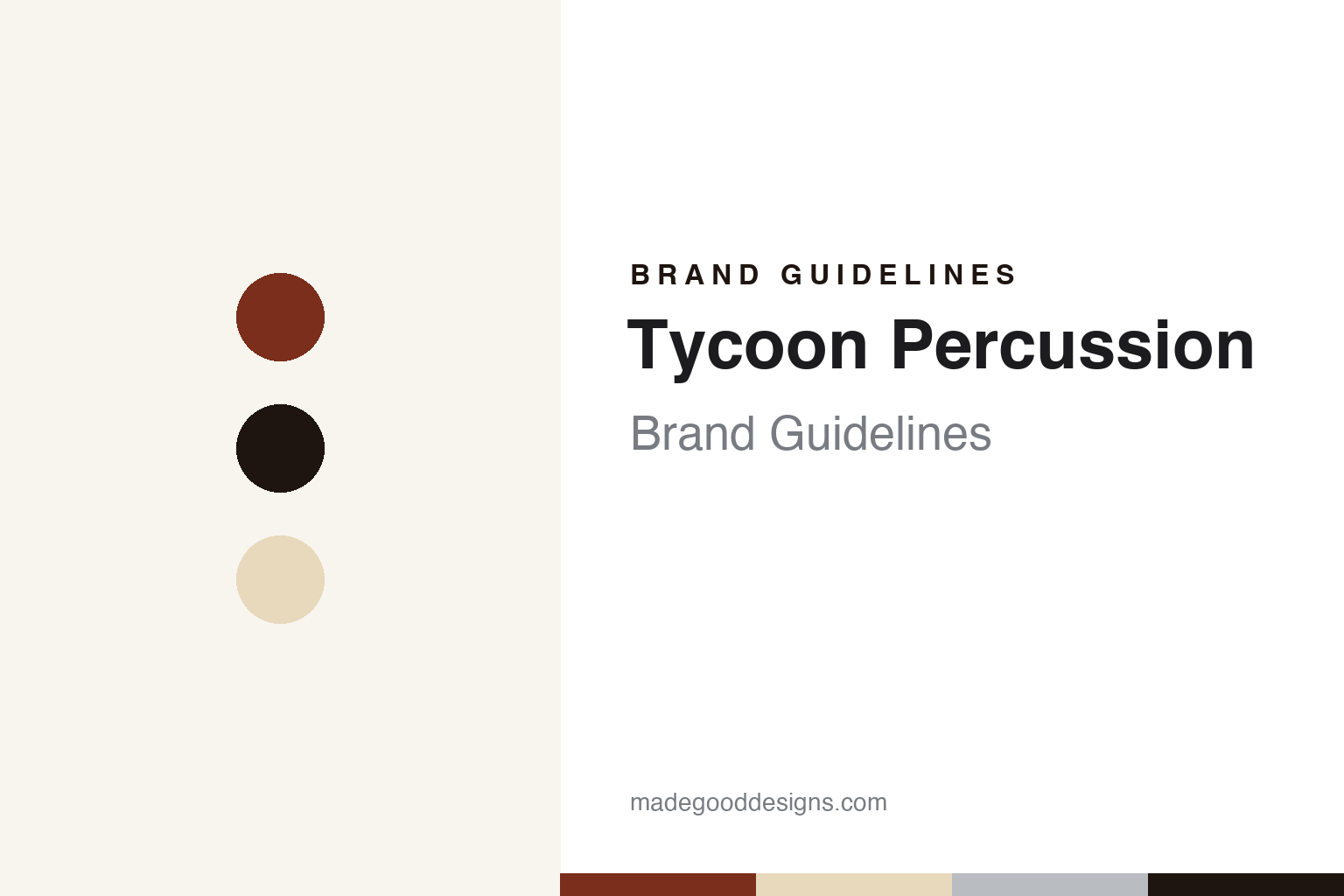
Tycoon Percussion Brand Guidelines
The Bangkok factory brand of congas and cajóns.
Aa
Two constants: a Siam red, rosewood and buffalo-skin palette and a grotesque sans register. Abstract homage — not a Tycoon Percussion product or mark; no instrument, logo or nameplate is reproduced.
Bangkok, 1983
From guitars to congas.
Tycoon Percussion is a Thai company. Its founder and president, Stephen Yu, is described on its website as “an avid musician from Hong Kong” who in the spring of 1983 gave up a career in commodities trading to start his own instrument company; Tycoon Music Company was founded later that year in Bangkok. Its headquarters and factory are in Bang Phli, in Samut Prakan province on the south-eastern edge of Bangkok, according to its contact page.
The company did not begin with drums. In a NAMM oral-history interview recorded in July 2006, Yu is described as having made “a long list of items, beginning with guitars, for a number of other companies,” and as having “pioneered conga making in Thailand before it was common and popular.” The company’s own history in 2010 said Tycoon Music was established as the first guitar factory in Thailand and made guitars on an OEM basis — under other companies’ brands — for markets in Europe, Asia and South America.
When the percussion business began depends on which account you read. Tycoon’s websites of 2006 and 2008 said Tycoon Percussion was “established in 1985,” the 2008 version adding that it first made hand percussion as an OEM supplier to “other well-known percussion brands”; NAMM’s summary dates the start of Yu’s own-name line to 1984; and the 2010 history said the company began making hand percussion on an OEM basis in 1996, after investing in research, machinery and training. The accounts agree that the drums were made for others first, and that the Tycoon Percussion brand grew until, in the company’s words, it “supplanted the company’s OEM business.”
Colour
Congas, cajóns and a catalogue of the world.
Congas and bongos are the core. The current catalogue runs from student models to the Master, Signature, Supremo and Supremo Select series, with finishes named Fantasy Siam, Terra Cotta, Café con Leche and Island Palm. The entry-level Supremo congas were launched for the American market in 2006, made, the company said, of aged Siam oak with buffalo-skin heads. Signature timbales carry the names of Ralph Irizarry and Robert Vilera.
Cajóns are the largest family: the company lists more than twenty lines. They include the Vertex, reviewed in the October 2011 issue of Modern Drummer; the Triple Play, with three distinct playing surfaces, which the magazine featured in January 2016; and the Roundback, Acrylic, Crate, Gig Box and Double Overhead Chamber designs. Beyond them sit djembes, a Dancing Drum signature series, Kalani’s World Rhythms educational collection, surdos, pandeiros, batá, talking drums, darbukas, frame drums, kanjira, Japanese nagado daiko, traditional Thai drums and, in a Serenity Sounds line, crystal singing bowls. Modern Drummer also covered its Hex-Jam shakers and fibreglass shekere in 2017.
Anniversaries mark the timeline. A 30th Anniversary Celebration Series of congas — American ash in a dark matte finish with white grain, with water-buffalo heads coloured black to match, in four sizes from 10 to 12½ inches, each with a matching stand — was made, the company says, to celebrate 30 years of manufacturing, and Tycoon’s news page points to a 2015 review in DRUM! magazine. A 40th Anniversary Celebration Series of congas, bongos, djembe and cajón has followed.
Typography
Hand percussion and the drum trade.
The seven brands in this group make the instruments that sit around the drum kit: hand drums, cajóns, frame drums, tambourines, concert percussion and drumheads.
Two are hand-drum makers. LP, or Latin Percussion, was founded in New York in 1964 by Martin Cohen; Drum Workshop bought it from Fender’s Kaman Music business in 2014–15, and Roland bought Drum Workshop in 2022. Tycoon Percussion says it was founded in Bangkok in 1983 by Stephen Yu, a musician from Hong Kong, and that it is family-owned and makes its instruments in its own Thai factory.
Two work mainly in wood. Schlagwerk says it began in 1982, when two carpentry apprentices, Gerhard Priel and Bengt Schumacher, copied a Brazilian slit drum, and that it makes its cajóns at Gingen an der Fils, Germany, though its cajón cymbals are hammered in Turkey. Cooperman says Patrick Cooperman began making drumsticks and fifes in Mount Vernon, New York, in the 1950s, and that it has worked from a former sawmill in Bellows Falls, Vermont, since 2006.
Three make tambourines, concert percussion and drumheads. Rhythm Tech grew from the crescent tambourine of the session drummer Richard Taninbaum, which it says it introduced in 1980; its website calls it a division of JAM USA. Black Swamp Percussion was founded by Eric Sooy in Bowling Green, Ohio, dates itself to 1995 and now works from Zeeland, Michigan, calling its instruments “USA made.” Aquarian, founded in 1980 by Roy Burns and Ron Marquez, has made drumheads since 1987 and is based in Anaheim, California.
This guide sets out what can be checked about each brand — who founded it, who owns it, and what it says about where its products are made — and marks clearly what rests only on the company’s own word.
Aa
A sturdy grotesque for a factory brand. (Specimen set in Archivo, a sans STAND-IN; NOT the Tycoon Percussion logo.)
Tycoon
“Made with heart. Played with heart.”
The brand’s central claim is about who makes the instruments. Tycoon says it is family owned and operated — Quincy Yu and Ivy Yu are listed as senior vice-president and general manager — and that it is the only hand-percussion brand that owns its own factory, a claim we could not check independently. Its website lists the Bang Phli site as “HQ & Manufacturing,” and it says it uses “only certified, renewable, plantation-farmed wood” and gives part of its sales to charities including Thailand’s Center for the Protection of Children’s Rights Foundation. Its slogan, on its websites since at least 2015, is “Made with heart. Played with heart.”
The United States was the market it set out to win. In June 2006 it set up Premium Sound, Inc., trading as Tycoon Percussion, in southern California, to handle American distribution and, according to its 2010 history, worldwide marketing, product development and artist relations. That year its website announced a distribution centre in Reno, Nevada, and an office in Pasadena, California, quoting Quincy Yu as general manager for U.S. operations; the American office later moved to Chino and Ontario. By 2008 it had named The Music Link as an American distribution partner and Gewa Music GmbH for most of Europe. Yu’s stated aim, quoted on its website, was “to propel the company to becoming the next elite hand percussion brand.” The current contact page lists only the Thai headquarters.
For a design guide, Tycoon Percussion shows how a contract manufacturer can turn its own factory into the brand story. Compare Meinl, the German cymbal and percussion maker, and Latin Percussion, the American conga brand. For this guide we use Siam red, rosewood brown and buffalo-skin cream with a sans, an unofficial interpretation; no product or logo is reproduced.
Explore & save
Keep Tycoon Percussion’s identity on hand — save it to a board in the Made Good inspiration library.
Tycoon Percussion identity set
Pin the Tycoon Siam red, rosewood and buffalo-skin palette and the grotesque sans register to your own board.