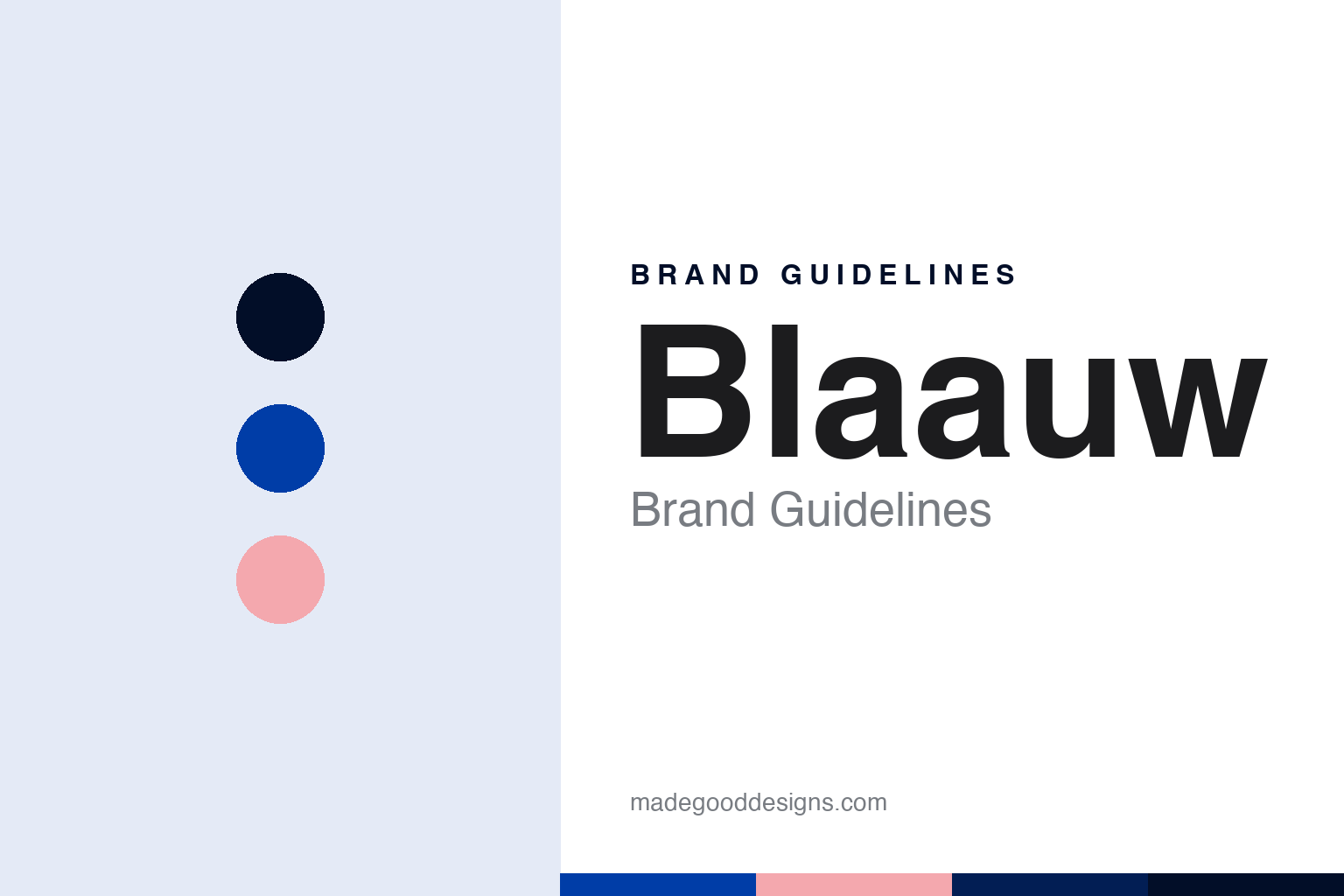
Blaauw Brand Guidelines
A ceramist’s kiln company, built near Amsterdam.
Aa
Two constants: a Blaauw-blue palette and a Dutch modern sans register. Abstract homage — not a Blaauw product or mark; no kiln or logo is reproduced.
A ceramist who built kilns
Blaauw began, like several kiln makers in this series, with a potter who needed a better kiln.
Blaauw says it has been “innovating and redefining kilns & furnaces” since 1978. The corporate advisers on its later sale describe it as having been “founded in the late 1970s by ceramist Gerard Blaauw.” That places it in a familiar pattern for this series: the maker who started as a user, and built the kiln it could not buy. Our guide to Bailey, the New York maker founded by an art-school potter, tells a version of the same story.
The company today is Blaauw Products B.V., registered at the Dutch Chamber of Commerce under number 34106316, and its registered trade names show how far it has spread beyond the studio kiln: Blaauw Kilns, Blaauw Furnaces, Blaauw Controls, Blaauw Industrial, Blaauw Projects and Blaauw Combustion Engineering. Its registered purpose, in Dutch, is het ontwerpen en produceren van ovens en besturingen — designing and producing kilns and controls for the ceramic industry and for the glass and coating industries. It files its balance sheets regularly; the most recent we saw covered 2024.
Its range now runs from studio gas and electric kilns, glass-melting and bronze-melting furnaces to industrial reduction kilns, dryers, annealing ovens, gradient kilns and thermal oxidisers. Its homepage says: “For more than 40 years Blaauw Kilns produce kilns and dryers… custom-built.”
Colour
A new owner, by 2021 — and a factory that is near Amsterdam, rather than in it.
Ownership has changed. A client story published in November 2021 by the Dutch corporate-finance firm Hoek en Blok, which advised on the deal, says Rob van Erven took over Blaauw, financed by a bank and “an informal investor,” under a shareholders’ agreement. The story does not give the year of the deal, so we say only that it had happened by 2021. We found no insolvency in the free register data we could read.
The origin wording is precise, with one wrinkle. Blaauw’s about page says: “We manufacture your kiln completely indoors at our factory in Amsterdam.” Its registered and contact address, though, is on the Haarlemmerstraatweg in Halfweg — a village between Amsterdam and Haarlem that lies outside the city of Amsterdam itself. It is a small geographical shorthand, the kind every company near a famous city uses; we note it because this series is about where things are really made, and here the answer is “near Amsterdam,” in a building it describes as its factory.
The same adviser’s story says that about twenty kilns are made to measure — a figure it gives without saying over what period, so we give it as written. Blaauw’s philosophy line is three words: “Think, Design, Make.” The order is the point.
Typography
Royal potteries in the Netherlands, a university in Kansas, a tableware maker in North Carolina.
Blaauw’s customers show what its kilns are for. In November 2020 it announced two large electric kilns, with zone control, forced cooling and guillotine doors, for Royal Tichelaar Makkum, the Frisian pottery; its sale advisers also name Royal Delft — De Koninklijke Porceleyne Fles — as a client. A Dutch kiln maker supplying two of the Netherlands’ celebrated historic potteries is a strong credential.
Its kilns travel. In 2017 the Wichita State University student newspaper reported that three Blaauw kilns had been installed in the university’s Henrion Hall after a $150,000 fundraising effort, and that they had been “shipped… by boat.” The North Carolina tableware company East Fork described the arrival of its own Blaauw kiln, “from The Netherlands, where they are manufactured,” installed by Blaauw’s own technicians, Guido Strijbos and Jeff Chown, and offered the most memorable line about the brand: “the wood kiln is like a Conestoga wagon; the Blaauw, a Tesla.”
That comparison is the identity in a sentence — a modern, engineered, electronically controlled kiln set against a centuries-old way of firing. It is also a reminder of what a modern kiln has to manage: the fumes and dust of the pottery studio, which are the subject of this round’s regulatory thread. However advanced the kiln, the clay that goes into it is still, in part, silica.
Across the North Sea, the British regulator’s guidance is unusually specific. The Health and Safety Executive’s “COSHH essentials in ceramics” series sets out good practice for each dusty task in a ceramics works, and one sheet is devoted to kiln loading and unloading. Other sheets cover glaze preparation, casting, dry fettling and glaze spraying. Its table of silica content is sobering: “slip, glazes, colours 10% to 60%”; “ball clay 15% to 30%”; “silica flour, cristobalite flour 100%.” And it warns that “Resuspension of dust containing RCS from surfaces, including from clothing, is a significant source of exposure even after the task has been completed, so cleaning and housekeeping are important.” The British workplace limit for respirable crystalline silica is 0.1 milligrams per cubic metre over eight hours — twice the American limit — and the HSE lists “potteries, ceramics, ceramic glaze manufacture, brick and tile manufacture” among the industries where workers are exposed. A kiln maker can engineer its own product; the dust in the room is the studio’s to manage.
Aa
A clean Dutch modern sans — geometric, precise, at home on a control panel. (Specimen set in Manrope, a sans STAND-IN; NOT the Blaauw logo or products.)
A B in a red square
Blue, red and a spaced-out name.
Blaauw’s logo, as it appears on its site, places a blue B inside a red square outline, beside the name spelled out in widely spaced capitals — B L A A U W — in blue, with the L picked out in red. It is a crisp, slightly technical mark, closer to an engineering firm’s than a craft studio’s, and it suits a company that now sells controls and combustion engineering as well as kilns. The name helps: blauw is Dutch for blue, and the founder’s surname happens to name the brand’s main colour. Few kiln makers get a palette for free with the family name.
Its lines are confident: “The expert in the field of kilns,” and “We change the way you think about kilns and furnaces.” Read beside the Conestoga-and-Tesla line from a customer, they describe a brand that sells modernity to potters.
For this guide we use a Blaauw blue and a soft signal tone with a clean modern sans. The blue is close to the logo’s own; the values are our interpretation, and nothing of the logo is reproduced.
Explore & save
Keep Blaauw’s identity on hand — save it to a board in the Made Good inspiration library.
Blaauw identity set
Pin the Blaauw-blue palette and the Dutch-modern register to your own board.