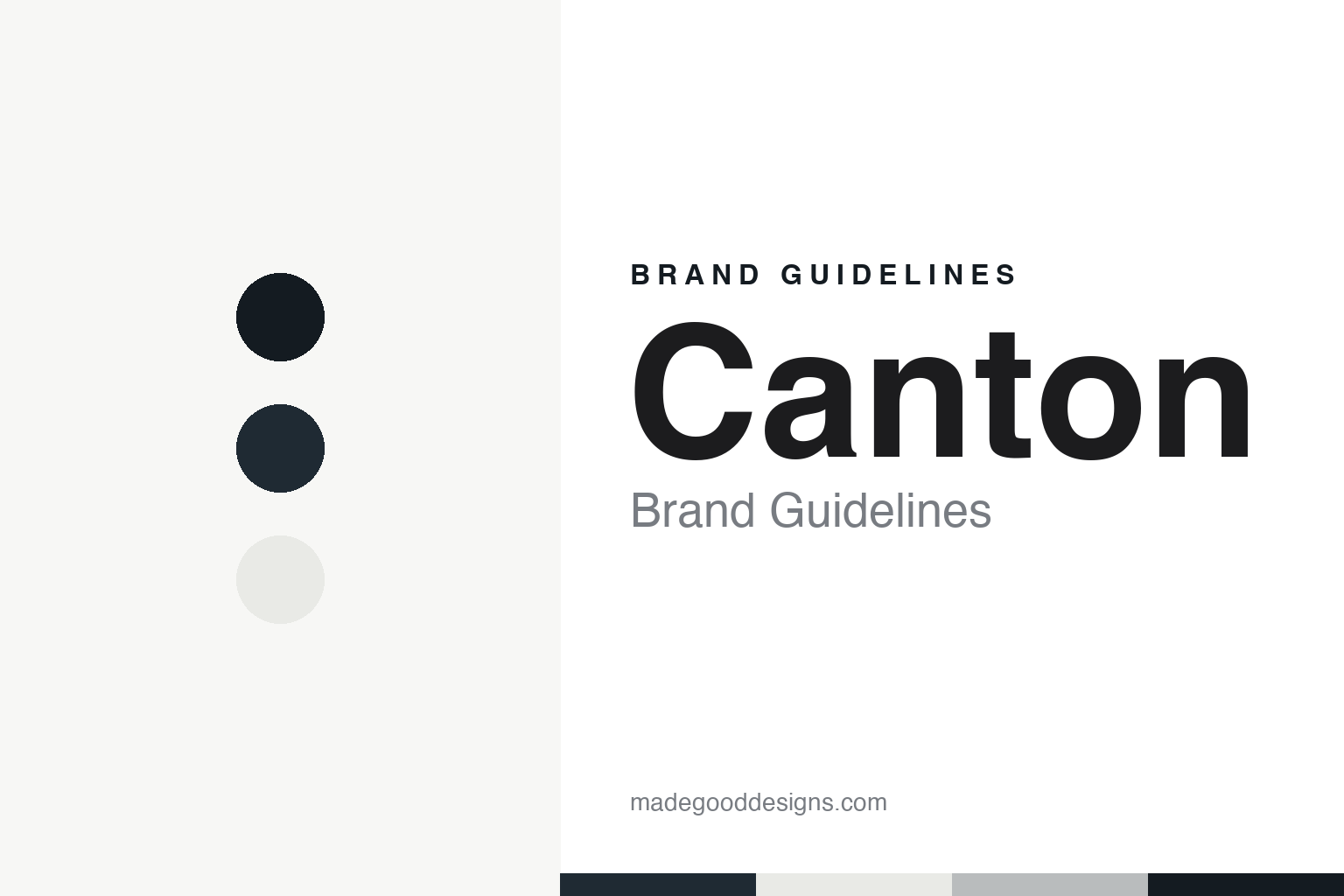
Canton Brand Guidelines
The Taunus speaker maker that began in a village school.
Aa
Two constants: a Canton slate, aluminium and white palette and a crescendo sans register. Abstract homage — not a Canton product or mark; no speaker, logo or nameplate is reproduced.
The village school
Four partners and a former schoolhouse in the Taunus.
Canton was founded in October 1972 in Niederlauken, a village in the municipality of Weilrod in the Taunus hills, about 35 kilometres north-west of Frankfurt. German Wikipedia names four founders, each with a role: Hubert Milbers in management, Otfried Sandig in marketing and sales, Wolfgang Seikritt in development and Günther Seitz in technical direction. The hi-fi site Lowbeats, in a 50th-anniversary history published in January 2023, gives the start date as 17 October 1972 and says the company moved into Niederlauken’s former village school, which had fallen empty when Hesse began busing pupils to a central school.
Seitz and Seikritt had met at Heco, another loudspeaker maker in the same district, and left when Heco was sold after its founder’s death, Lowbeats says. It reports that Canton started with 36 employees, eight of them from Heco, and sold 24,000 speakers in its first year — figures that come from the company’s own telling.
The name is a compound: Latin cantare, “to sing,” and the German Ton, “sound.” “I just knew Latin,” Seitz told Lowbeats. The first model, the compact LE 250, went on sale in 1973; Lowbeats notes that “LE,” for Lautsprechereinheit or “speaker unit,” was a term Braun had coined.
Colour
From the LE 250 to the Digital 1.
Canton built compact boxes first. Its first floor-standing speaker, the Ergo, arrived in 1979, followed in 1980 by a subwoofer-and-satellite system, German Wikipedia says. In the 1980s came the Quinto range, titanium dome tweeters, the Pullman car-audio speakers of 1983 and, in 1986, the EC-P1 preamplifier for active speakers, whose circuit, Lowbeats says, came from mbl of Berlin.
In 1995 Canton introduced the Digital 1, which German Wikipedia calls the first commercially available digitally equalised loudspeaker; it won a European Audio Award for audio innovation. Later lines include the coloured plastic POPsmarts of 1999, the aluminium-cased CD series of 2003, the Vento range of 2005, placed above the long-running Karat, and the Reference series of 2009. The DM 90.3 was named European Soundbar 2015–2016 by EISA. Canton developed a premium sound system offered on Škoda’s Superb and Octavia from 2013, and since the 2020–21 season has been the audio partner of the football club Eintracht Frankfurt.
Lowbeats names the developers behind the sound: Klaus Dotter from 1981 to 1989, Horst Heyder, who led work on the Digital 1, and Frank Göbl, chief developer since the late 1990s. In 2025 the magazine fairaudio reported that his team was working on diamond-coated midrange cones.
Typography
Germany’s speaker makers.
Germany has a long record in consumer audio. Braun, founded in 1921 and now part of Procter & Gamble, is known for its design of the 1960s to the 1980s, English Wikipedia says; Grundig, founded by Max Grundig in 1945 and based for most of its life in Fürth, became a leading maker of radios and televisions before filing for insolvency in 2003.
For more than two decades the hi-fi trade met at the HIGH END show in Munich, run by the HIGH END SOCIETY. In September 2024 the society announced that the show would leave Munich’s MOC, audioXpress reported, and in June 2026 it opened for the first time at the Austria Center Vienna, with about 23,100 visitors, according to sempre-audio.at.
German magazines such as STEREO, stereoplay, AUDIO and FIDELITY review the country’s hi-fi equipment.
Some makers sell direct rather than through dealers. Teufel, founded in Berlin in 1979, switched in 1990 from specialist retailers to direct sales by catalogue, English Wikipedia says, and Nubert describes itself on its website as a direct seller, a “Direktvertrieb.”
The makers in this guide are spread across the country: MBL and Teufel in Berlin, T+A in Herford in Westphalia, Canton at Weilrod in the Taunus, Quadral at Isernhagen near Hanover, Nubert in Schwäbisch Gmünd and Audio Physic in Brilon in the Sauerland, according to the legal notices on their websites.
This guide sets out what can be checked about each brand — who founded it, who owns it, and what it says about where its products are made — and marks clearly what rests only on the company’s own word.
Aa
A heavy, stepped sans — after a logo built like a crescendo. (Specimen set in Archivo, a sans STAND-IN; NOT the Canton logo.)
Canton
A logo that gets louder from left to right.
The Canton logo is unusually well explained. German Wikipedia says it is derived from an acoustic wavefront: the lettering thickens from left to right to suggest rising volume, a crescendo, and the gap between the N and the T stands for stereo. Lowbeats says the logo was designed in 1973, is still in use and was drawn so it could be set horizontally or vertically. No official colour values or typeface are published.
The company is still family-run. Seikritt and Milbers left early, Lowbeats says; Seitz ran Canton with Sandig until Sandig left in 1999, then alone until 2019, when Christoph Kraus, a former investment banker and Seitz’s son-in-law, became chief executive. In April 2025 fairaudio reported that the shares were held within the family by Günther Seitz, Achim Seitz, Oliver Hennel and Christoph Kraus and were “not for sale.” German Wikipedia calls Canton the largest German hi-fi loudspeaker maker, without a source; we have not been able to check that.
On manufacturing, Canton says its products are made mainly at its Weilrod headquarters, which handles its upper ranges such as Reference, Vento and Townus, and at a plant near Tachov in the Czech Republic, which makes series such as GLE. Press visits add detail. Lowbeats reported in 2023 that the Czech plant, in the village of Dlouhý Újezd, was set up a little over 20 years earlier and makes drivers, crossovers and other parts, and that Canton’s cheaper series are made in China and checked in Niederlauken before sale. fairaudio counted 120 staff in 2025, 80 in the Taunus and 40 in the Czech Republic. Larger cabinets come from the furniture maker Roterring in Münsterland, which also builds cabinets for T+A and Nubert, according to i-fidelity in 2018.
For a design guide, Canton shows how a logo can carry an idea — sound getting louder — for more than 50 years. Compare Nubert, whose cabinets come from the same workshop, and mbl, which supplied a Canton preamplifier circuit. For this guide we use slate, aluminium grey and white with a sans, an unofficial interpretation; no product or logo is reproduced.
Explore & save
Keep Canton’s identity on hand — save it to a board in the Made Good inspiration library.
Canton identity set
Pin the Canton slate, aluminium and white palette and the crescendo sans register to your own board.