Nubert Brand Guidelines
The Swabian garage speaker maker that skipped the dealers.
Aa
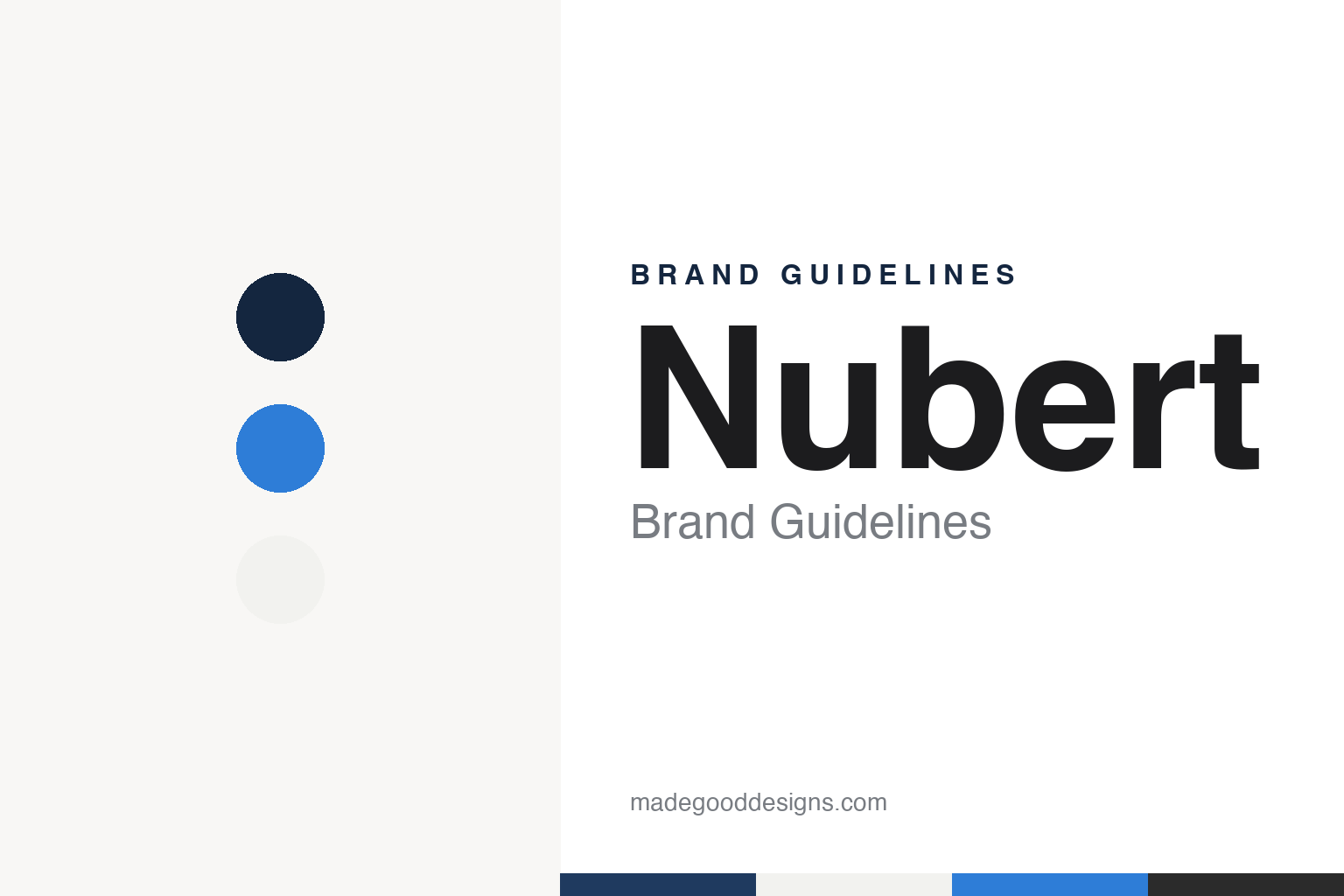
Two constants: a navy, graphite and signal-blue palette and a plain geometric sans register. Abstract homage — not a Nubert product or mark; no speaker, logo or nameplate is reproduced.
The garage in Gmünd
A student, a soldering iron and his mother’s garage.
Nubert began in a garage in Schwäbisch Gmünd, east of Stuttgart. Günther Nubert, born in 1949 according to German Wikipedia, studied electrical engineering in Stuttgart; Die Zeit reported in 2003 that he set up his own firm after his intermediate exams, then left university to build made-to-measure speakers for local hi-fi fans, working about 100 hours a week. LowBeats gives the date on which Nubert electronic GmbH was formed as 10 January 1975, and quotes the founder calling it the “legalisation of a state of affairs.” The trade site AREA DVD, in a 2020 company history, says his first models, the 388, 471 and 551, were built in his mother’s garage.
The business grew as a shop as much as a speaker maker. AREA DVD says the first “nubert HiFi studio” opened at Goethestraße 59 in Gmünd in 1977, followed by branches in Ellwangen in 1979 and Aalen in 1983, selling televisions, car stereos and home computers alongside Nubert’s own speakers, which were then built by hand on site, crossovers included. An early customer, Roland Spiegler, ran the Ellwangen branch and became the commercial partner; Die Zeit says he first sold Nubert speakers on commission through notices at the university. Spiegler led marketing until 2020, stereo reported. Die Zeit also reported that the jazz pianist Wolfgang Dauner, the composer Klaus Doldinger and sound engineers at the Südwestfunk broadcaster bought Nubert speakers.
Colour
Direct, by parcel.
The turning point was a sales model. Magazines would not test speakers without national distribution, and dealers would not stock them without tests, Die Zeit explained; so in 1996 Nubert began shipping nationwide, direct to customers. That March stereoplay tested a Nubert speaker for the first time and rated it “Spitzenklasse,” top class. Sales, which Die Zeit put at €300,000 in 1996, grew by an average of 40 per cent a year to 2001 in a shrinking hi-fi market and were expected to reach €5.3 million in 2002, when the firm had 18 staff and sold about 15,000 speakers a year.
The range is still sold the same way: online and in the company’s own stores, now in Schwäbisch Gmünd and Duisburg after the Aalen shop closed in 2020, according to German Wikipedia and regional press. The lower-case “nu” names run through the catalogue: the nuBox line dates from 1994, according to AREA DVD, followed by nuLine, nuVero, nuPro active speakers from 2011, soundbars, and the nuConnect ampX amplifier of 2019. In September 2025 Nubert announced the third generation of its flagship line, the nuVero nova, FIDELITY and LowBeats reported.
Design recognition came early. The nuForm 60 and nuForm 90 of 1994 and 1995, the first Nubert models with a deliberately styled exterior, won awards from iF in Hanover and the Chicago Athenaeum’s Good Design programme, AREA DVD says; German Wikipedia lists Red Dot awards from 2007, and iF and Red Dot awards for the nuControl and nuPower D amplifiers in 2016 and the nuPro speakers in 2019. In consumer testing, Stiftung Warentest placed the nuBox AS-225 soundbar first in 2020 and the nuPro AS-3500 first in 2022, according to German Wikipedia.
Typography
Design and documentation.
Germany has a long record in consumer audio. Braun, founded in 1921 and now part of Procter & Gamble, is known for its design of the 1960s to the 1980s, English Wikipedia says; Grundig, founded by Max Grundig in 1945 and based for most of its life in Fürth, became a leading maker of radios and televisions before filing for insolvency in 2003.
For more than two decades the hi-fi trade met at the HIGH END show in Munich, run by the HIGH END SOCIETY. In September 2024 the society announced that the show would leave Munich’s MOC, audioXpress reported, and in June 2026 it opened for the first time at the Austria Center Vienna, with about 23,100 visitors, according to sempre-audio.at.
German magazines such as STEREO, stereoplay, AUDIO and FIDELITY review the country’s hi-fi equipment.
Some makers sell direct rather than through dealers. Teufel, founded in Berlin in 1979, switched in 1990 from specialist retailers to direct sales by catalogue, English Wikipedia says, and Nubert describes itself on its website as a direct seller, a “Direktvertrieb.”
The makers in this guide are spread across the country: MBL and Teufel in Berlin, T+A in Herford in Westphalia, Canton at Weilrod in the Taunus, Quadral at Isernhagen near Hanover, Nubert in Schwäbisch Gmünd and Audio Physic in Brilon in the Sauerland, according to the legal notices on their websites.
This guide sets out what can be checked about each brand — who founded it, who owns it, and what it says about where its products are made — and marks clearly what rests only on the company’s own word.
Aa
A plain geometric sans for a brand of lower-case “nu” names. (Specimen set in Manrope, a sans STAND-IN; NOT the Nubert logo.)
Who builds a Nubert
Developed in Gmünd, built by others — for now.
Nubert says its engineers develop its speakers in Schwäbisch Gmünd; the building is another matter. As early as 2003, Die Zeit reported, most were made by two contract firms in Baden-Württemberg and North Rhine-Westphalia. On a 2017 visit to the company’s new headquarters, fairaudio found no production line: cabinets, and the assembly of the nuVero and nuLine speakers, were handled by the furniture maker Roterring in Ahaus, with the rest made in Poland and the Far East, something the magazine said the company did not hide. A 2021 fairaudio review placed the nuConnect ampX’s manufacture in Asia. In February 2025 the Schwäbische Post reported that Nubert planned to resume production in Gmünd, with “premium” speakers assembled by hand; we found no report confirming that the line had started.
The ownership story is simpler. The company register lists Nubert electronic GmbH at Nubertstraße 1 in Schwäbisch Gmünd, and the website names Günther Nubert and Daniel T. Schütze, previously finance chief at Burmester, as managing directors. Markus Pedal, named alongside them in January 2025, left the board in August 2025, according to register notices summarised by North Data. We found no report of an outside investor in the sources checked. Revenue was about €20 million in 2018, according to annual accounts cited by German Wikipedia, and the Schwäbische Post put the staff at more than 80 in 2025.
For a design guide, Nubert shows how a direct seller can build a brand on test results and plain, numbered product names. Compare Teufel, Berlin’s much larger direct seller, and Canton, whose cabinets German Wikipedia says also come from Roterring. For this guide we use navy, graphite and a signal blue with a sans, an unofficial interpretation; no product or logo is reproduced.
Explore & save
Keep Nubert’s identity on hand — save it to a board in the Made Good inspiration library.
Nubert identity set
Pin the Nubert navy, graphite and signal-blue palette and the plain geometric sans register to your own board.