Teufel Brand Guidelines
The West Berlin kit-speaker brand that learned to sell direct.
Aa
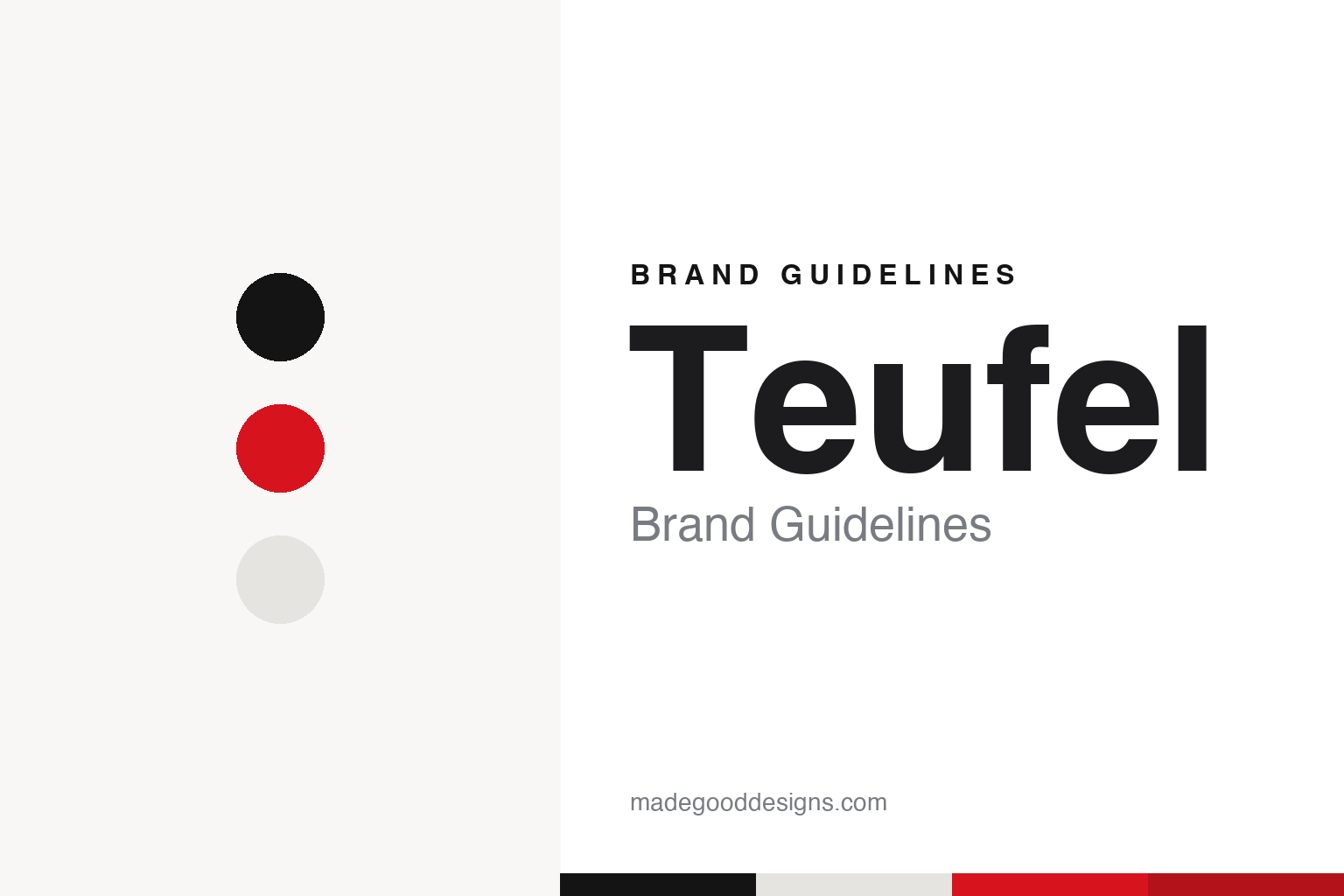
Two constants: a black, concrete and red palette and a heavy grotesque sans register. Abstract homage — not a Teufel product or mark; no speaker, logo or nameplate is reproduced.
Kits in West Berlin
A former law student and a box of parts.
Lautsprecher Teufel — Teufel is German for “devil” — was founded in West Berlin in 1979 by Peter Tschimmel, according to German and English Wikipedia and the company itself. A 1989 profile in the magazine HIFI VISION, reproduced by the hifimuseum.de archive, says he had studied law in Berlin and worked as a hi-fi dealer before offering kit speakers under the Teufel name in 1979. The first products were kits — ready-built crossovers, drivers and cabinet parts for customers to assemble — before the first finished speakers, the M 200 and its M 6000 subwoofer, according to German Wikipedia.
The decisive change was selling direct. Both Wikipedias date the switch from specialist dealers to direct sales by catalogue to 1990; in a 2025 interview LowBeats put it at 1989 and called Teufel the first German maker to take that step, so we give both dates. German Wikipedia also says, without citing a source, that the Theater 2 of 1995, launched as DVD arrived, was Europe’s first 5.1 home-cinema system with a subwoofer, a horizontal centre speaker and dipole rear speakers.
Colour
Three owners in twelve years.
Tschimmel sold the company to the private-equity firm Riverside, whose portfolio page gives the investment date as October 2006 and the exit as July 2010. Under Riverside, Private Equity Wire reported in July 2010, a new chief executive, Thorsten Reuber, took over, sales began in other European countries including the UK, revenue and earnings more than doubled and staff rose from 26 to 72. The buyer was HgCapital, the London investor, with management keeping a significant stake; Hg’s Justin von Simson cited Teufel’s “outsourced production” as part of the model. Revenue was then about €40 million, according to Hg; LowBeats gives €44 million.
Later in 2010 Teufel bought Raumfeld, a Berlin start-up founded in 2008 by Stephan Schulz and Michael Hirsch that had sold wireless multiroom audio systems since late 2009, rein-hoeren.de reported in December 2010; the High-Tech Gründerfonds, an early investor, dates its exit to October 2010. Raumfeld’s staff had joined Teufel by mid-November, and the brand was kept as a product line. In September 2014 the company moved its headquarters into the Bikini-Haus in Berlin, where it also opened a flagship store, and in January 2015 i-fidelity.net reported a new umbrella company for both brands, the Berlin Acoustics Group, under chief executive Edgar van Velzen. Teufel now says it has retired the Raumfeld name for new streaming products in favour of its Teufel Home range; its software team, “formerly Raumfeld,” still writes the apps, managing director Sascha Mallah told LowBeats in 2025.
On 30 April 2018 Hg announced the sale of Teufel to Naxicap Partners, the French private-equity affiliate of Natixis Investment Managers, which said on 4 May that it would become the majority shareholder. Hg said revenue had grown from about €40 million to more than €100 million during its ownership, with around 200 staff. Naxicap’s portfolio page still lists Teufel, with a 2018 initial investment, and we found no later sale reported in the sources checked.
Typography
Design and documentation.
Germany has a long record in consumer audio. Braun, founded in 1921 and now part of Procter & Gamble, is known for its design of the 1960s to the 1980s, English Wikipedia says; Grundig, founded by Max Grundig in 1945 and based for most of its life in Fürth, became a leading maker of radios and televisions before filing for insolvency in 2003.
For more than two decades the hi-fi trade met at the HIGH END show in Munich, run by the HIGH END SOCIETY. In September 2024 the society announced that the show would leave Munich’s MOC, audioXpress reported, and in June 2026 it opened for the first time at the Austria Center Vienna, with about 23,100 visitors, according to sempre-audio.at.
German magazines such as STEREO, stereoplay, AUDIO and FIDELITY review the country’s hi-fi equipment.
Some makers sell direct rather than through dealers. Teufel, founded in Berlin in 1979, switched in 1990 from specialist retailers to direct sales by catalogue, English Wikipedia says, and Nubert describes itself on its website as a direct seller, a “Direktvertrieb.”
The makers in this guide are spread across the country: MBL and Teufel in Berlin, T+A in Herford in Westphalia, Canton at Weilrod in the Taunus, Quadral at Isernhagen near Hanover, Nubert in Schwäbisch Gmünd and Audio Physic in Brilon in the Sauerland, according to the legal notices on their websites.
This guide sets out what can be checked about each brand — who founded it, who owns it, and what it says about where its products are made — and marks clearly what rests only on the company’s own word.
Aa
A heavy grotesque sans for a loud, plain-spoken brand. (Specimen set in Archivo, a sans STAND-IN; NOT the Teufel logo.)
Developed in Berlin
Designed at the Bikini-Haus, made in China.
Teufel describes itself as a developer of audio products, and the press fills in where they are made. German Wikipedia, citing Der Tagesspiegel in 2020, says manufacturing moved to China many years ago, and LowBeats reported in 2025 that about 50 of the company’s roughly 350 staff work in Dongguan; German Wikipedia describes that office as handling supply management and sales, and Teufel’s published accounts list a stake in Dongguan Teufel Trading Company, according to North Data. Development stays in Berlin: LowBeats counted eight acoustic engineers, ten product designers and about 20 app developers. Lautsprecher Teufel GmbH is registered at Budapester Straße 44, with Teufel Audio GmbH as its shareholder, according to North Data. Mallah, a managing director since 2016, put revenue at about €175 million in 2025, down from a peak of €200 million.
The range has moved from passive speakers to portables, headphones and soundbars. The company dates its Rockster party speaker to 2015, and Mallah called the Ultima 40, now in its fourth generation, Europe’s best-selling floorstanding speaker — his claim. In June 2024 Teufel and Fender launched three co-branded Rockster speakers, Hypebeast reported, and the Mynd portable, announced in 2024 and listed in May 2025, came with its design files published as open-source hardware, according to heise online and German Wikipedia.
For a design guide, Teufel shows how a kit-speaker brand turned a cheeky name into a mass-market direct seller. Compare Nubert, the other long-running German direct seller, and Sennheiser, another German audio brand with a large headphone business. For this guide we use black, concrete and a hot red with a sans, an unofficial interpretation; no product or logo is reproduced.
Explore & save
Keep Teufel’s identity on hand — save it to a board in the Made Good inspiration library.
Teufel identity set
Pin the Teufel black, concrete and red palette and the heavy grotesque sans register to your own board.