Albedo Audio Brand Guidelines
The Italian speaker maker that turned a physics problem into a product line.
Aa
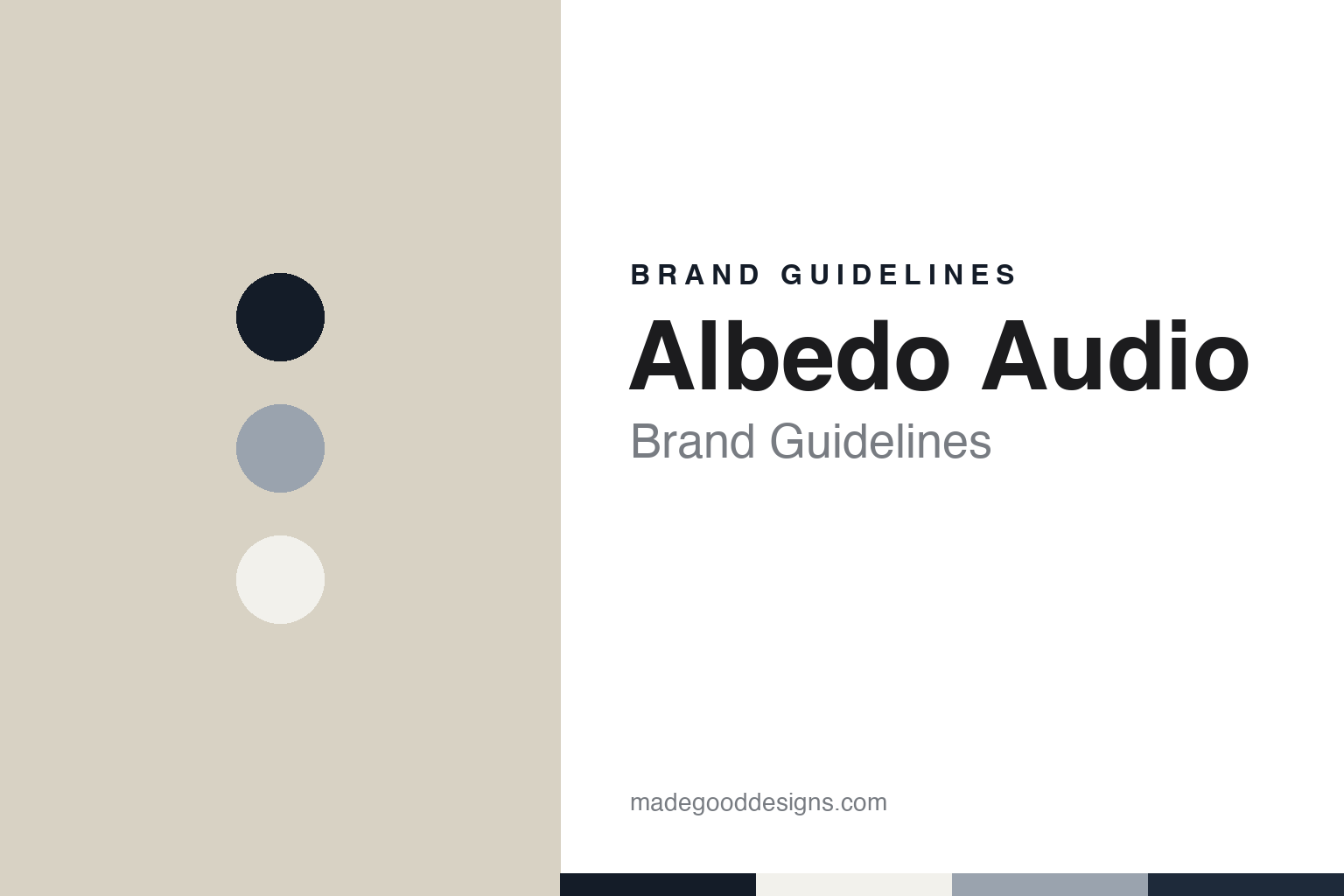
Two constants: an Albedo night-blue, white and grey palette and a geometric sans register. Abstract homage — not an Albedo Audio product or mark; no loudspeaker, logo or nameplate is reproduced.
A line of research
An editor, a physicist and a speaker called Albedo.
Albedo Audio began as a research partnership rather than a company. In the early 1990s, Positive Feedback reported in 2014, Massimo Costa, then editor-in-chief of the Italian do-it-yourself audio magazine Costruire Hi-Fi, and Giuseppe Pucacco, who holds a doctorate in physics from the University of Rome, “joined their forces” to study one of the oldest and least predictable ways of loading a bass driver: the transmission line, a long folded duct inside the cabinet that carries the rear output of the woofer.
The company says the pair worked out the mathematics of the line and wrote their own software “to model with great accuracy the behavior of any classical transmission line system.” The reviewer Srajan Ebaen, writing in 6moons, put it the same way: “Albedo wrote their own software simulation program to better predict the behaviour of their non-standard bass alignments.”
The first product came in 1995. According to the company and its New Zealand distributor, Critical Sound, it was a small two-way loudspeaker with a 4-inch driver, sold alongside a slim three-way model called Albireo, both with Morel drivers, and both introduced by another firm, Apex Audio, which sold them only in Italy. The two-way speaker was named Albedo. When Apex Audio was later dissolved, the distributor says, the designers formed a new company and took the speaker’s name for it.
The date of that new company is reported differently. Critical Sound says Albedo Audio was formed in 2008; Positive Feedback said in 2014 that the two did not form Albedo until 2009. We give both. The distributor adds that the HL1.2 and HL2.2 models appeared in 2009.
The name is astronomical. The company’s website explains that albedo, from the Latin for “whiteness,” is “the measure of the reflection of light from a planet” — a fitting word for a firm that talks mostly about accuracy.
Colour
Helmholtz resonators inside the line.
Albedo’s signature idea is a refinement of the classic transmission line. A line can produce unwanted peaks and dips as sound travels down the duct and out of its mouth. Albedo’s answer, according to the company, was to use Helmholtz resonators — small tuned cavities named after the 19th-century German physicist Hermann von Helmholtz — “to equalize the duct emission.” The company calls the result Helmholine. QuotidianoAudio, describing the HL 2.2 in January 2015, called it a “linea di trasmissione filtrata,” a filtered transmission line. In December 2025 the chief executive, Cristiano Bastianelli, described it to SoundStage! Australia as “a network of precisely tuned Helmholtz resonators, functioning as an acoustic filter embedded within the enclosure architecture.”
The range grew from the compact HL models to larger floor-standing designs. The distributor lists the Aptica, Amira, Axcentia, Alecta and Atesia; the company’s current list also includes the Achema, Alma, Agadia and Acclara — nearly every name beginning with an A. Later models moved to ceramic drivers from the German maker Accuton, which the distributor says were made to Albedo’s specification. The German magazine Fidelity, reviewing the Acclara Diamond SGS in April 2024, described a three-way speaker with three 7-inch ceramic woofers, a ceramic midrange and a diamond tweeter, weighing 140 kg each and priced at about €69,000 a pair. SoundStage! Australia described the Achema in 2025 as the first model of a new line.
The reviews have come mostly from specialist magazines outside Italy: Positive Feedback in the United States, 6moons, Fidelity in Germany and SoundStage! Australia.
Typography
Design and documentation.
Italian hi-fi has long been judged on looks as well as sound. In the 1960s the Milan maker Brionvega worked with designers such as Marco Zanuso and Richard Sapper; its Doney television won the Compasso d’Oro in 1962, and in 1970 the award went to the company itself, according to Italian Wikipedia.
The loudspeaker story usually begins with Sonus faber, founded by Franco Serblin in 1983 and based at Arcugnano, outside Vicenza. Serblin left in 2006; in 2007 the brand passed to the Fine Sounds group, renamed McIntosh Group in 2016, and in November 2024 Bose announced it was buying McIntosh Group, Sonus faber included.
Italian magazines such as Audio Review and Fedeltà del Suono review the country’s equipment, and makers launch products at shows in Milan and at HIGH END, held for many years in Munich and, from 2026, in Vienna.
The makers in this guide are spread out. Franco Serblin’s studio gives its home as Vicenza; Rosso Fiorentino is at Bagno a Ripoli, outside Florence; Albedo’s maker is at Montelabbate in the Marche; Zingali is at Aprilia, south of Rome; and Indiana Line, a Turin name since 1977, has been owned since 2020 by the Polish distributor Audio Klan, Italian trade press reports. Riviera Audio Laboratories is named for the Ligurian coast its founders call home but is registered at Pozzuoli, near Naples. Diesis Audio is in Umbria, at Castel Ritaldi near Spoleto, according to its website and business-registry summaries.
This guide sets out what can be checked about each brand — who founded it, who owns it, and what it says about where its products are made — and marks clearly what rests only on the company’s own word.
Aa
A geometric sans — the register of a firm that talks in formulas. (Specimen set in Jost, a sans STAND-IN; NOT the Albedo Audio logo.)
Albedo Audio
A speaker maker inside a furniture workshop.
Albedo Audio is a small company, and its home is less conventional than its name suggests. Its website and its reviewers give the same address: Via Pantanelli in Montelabbate, a town in the province of Pesaro and Urbino in the Marche, on Italy’s Adriatic side. The business behind the website is Music Tools & More srl, which company registers list under furniture manufacturing. Its sister brand, Music Tools, says it has designed and hand-made speaker stands, hi-fi furniture and accessories “since 1997.” Albedo, in other words, builds its loudspeakers alongside a maker of the furniture that hi-fi sits on.
The people have changed too. Fidelity reported in 2024 that Pucacco “has since left the company,” and named Cristiano Bastianelli as chief executive; the 6moons reviewer had earlier described him as Costa’s “business partner,” and SoundStage! Australia called him a co-founder in 2025.
On manufacturing, the claims are the company’s own. Its website carries the words “Made in Italy,” and SoundStage! Australia describes the speakers as “handcrafted in Italy” at the Montelabbate address. The drivers, however, are bought in: the ceramic and diamond units come from Accuton in Germany, as the company and its reviewers state openly. We could not find an independent account of how much of each speaker is built in-house, so we give the Italian-made claim as the company’s.
No logo history, typeface or brand colour is documented in the sources we checked. The firm’s mission statement is plain: “We design and produce loudspeaker systems whose sonic accuracy and precision are on duty for music reproduction.”
For a design guide, Albedo Audio shows how a narrow technical idea, pursued for three decades, can become a whole identity — down to a range in which nearly every model starts with the same letter. Compare Chario, another Italian loudspeaker maker built on its own acoustic theory, and Opera Loudspeakers. For this guide we use a night blue, a pale white and a lunar grey with a sans, an unofficial interpretation; no product or logo is reproduced.
Explore & save
Keep Albedo Audio’s identity on hand — save it to a board in the Made Good inspiration library.
Albedo Audio identity set
Pin the Albedo night-blue, white and grey palette and the geometric sans register to your own board.