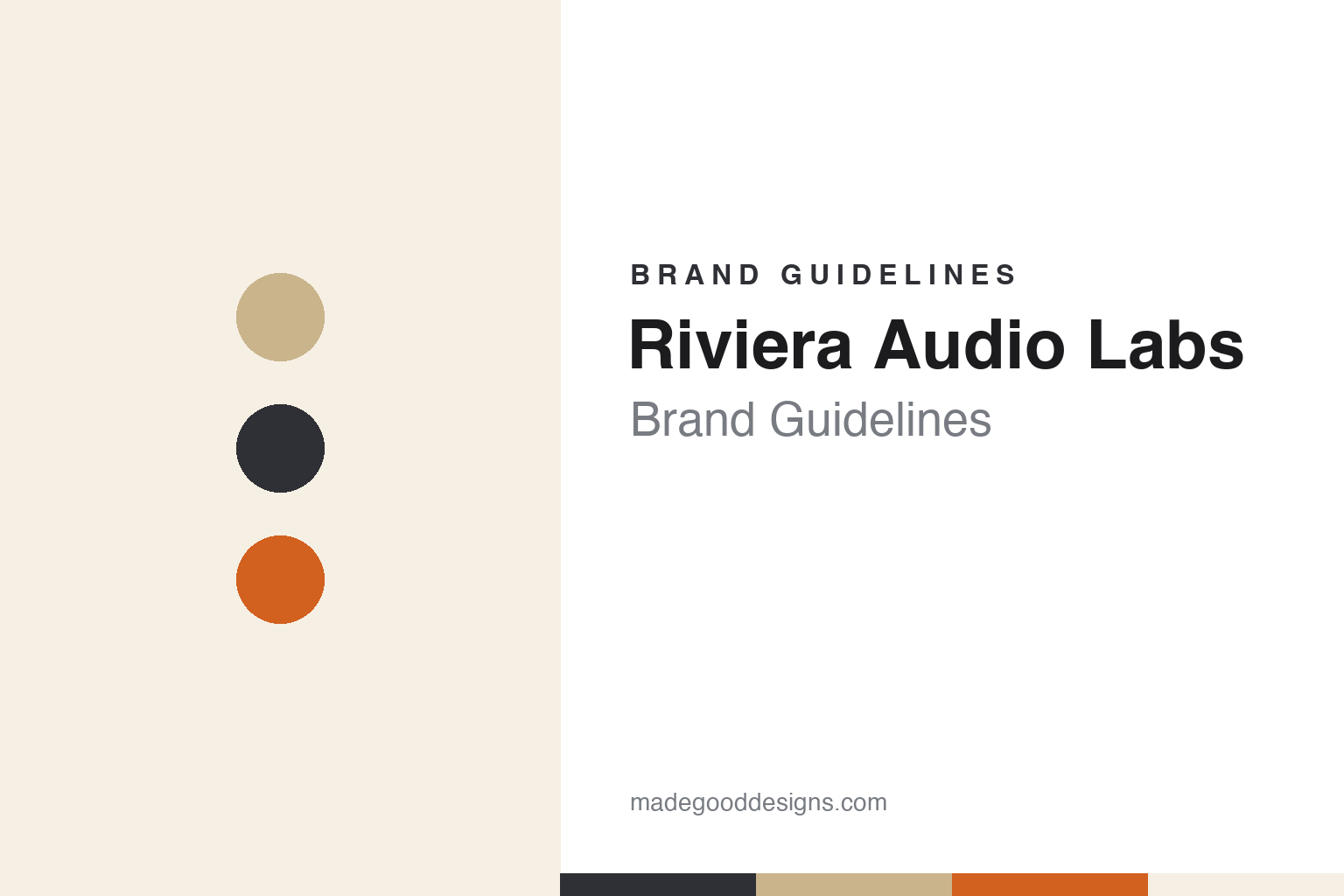
Riviera Audio Labs Brand Guidelines
The hybrid class-A amplifier maker named for the Italian Riviera.
Aa
Two constants: a sand, gold and dark-titanium palette and a geometric sans register. Abstract homage — not a Riviera product or mark; no amplifier, logo or faceplate is reproduced.
Two veterans
An engineer, a magazine man and a drive to Munich.
Riviera Audio Laboratories s.r.l. is a young company run by two men with long careers in Italian hi-fi. Its website says it was founded in January 2017; its Italian “about” page puts the decision “between 2016 and 2017.” The American writer Michael Lavorgna, reviewing for Twittering Machines in March 2021, gave the origin story as the founders tell it: after decades of talking about the amplifier they would build, they decided to do it on the drive from Italy to the High End show in Munich in 2016.
The two partners are Luca Chiomenti, the designer, and Silvio Delfino, who handles sales and public relations. The company’s biographies, which we give as its own account, say Chiomenti studied electronic engineering at the Politecnico di Milano and has worked as an audio designer since the early 1990s. They say he designed the analogue circuits of the Linea 2000 amplifiers when the Italian Galactron name was relaunched in 1993, wrote for Fedeltà del Suono and Costruire HiFi, where he was chief editor, founded his own custom-audio brand, Kiom, in 1999, and between 2004 and 2009 designed two lines of valve amplifiers for another engineer’s company, SAP.
Delfino’s path ran through distribution and publishing. The company says that in the 1980s he co-founded CSL Sound in San Diego to sell Sonus faber, Cabre and Chario loudspeakers in America, exhibiting at the Las Vegas CES in 1983; that back in Italy he worked on the magazines Stereoplay, Digital Audio Club and Suono between 1987 and 1991; and that he then founded Fedeltà del Suono with Gianfranco Maria Binari and directed it until 1998, before turning to consultancy. A third name, Marco Muzio, is credited for rendering and mechanical design.
Colour
A name from Liguria, an address near Naples.
The name needs a note. Delfino told Stereophile’s Herb Reichert, in a review published in January 2022, that “the name of our company Riviera came naturally, since both I and Luca were born and live on the Italian Riviera,” and that the Levante amplifier “was designed on the Riviera di Levante in front of Portofino Bay” — the eastern coast of Liguria. Levante is also the name of an easterly Mediterranean wind, which he said made the name sound right.
The paperwork points elsewhere. Business-registry summaries give the company’s registered office as Pozzuoli, in the province of Naples, on the other side of the country, and the contact block printed with Mono & Stereo’s review of the AFM-50 amplifiers in April 2018 gives the same town. Riviera’s own website lists no street address or factory, only email contacts. It promises “quality Italian manufacturing,” and Stereophile describes the Levante as made in Italy; we found no source that says who assembles the amplifiers, or where, so the place of manufacture rests on the company’s word.
The first products appeared quickly. By June 2017 the website listed two headphone amplifiers, the AIC-10 and AFC-10, the APV-01 line preamplifier, the AFM-50 power amplifier and the AIS-35 integrated, and showed galleries from the High End show in Munich and from Milano Hi-Fidelity that year.
The engineering idea behind them is unusual and stated plainly. The company describes “hybrid circuitry, with valves (triodes) for signal processing and solid state (BJT and Mosfets) for the power stage,” running in class A without global feedback. Chiomenti told Stereophile that an amplifier must be faithful “for the human ear, not for instruments,” and that any distortion it makes should have the same shape as the ear’s own, dominated by low-order harmonics.
Typography
Italian hi-fi and its makers.
Italian hi-fi has long been judged on looks as well as sound. In the 1960s the Milan maker Brionvega worked with designers such as Marco Zanuso and Richard Sapper; its Doney television won the Compasso d’Oro in 1962, and in 1970 the award went to the company itself, according to Italian Wikipedia.
The loudspeaker story usually begins with Sonus faber, founded by Franco Serblin in 1983 and based at Arcugnano, outside Vicenza. Serblin left in 2006; in 2007 the brand passed to the Fine Sounds group, renamed McIntosh Group in 2016, and in November 2024 Bose announced it was buying McIntosh Group, Sonus faber included.
Italian magazines such as Audio Review and Fedeltà del Suono review the country’s equipment, and makers launch products at shows in Milan and at HIGH END, held for many years in Munich and, from 2026, in Vienna.
The makers in this guide are spread out. Franco Serblin’s studio gives its home as Vicenza; Rosso Fiorentino is at Bagno a Ripoli, outside Florence; Albedo’s maker is at Montelabbate in the Marche; Zingali is at Aprilia, south of Rome; and Indiana Line, a Turin name since 1977, has been owned since 2020 by the Polish distributor Audio Klan, Italian trade press reports. Riviera Audio Laboratories is named for the Ligurian coast its founders call home but is registered at Pozzuoli, near Naples. Diesis Audio is in Umbria, at Castel Ritaldi near Spoleto, according to its website and business-registry summaries.
This guide sets out what can be checked about each brand — who founded it, who owns it, and what it says about where its products are made — and marks clearly what rests only on the company’s own word.
Aa
A geometric sans, in the spirit of the clean type on Riviera’s website. (Specimen set in Montserrat, a sans STAND-IN; NOT the Riviera logo.)
Levante
A tube front end, a MOSFET heart and a wind.
The product that brought Riviera wider attention is the Levante integrated amplifier. In Stereophile’s January 2022 review, Herb Reichert described a $16,500 hybrid with an ECC81/12AT7 twin-triode input stage and a power stage of six pairs of MOSFETs driven by bipolar transistors, switchable between 30 watts per channel in class A and 120 watts in a high-bias class AB. It weighed 66lb, and he wrote that no amplifier he had encountered, “not even at $250,000,” equalled it in fit and finish. John Atkinson’s measurements were more qualified: the magazine had to relax its definition of clipping to 3% distortion for the Levante to meet its rated power, and he found distortion of about 0.5% at moderate levels, almost all of it second harmonic, concluding that the amplifier would have “a distinctive sonic character.” The Levante was then listed in the 2022 edition of Stereophile’s Recommended Components. Lavorgna, in Twittering Machines, had called it in 2021 “the most seductive piece of hifi gear to spend time in the barn,” as he calls his listening room.
The current range, as listed on the website in 2026, runs from the AIC10Bal headphone amplifier through the APL01SE and APL1 preamplifiers to the AFM100SE and AFM70 power amplifiers, alongside the Levante. Every model comes in two finishes, which the company specifies: Gold, a glossy sand colour with 24-carat mirror-gold knobs and buttons, and Dark Titanium, a matte grey with matte aluminium controls. The website says a special edition of its APF01 phono preamplifier was presented at HIGH END in Vienna in 2026. It describes the company as the venture of its two partners; we found no record of an outside owner or acquisition in the sources we checked.
The visual identity beyond the hardware is undocumented. No brand standard or official colour is published; Riviera’s website pairs a cream background with near-black type and an orange accent, and its faceplates carry the gold-or-titanium choice. For a design guide, Riviera Audio Labs shows how a small maker can make a finish specification do the work of a brand book. Compare Audio Analogue, another Italian amplifier maker, and Unison Research, which also builds valve amplifiers. For this guide we use sand, gold, dark titanium and a Ligurian orange with a sans, an unofficial interpretation; no product or logo is reproduced.
Explore & save
Keep Riviera Audio Labs’s identity on hand — save it to a board in the Made Good inspiration library.
Riviera Audio Labs identity set
Pin the Riviera sand, gold and dark-titanium palette and the geometric sans register to your own board.