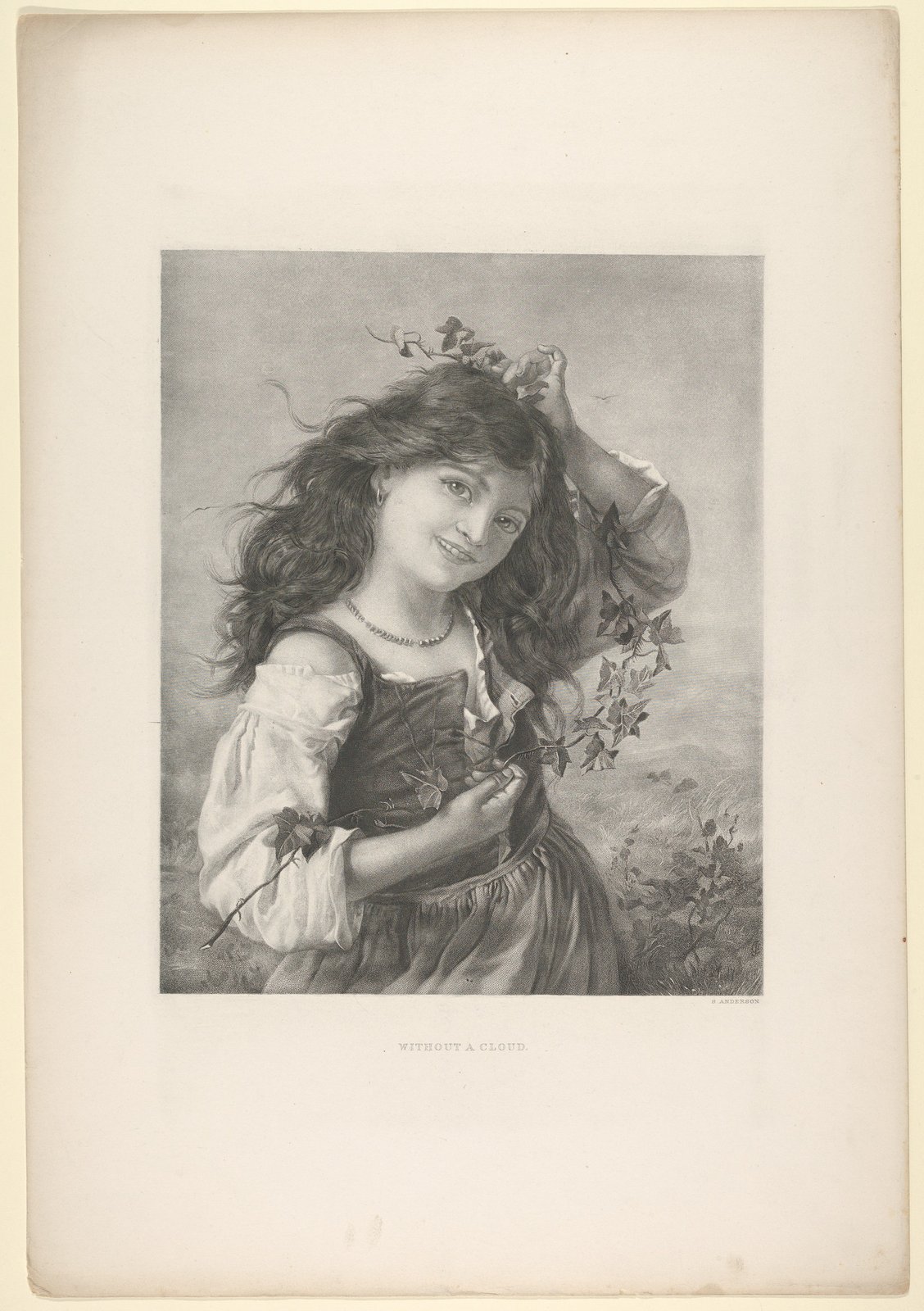
Sophie Anderson painted the kind of picture Victorian audiences hung in parlours and bought as prints: a child looking straight out of the frame, a few flowers, a soft landscape that fades behind the figure. The Metropolitan Museum of Art records her as British, born in Paris in 1823 and died in Falmouth in 1903, and holds a reproductive engraving of her painting Without a Cloud. That print, made by the engraver James John Chant, is the starting point for this guide.
What follows looks at her work with a designer’s eye: the compositions, how engraving translated paint into printed tone, a short career outline, and what you can borrow for illustration, packaging and editorial layouts. For more cleared images, browse the MGD museum inspiration collection.
Who was Sophie Anderson?
Museum and gallery records give her dates as 1823–1903. The Met lists her nationality as “British, born France” and names Paris and Falmouth as the places of her birth and death; Falmouth Art Gallery’s collection page lists her as Sophie Anderson (1823–1903). She is often catalogued under her full name, Sophie Gengembre Anderson, which is how the Foundling Museum and dealers such as Richard Green present her.
Gengembre was her family name. The Met also holds a small landscape drawing in graphite and brown ink, dated 1839, by Charles Antoine Colomb Hubert, born Gengembre (1790–1863), from an American scrapbook; biographical sources identify her father as an architect of that name.
Her career moved between countries. Biographical summaries, including AskART’s, record that the family left France for the United States around the 1848 revolution, that she worked in Cincinnati, and that she collaborated there with the British painter Walter Anderson, whom she married, on portraits of Protestant Episcopal bishops. The Foundling Museum describes her as an artist who lived and worked across France, America, England and Italy.
Key works and dates
1870, Elaine. Shown at the Royal Academy in London and acquired by Liverpool Corporation for the Walker Art Gallery in 1871. The Foundling Museum describes her as one of the earliest living women artists whose work a British public museum bought.
About 1877, Foundling Girls at Prayer in the Chapel. Oil on canvas, 67.3 by 53.3 centimetres, belonging to Coram and shown at the Foundling Museum in London. The museum notes that the hospital’s children attended chapel every day and twice on Sundays, with girls and boys seated apart.
After 1870, Without a Cloud. The Met’s mixed-method engraving after her painting, by James John Chant, with an image of 25 by 20.4 centimetres on a sheet of 43 by 29.7 centimetres.
1894, Falmouth. Falmouth Art Gallery records that she was a major exhibitor at the opening exhibition of the town’s first art gallery, in Grove Place, in 1894. In 2011 the Art Fund gave a still life by her, Roses, to Falmouth Art Gallery.
Many of her paintings are in private hands and appear mainly in sale catalogues, so this guide sticks to works with a public collection and a museum record.
What to look at in Sophie Anderson’s compositions
The close crop. In Without a Cloud, the girl fills most of the image from the waist up. Her head sits in the upper third, turned and tilted towards the viewer, and the frame cuts her skirt at the bottom edge. There is almost no room around her, which makes the picture feel personal and immediate. It is the same crop used on book covers and social posts today.
One gesture. Her raised arm, hand resting in her hair, makes a triangle with her head and shoulder. That one movement gives the figure energy and leads the eye from the face up through the ivy and back down the trailing stem in her other hand.
A soft background, a sharp face. The landscape behind her is a hazy field and pale sky, worked in fine, even tone; the face, the necklace and the ivy leaves carry the crispest detail. Contrast is saved for the area that matters.
Movement through hair and plants. The hair blows out to the left and the ivy trails right, so the picture reads as a moment of wind and light rather than a posed studio portrait. Natural props, flowers, leaves and sprigs, recur across her genre work and act like decorative borders inside the image.
Children as subject. The Foundling Museum painting groups girls of varied ages in their institution dress at prayer, according to the museum’s description. Where Without a Cloud is a single close figure, the chapel painting shows how she arranged a group around a shared activity.
Engraving: how her paintings reached print
Reproductive prints carried paintings to buyers who would never see the canvas. The Met catalogues Without a Cloud as a “mixed method engraving”, a term for plates that combine several intaglio techniques. Looking closely at the scan, the tones of the dress and background are built from fields of fine dots, a stipple-like texture, while outlines and the hair use finer lines. The engraver’s task was to translate colour and brushwork into a black-and-white system of dots and lines that could be printed many times.
The print also shows the standard lettering of a reproductive engraving. Below the image, at the right, the painter’s name appears in small capitals as “S. ANDERSON”; centred lower on the sheet, the title “WITHOUT A CLOUD.” is set in open, outlined capitals with a full stop. The large margin of plain paper around the image is part of the design, framing the picture like a mount. For the wider print culture of the period, see our guide to Victorian art, and our explainer on lithography, the other main printing method of the century.
Measured from the Met’s scan of this impression, the sheet’s paper sits around #F0E7D9, the main mid-tone of the printed image around #B6B0A6, and the darker passages near #69655D. These values describe the photograph of this impression, not the colours of the original painting, which is not in the museums cited here.
Sophie Anderson and her contemporaries
Anderson worked in London, Capri and Cornwall in the same decades that the Pre-Raphaelites and their followers were painting literary heroines and detailed natural settings. Most of her output, though, is genre painting: everyday scenes of children and young women in rural settings. If you want the movement context rather than a single artist, our guide to the Pre-Raphaelites covers the wider group.
Biographical summaries record that she and Walter Anderson lived on Capri from around 1871, for reasons of health, before settling in Falmouth in Cornwall, where she died in 1903. Falmouth Art Gallery holds her work today, and the gallery’s records of the 1894 exhibition show that she remained an active exhibitor late in life.
How designers can borrow Sophie Anderson’s ideas
Crop close and tilt the head. For a portrait illustration or a cover, place the face in the upper third, tilt it slightly, and let the frame cut the figure at the waist or below. The viewer reads the face first and feels near the subject.
Give the figure one clear gesture. A raised arm or a hand holding a sprig of leaves creates a line for the eye to follow. In packaging or character design, one decisive pose is easier to read at small sizes than several small actions.
Keep the background quiet. Use soft, low-contrast texture behind a sharply drawn face. In digital work, that might be a blurred photo, a grain texture or a gentle gradient, with the detail kept for the eyes and hands.
Borrow the print layout. The engraving’s generous margin, small artist credit at the right and centred title in outlined capitals form a simple, elegant template for art prints, posters and gallery labels. Set the title in a high-contrast serif capital with wide letter spacing to get a similar effect.
Work in a warm, limited palette. The paper and ink values above make a ready-made sepia scheme for editorial or heritage branding. Feed them into our colour palette generator and add one accent colour sparingly.
Frequently asked questions
Who was Sophie Anderson?
A French-born British painter (1823–1903) of genre scenes, especially children and young women, who worked in France, the United States, England and Italy and died in Falmouth, Cornwall.
What is Sophie Anderson’s painting Elaine?
An 1870 painting shown at the Royal Academy and bought for the Walker Art Gallery in Liverpool in 1871. The Foundling Museum notes this made her one of the earliest living women artists collected by a British public museum.
Are Sophie Anderson’s works in the public domain?
The Met flags its engraving after Without a Cloud as public domain, and that is the image used here. For other works, check each collection’s own record and licence before reuse.
Where can I see Sophie Anderson’s paintings?
Foundling Girls at Prayer in the Chapel is shown at the Foundling Museum in London, Elaine was bought for the Walker Art Gallery in Liverpool, and Falmouth Art Gallery holds work including the still life Roses.