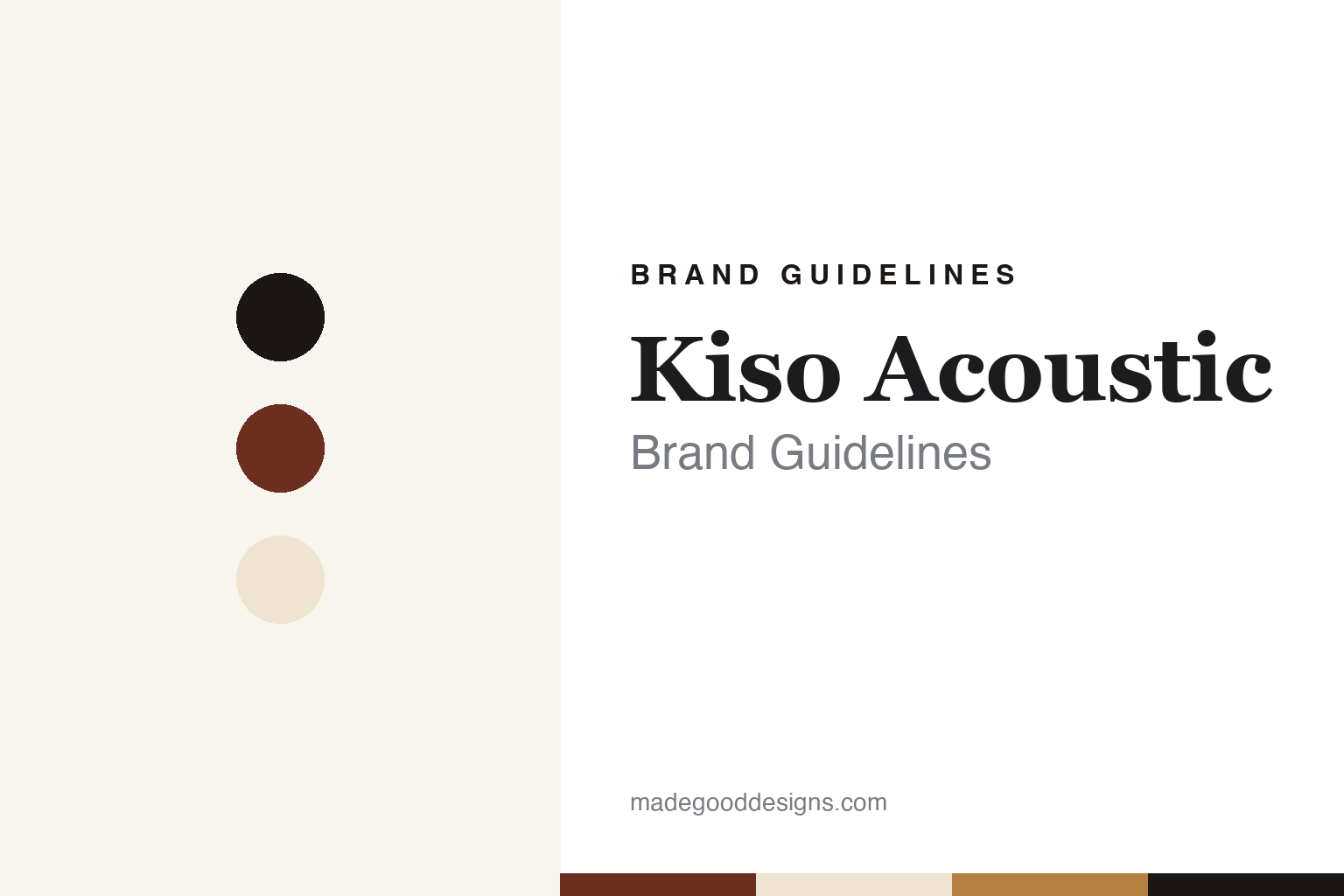
Kiso Acoustic Brand Guidelines
The speaker maker whose cabinets are built by a guitar factory.
Aa
Two constants: a Kiso mahogany, ebony and koa palette and a Luthier serif register. Abstract homage — not a Kiso Acoustic product or mark; no speaker, logo or nameplate is reproduced.
An audiophile and a guitar town
Toru Hara, Sakashita and the Kiso River.
Kiso Acoustic is a very small company with an unusual partner. Its own website gives its legal name as Kiso Acoustic Co., Ltd., says it was founded in June 2009, names Toru Hara as its representative director, and gives its address as Sakashita, in the city of Nakatsugawa, Gifu Prefecture. That corrects a common shorthand. The company is sometimes placed in Nagano, because the Kiso valley it is named after lies mostly in Nagano Prefecture. But its registered address, and the guitar factory that builds its cabinets, are on the Gifu side of the prefectural line.
Hara is not a former engineer from a large electronics group. In a statement on the company’s website, dated July 2009, he describes himself as an audio enthusiast of more than 50 years who has owned speaker systems from 1940s designs to modern high-end models, heard many live performances and taken part in recordings; he calls the HB-1 a speaker system “dedicated to the art of music.” The online magazine 6moons, reviewing the speaker in February 2011, called him a Japanese audiophile “with a legendary hardware collection,” and reported that Stig Bjørge, of the Lyra cartridge company, was a minority shareholder. We found no later source on the shareholding, so we give it as 6moons’ account at that date.
The idea came from an earlier project. Hara writes that he took part, as an observer on the guitar maker’s side, in the development of the Onkyo D-TK10, a “guitar acoustic” speaker made by Onkyo with Takamine and released in December 2005, and that it convinced him a speaker built like an acoustic instrument had real potential.
Colour
A cabinet built like a guitar.
The partner is Takamine Gakki, the guitar maker. Its company history says it began in December 1959 as Ozone Gakki and took the name Takamine in May 1962, after Mount Takamine, the symbol of Sakashita town; it is known especially for the electro-acoustic guitars it began selling in 1979. Takamine lists the Kiso speakers among its own “create project” products, and Kiso Acoustic says the cabinets’ materials, machining and finishing are all done by Takamine. Of the later HB-N1 it states plainly that the speaker is made at Takamine in Gifu Prefecture.
The HB-1 is a small two-way speaker, 313 millimetres tall and 4.5 kilograms, according to the company. Where most expensive speakers use thick, heavily braced boxes to kill resonance, the HB-1’s curved body is made of 2.5-millimetre solid mahogany, bent with steam, with 3.5-millimetre mahogany side panels carrying guitar-style braces. The company says there is no sound-absorbing material inside, as in an acoustic instrument. The tweeter sits in a horn carved from ebony; the 10-centimetre woofer is by Peerless, Kiso Acoustic says, and 6moons reported the tweeter as a Fostex unit. The crossover, built with Mundorf parts, sits not in the cabinet but in a laminated maple plinth. Every driver is measured and then pair-matched by listening, the company says.
Takamine’s blog records that the speaker was shown at T.H.E. Show in Las Vegas in January 2009 and went on sale in Japan on 20 June 2009. That December it won the Stereo Sound Grand Prix 2009 and first place in its price class in Stereo Sound’s Best Buy Components, Takamine says. Not everyone was persuaded. At CES in January 2011 Stereophile’s Stephen Mejias wrote that the HB-1 was “nearly identical in size and shape and design philosophy” to the Onkyo D-TK10, and questioned its American price of $16,000 to $24,000 a pair.
Typography
Japan’s small makers.
Japan supports many small hi-fi makers, and several in this guide were started by people from the big names. Air Tight’s founder, Atsushi Miura, had been at Lux, now Luxman, before he set up A&M in 1986, according to a 2017 Phile Web interview. Leben’s Taku Hyodo also worked for Luxman, his company says, and Soulnote’s parent, CSR, was founded in 2004 by former members of Marantz Japan, according to Soulnote.
Others came from outside hi-fi. Aurorasound’s Shinobu Karaki spent almost 30 years at Texas Instruments Japan, his company says; Phasemation belongs to Kyodo Denshi Engineering, mainly an automotive-electronics firm; Kiso Acoustic was founded by a collector, Toru Hara.
Valve amplifiers remain central to this world: Zanden says it mainly makes products that use vacuum tubes, Leben calls itself a maker of tube amplification, and Air Tight says it holds to valve amplifiers. The Tokyo publisher Stereo Sound, whose founder held that no measuring instrument surpasses human sensibility, Japanese Wikipedia says, ran a quarterly devoted to valve equipment until October 2025. Its Grand Prix counts for small makers: Kiso Acoustic’s HB-1 won in 2009, and Phasemation says it was honoured in 2025.
The seven are not gathered in one district. Air Tight is in Takatsuki and Zanden in Kishiwada, both in Osaka Prefecture, and Leben in neighbouring Amagasaki; Phasemation and Aurorasound are in Yokohama, Soulnote elsewhere in Kanagawa, and Kiso Acoustic in Nakatsugawa, Gifu, according to their own websites and listings.
This guide sets out what can be checked about each brand — who founded it, who owns it, and what it says about where its products are made — and marks clearly what rests only on the company’s own word.
Aa
A luthier’s serif — Kiso Acoustic as a wordmark. (Specimen set in Cormorant Garamond, a serif STAND-IN; NOT the Kiso Acoustic logo.)
Kiso Acoustic
Purfling, binding and a wordmark.
The range has grown slowly. The HB-X1, which Phile Web reported in September 2013, was of much the same size as the HB-1 but added natural-wood purfling, rosewood binding and a piano-black maple front. The HB-G1 of 2016 was the first floor-standing model, pairing a Scan-Speak beryllium tweeter with a sealed bass section of four 10-centimetre woofers. The HB-N1, released on 20 November 2018, simplified the look with a matte finish, AV Watch reported. On its website the company lists the HB-1 at ¥1,640,000 a pair including tax, and offers maple and Hawaiian koa cabinets, a limited “mahogany premium” version using wood long stored at Takamine, and shell inlay by Takamine’s craftsmen. Since 2011 it has also sold audio accessories under a second brand, -Shizuka-. Its website lists distributors in Europe, North America and Asia, among them Fast Audio in Germany and Symmetry in Britain, though the list may not be current. The most recent news item on its website is dated August 2022; we found no report of any change since.
We found no published brand guidelines, logo history or colour standard. The company presents itself through the wood: photographs of grain and binding, and the name set as a simple wordmark. The palette here — mahogany, ebony, koa gold and maple cream — is our own interpretation of those materials.
For a design guide, Kiso Acoustic shows a brand whose identity is borrowed, openly, from instrument making. Compare Zanden, which also says its products are made “as if they were musical instruments,” and TAD, the Japanese speaker maker that grew out of Pioneer’s engineering. For this guide we use mahogany, ebony and koa gold with a serif, an unofficial interpretation; no product or logo is reproduced.
Explore & save
Keep Kiso Acoustic’s identity on hand — save it to a board in the Made Good inspiration library.
Kiso Acoustic identity set
Pin the Kiso mahogany, ebony and koa palette and the Luthier serif register to your own board.