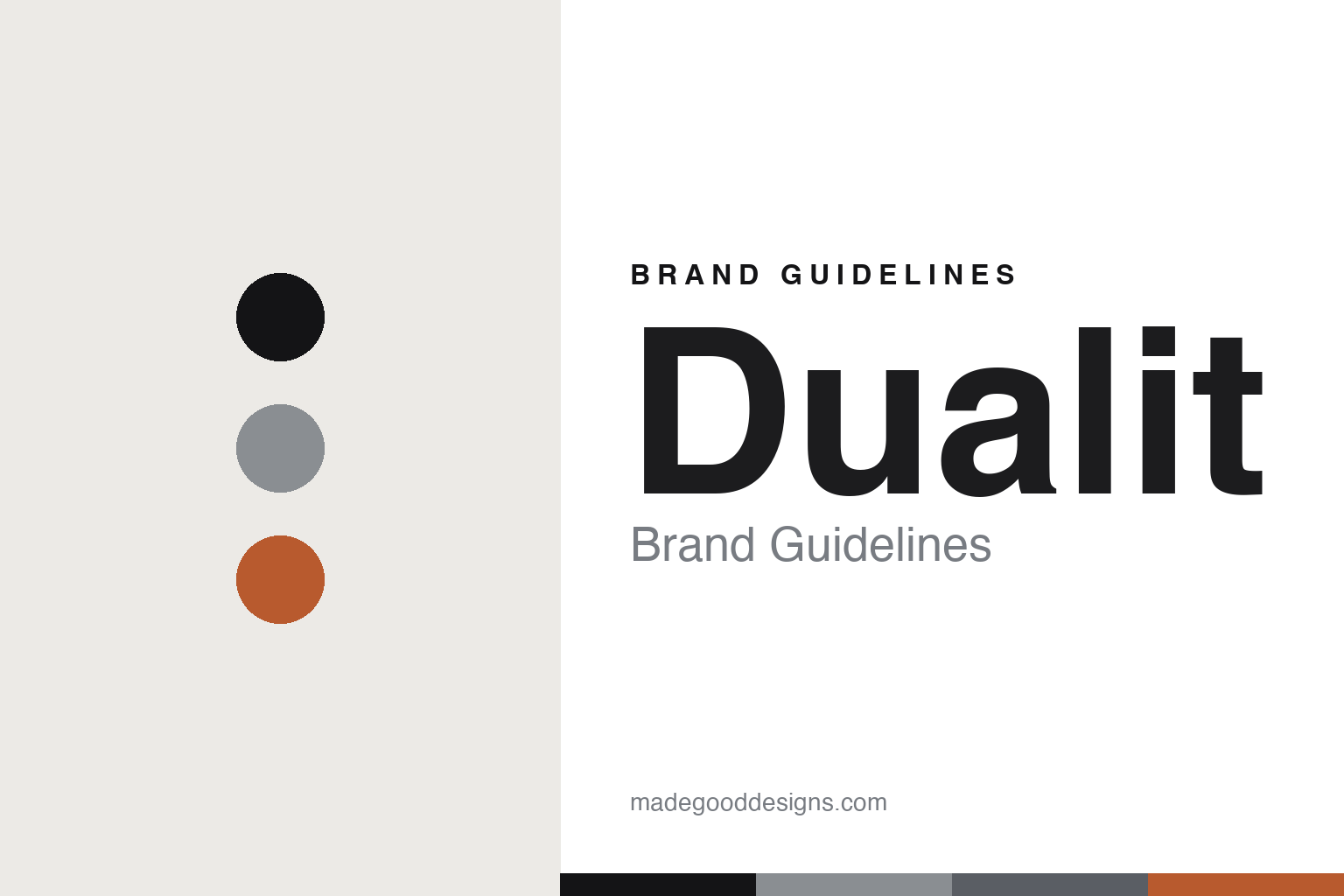
Dualit Brand Guidelines
The Classic toaster.
Aa
Two constants: a chrome-and-ember palette and an industrial sans register. Abstract homage — not the Dualit toaster or packaging.
The Classic toaster
Dualit built a domestic icon from a catering machine.
Dualit is a lesson in a product as identity. Founded in 1945 by the German-born inventor Max Gort-Barten (incorporated as Dualit Ltd in 1948), it is still family-owned and based in Crawley, West Sussex.
Its identity is the Classic toaster. The form began as a commercial, catering six-slot toaster with a manual eject lever, designed by Max in 1952; the household Classic is the domestic descendant of that catering machine, and demand for the home version grew in the 1990s. It carries patented ProHeat armour-plated elements (a 1999 Millennium Product Award) that are replaceable — a repair-not-replace ethos — and, the brand says, is hand-assembled by a single worker who stamps the base with their mark, with a manual timer and lever eject rather than an automatic pop-up. Its stance: “No frills. No gimmicks. No compromise.”
(Honest notes: we say “German-born inventor” rather than flatly “Jewish refugee,” which is commonly reported; 1945 is the founding and 1948 the incorporation — both correct. The hand-assembly, individual stamp and manual-eject details are widely documented but are best framed as the brand’s claim. There’s no official brand hex, so these tones are an unofficial interpretation. This is design commentary and does not promote any product.)
Colour
Dualit lives in a chrome-and-ember palette. Click a swatch to copy the hex.
Dualit’s identity is industrial, durable and British — a chrome, an ink, an ember, a steel, and a cream. The palette pairs a chrome with an ember — the register of polished steel and a glowing element. It signals engineering and longevity rather than novelty. The honest caveat: with no published brand hex, these tones are an original, unofficial interpretation, not first-party values.
The lesson is a chrome with an ember signals a built-to-last appliance. Dualit’s world is a heavy, polished, repairable machine. For designers, it is a reminder that an industrial-metal palette with one warm glow reads as engineered and enduring — right for a repairable icon. The takeaways: make the product the identity; build it to be repaired (replaceable elements); keep the palette industrial with one warm accent; and treat any single hex as unofficial.
Typography
The register is an industrial sans — sturdy, no-frills, British.
Dualit’s identity carries a sturdy, no-frills, British spirit — a heavy, hand-built machine. A robust industrial sans captures the mood: it is solid and plain-spoken, the register of an all-caps engineering wordmark. Set in a chrome-and-ember palette, the industrial sans feels sturdy and no-frills — exactly the personality Dualit carries. It is functional rather than decorative, mirroring “No frills. No gimmicks. No compromise.” (Dualit’s real toaster and wordmark are works we describe but do not reproduce, and the exact typeface is not ours to use.) Because it is not ours to use, the honest description is “an industrial sans spirit,” shown here in a stand-in. The type behaves like the brand: sturdy, no-frills and British.
Aa
An industrial sans spirit — sturdy and no-frills. (Specimen set in Archivo, a sturdy industrial sans STAND-IN; NOT the Dualit packaging.)
A product as identity
Dualit stands for the hand-assembled Classic toaster.
Dualit is a lesson in making a product the identity. A chrome-and-ember palette, an industrial sans and a heavy, repairable toaster make a product the whole brand — sturdy, no-frills, British. The product is the differentiator. The differentiator is a hand-assembled, repairable icon.
For designers and brand-builders, Dualit offers a clear takeaway: build one thing so well it becomes the brand. The lessons: make the product the identity; design it to be repaired (replaceable elements); keep the palette and type industrial; and be honest about the story. It is also a reminder to stay accurate: Max Gort-Barten was German-born, 1945 founded / 1948 incorporated, the hand-assembly is the brand’s claim, and the palette here is an unofficial interpretation. Dualit made a product the brand — proof that one well-built object can be the difference.
Explore & save
Keep Dualit’s identity on hand — save it to a board in the Made Good inspiration library.
Dualit identity set
Pin the chrome-and-ember palette and the industrial-sans register to your own board.