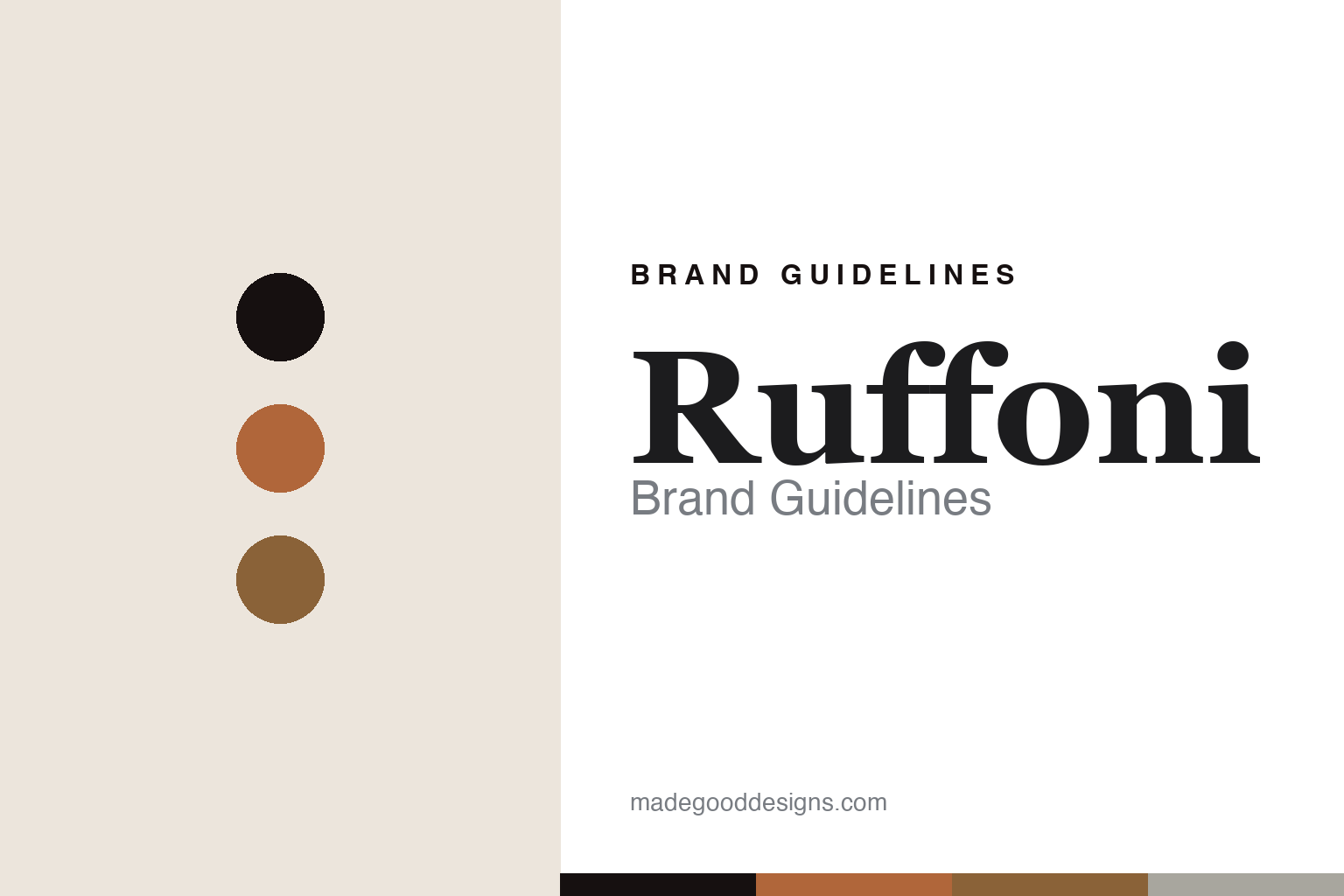
Ruffoni Brand Guidelines
The hammered copper.
Aa
Two constants: a copper-and-bronze palette and an heirloom serif register. Abstract homage — not the Ruffoni cookware or packaging.
The hammered copper
Ruffoni makes hammered copper an heirloom.
Ruffoni is a lesson in a craft as identity. It traces itself to 1931, when grandfather Antonio made his first copper pot; the family workshop in Omegna, on Piedmont’s Lake Orta, was opened in 1962 by his son Fremide. It remains a family business, still operating, and has supplied Williams-Sonoma since the mid-1980s.
Its identity is hammered (martellato) copper. The signature is a hand-hammered copper body, made in three tiers: Historia (tin-lined copper with decorated cast-bronze knobs), Opus Cupra (stainless-lined copper with silver-plated knobs), and Opus Prima (clad stainless with silver-plated knobs). The decorative, hand-cast finials are a hallmark — an heirloom object to hand down.
(Honest notes: the common “founded 1962 by Antonio” line is imprecise — the brand dates itself to Antonio’s first pot in 1931, and the 1962 workshop was opened by his son Fremide; the family came originally from Emilia-Romagna and settled in Omegna in 1933. The cast-bronze knobs are the Historia line specifically (the Opus lines use silver-plated knobs), and the fruit/nut finial shapes are reported rather than verified, though the “choose your finial” feature is real. There’s no official brand hex, so these tones are an unofficial interpretation. This is design commentary and does not promote any product.)
Colour
Ruffoni lives in a copper-and-bronze palette. Click a swatch to copy the hex.
Ruffoni’s identity is warm, artisanal and Italian — a hammered copper, an ink, a bronze, a tin silver, and a cream. The palette pairs a copper with a bronze — the register of a hand-hammered pot with a cast finial. It signals craft and heirloom permanence rather than novelty. The honest caveat: with no published brand hex, these tones are an original, unofficial interpretation, not first-party values.
The lesson is a copper with a bronze signals an heirloom-copper brand. Ruffoni’s world is a hammered, gleaming pot meant to outlive you. For designers, it is a reminder that a warm copper with a decorative bronze reads as artisanal and heirloom — right for a hand-made object. Because a mid copper fails as small text, keep type dark and let the copper live in the accents, palette and band. The takeaways: make the craft the identity (hand-hammering); add a decorative signature (the cast finial); keep the palette warm; and treat any single hex as unofficial.
Typography
The register is an heirloom serif — elegant, Italian, artisanal.
Ruffoni’s identity carries an elegant, Italian, artisanal spirit — a hammered copper heirloom. A high-contrast heirloom serif captures the mood: it is refined and expressive, the register of a heritage Italian house. Set in a copper-and-bronze palette, the heirloom serif feels elegant and Italian — exactly the personality Ruffoni carries. It is artisanal rather than industrial, mirroring a hand-hammered pot. (Ruffoni’s real cookware and wordmark are works we describe but do not reproduce, and the exact typeface is not ours to use.) Because it is not ours to use, the honest description is “an heirloom serif spirit,” shown here in a stand-in. The type behaves like the brand: elegant, Italian and artisanal.
Aa
An heirloom serif spirit — elegant and Italian. (Specimen set in Playfair Display, a high-contrast display serif STAND-IN; NOT the Ruffoni packaging.)
A craft as identity
Ruffoni stands for hammered artisan copper.
Ruffoni is a lesson in making a craft the identity. A copper-and-bronze palette, an heirloom serif and a hand-hammered pot make a craft the whole brand — elegant, Italian, artisanal. The craft is the differentiator. The differentiator is hammered, heirloom copper.
For designers and brand-builders, Ruffoni offers a clear takeaway: make the handwork visible. The lessons: make the craft the identity (hand-hammering); add a decorative signature (the cast finial); tier it honestly (tin, stainless-lined, clad); and be honest about the origin. It is also a reminder to stay accurate: the craft traces to Antonio’s 1931 pot, the 1962 workshop was Fremide’s, bronze knobs are the Historia line only, and the palette here is an unofficial interpretation. Ruffoni made a craft the brand — proof that visible handwork can be the difference.
Explore & save
Keep Ruffoni’s identity on hand — save it to a board in the Made Good inspiration library.
Ruffoni identity set
Pin the copper-and-bronze palette and the heirloom-serif register to your own board.