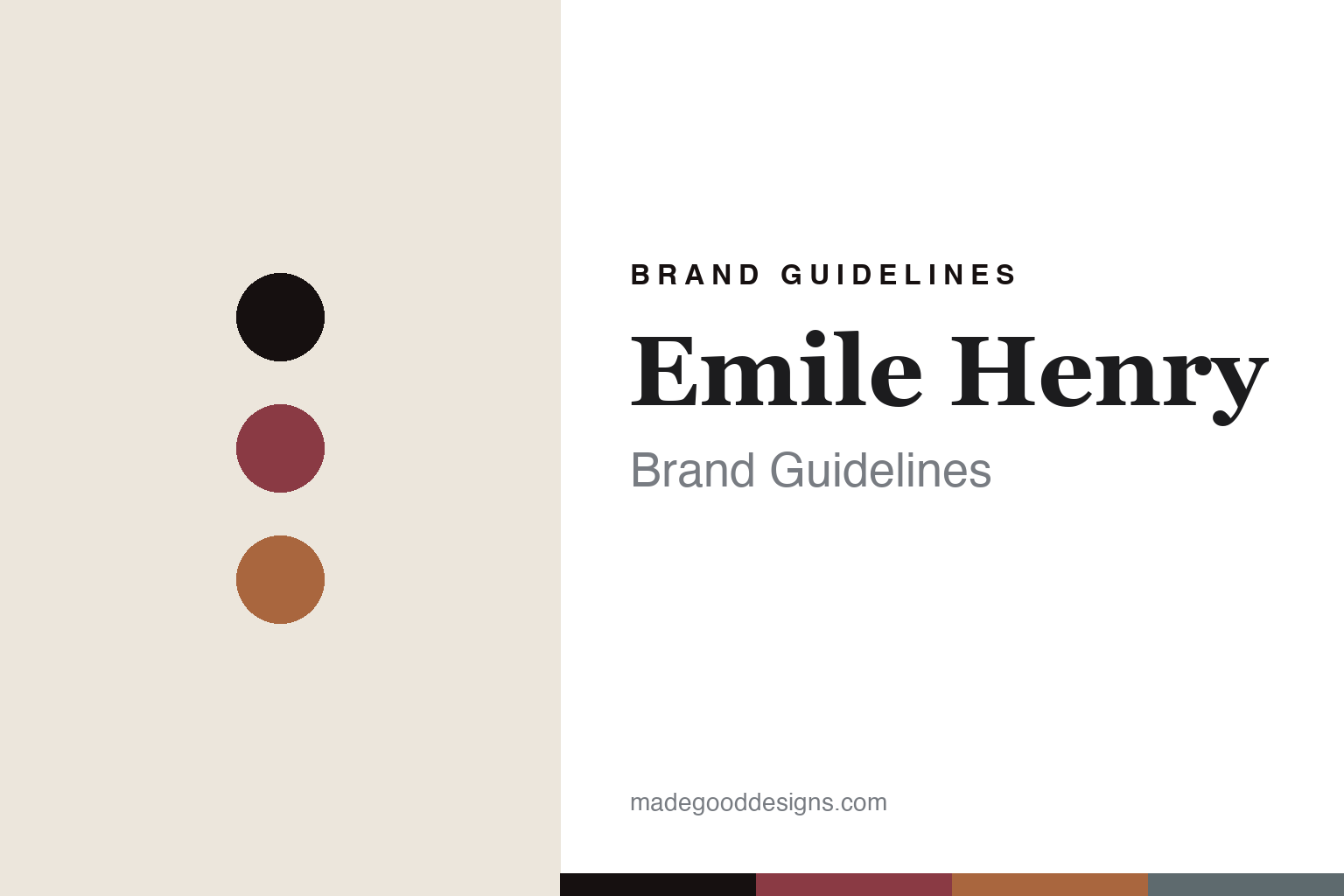
Emile Henry Brand Guidelines
The Burgundy clay.
Aa
Two constants: a burgundy-and-clay palette and a heritage serif register. Abstract homage — not the Emile Henry cookware or packaging.
The Burgundy clay
Emile Henry makes fired clay the cookware.
Emile Henry is a lesson in a material as identity. Founded in 1850 by Jacques Henry, a potter, in Marcigny in southern Burgundy, France, it is a family house now around its fifth generation, still firing clay in the same town.
Its identity is high-fired ceramic. Emile Henry’s vessels are made from natural, thermal-shock-resistant clay — a fired-clay body that can go from oven to table, and, in the brand’s Flame range, onto a direct gas flame for tagines, stewpots and bread cloches. The glaze names double as the world: Burgundy, Slate, Clay, Vanilla — the region in a colour. The material is the whole proposition: a rustic ceramic engineered to take real heat.
(Honest notes: the company was founded by Jacques Henry — Emile Henry is a later-generation namesake who took over in 1922, so we don’t say “founded by Emile Henry in 1850”; and this is not the 19th-century anarchist of the same name. The Flame direct-flame range and the tagine/bread-cloche line-up are the brand’s marketed claims (deeper pages weren’t reachable this pass). The guarantee is ten years, not lifetime. There’s no official brand hex, so these tones are an unofficial interpretation. This is design commentary and does not promote any product.)
Colour
Emile Henry lives in a burgundy-and-clay palette. Click a swatch to copy the hex.
Emile Henry’s identity is earthy, fired and French — a burgundy, an ink, a clay, a slate, and a vanilla. The palette pairs a burgundy with a clay — the register of glazed ceramic and Burgundy earth. It signals material and craft rather than novelty. The honest caveat: with no published brand hex, these tones are an original, unofficial interpretation, not first-party values.
The lesson is a burgundy with a clay signals a fired-ceramic house. Emile Henry’s world is a glazed clay dish, warm from the oven. For designers, it is a reminder that an earthy, glaze-derived palette reads as material and crafted — right for a ceramic maker. Because a mid burgundy fails as small text, keep type dark and let the colour live in the accents, palette and band. The takeaways: make the material the identity (fired clay); source the palette from the glazes; honour the place (Marcigny/Burgundy); and treat any single hex as unofficial.
Typography
The register is a heritage serif — earthy, French, crafted.
Emile Henry’s identity carries a earthy, French, crafted spirit — a Burgundy pottery and a glazed dish. A warm heritage serif captures the mood: it is characterful and historic, the register of a 19th-century maison. Set in a burgundy-and-clay palette, the heritage serif feels earthy and French — exactly the personality Emile Henry carries. It is crafted rather than slick, mirroring fired clay. (Emile Henry’s real cookware and wordmark are works we describe but do not reproduce, and the exact typeface is not ours to use.) Because it is not ours to use, the honest description is “a heritage serif spirit,” shown here in a stand-in — and worth noting the brand’s own modern wordmark is a clean sans; this serif is our editorial register for an 1850 house. The type behaves like the brand: earthy, French and crafted.
Aa
A heritage serif spirit — earthy and French. (Specimen set in Fraunces, a warm old-style serif STAND-IN; NOT the Emile Henry packaging.)
A material as identity
Emile Henry stands for high-fired ceramic.
Emile Henry is a lesson in making a material the identity. A burgundy-and-clay palette, a heritage serif and a glazed fired-clay dish make a material the whole brand — earthy, French, crafted. The clay is the differentiator. The differentiator is a fired-ceramic identity.
For designers and brand-builders, Emile Henry offers a clear takeaway: own a material and its place. The lessons: commit to a material (fired clay); let the glazes name the palette; honour the town (Marcigny); and be honest about the story. It is also a reminder to stay accurate: it’s an 1850 house founded by Jacques Henry (Emile is a later namesake), the Flame range is a marketed claim, and the palette here is an unofficial interpretation. Emile Henry made fired clay the brand — proof that a material can be the difference.
Explore & save
Keep Emile Henry’s identity on hand — save it to a board in the Made Good inspiration library.
Emile Henry identity set
Pin the burgundy-and-clay palette and the heritage-serif register to your own board.