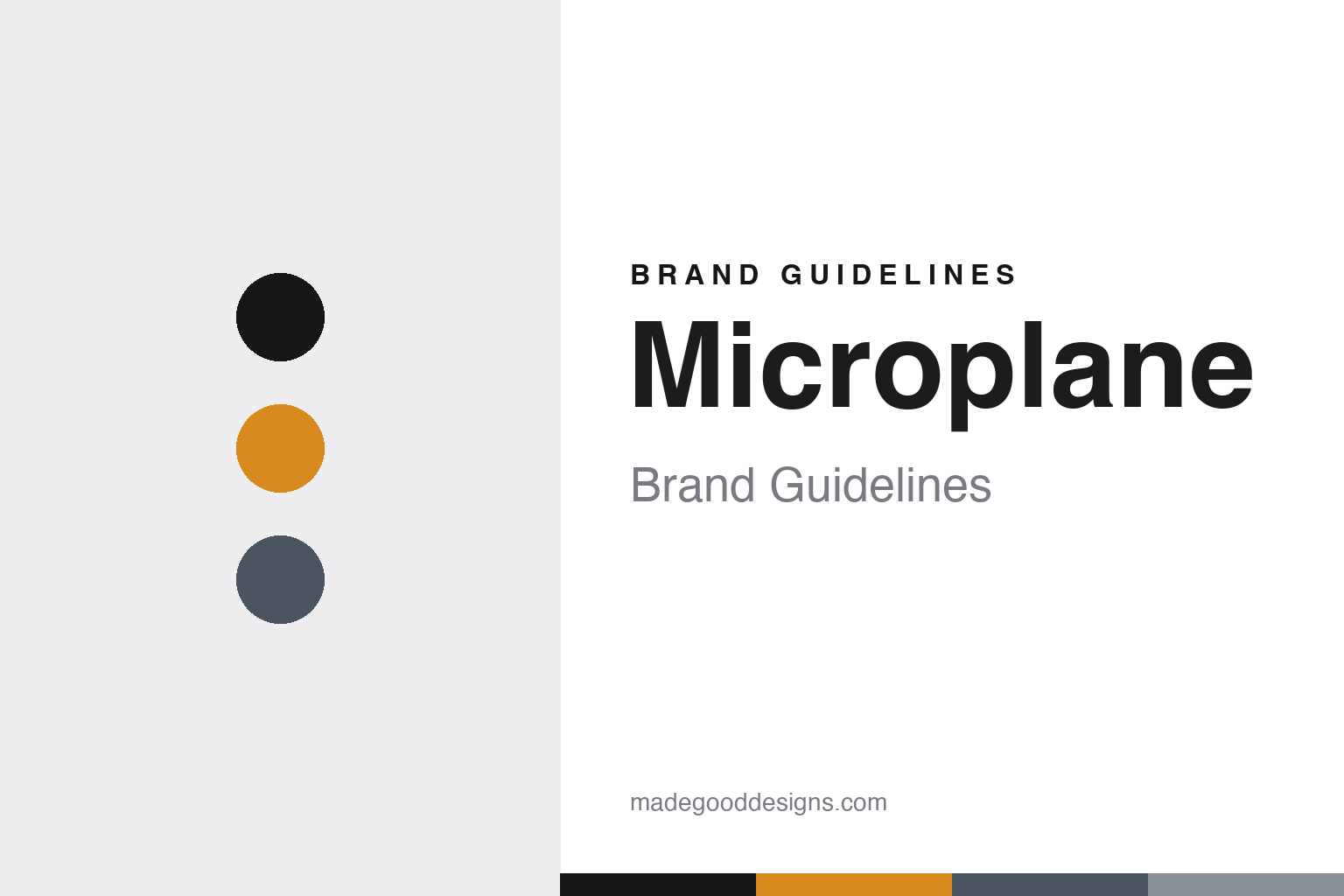
Microplane Brand Guidelines
The etched blade.
Aa
Two constants: a zest-and-steel palette and an industrial sans register. Abstract homage — not the Microplane grater or packaging.
The etched blade
Microplane turned a woodworking rasp into a kitchen icon.
Microplane is a lesson in a blade as identity. Made by Grace Manufacturing — founded by brothers Richard and Jeff Grace, and employee-owned (an ESOP) — it began not in the kitchen but in the workshop, making a photo-etched woodworking rasp (the “Microplane” name arriving around 1991).
Its identity is the photo-chemically etched blade. Each tooth is etched and sharpened rather than stamped and punched, so the tool shaves food — zest, hard cheese, nutmeg, garlic — rather than tearing it, the way an old box grater does. The kitchen story is famous: around 1994 a Canadian home cook discovered that the woodworking rasp zested an orange beautifully, and a kitchen icon was born. The range spans Classic, Premium Classic, Gourmet, Master, Professional and Artisan series.
(Honest notes: the blades are etched in the USA, but assembly moved to Mexico in 2007 — so it isn’t “entirely made in USA.” Russellville, Arkansas is reported as the base. The 1994 zesting story is on the brand’s own site, but the cook’s name — often given in press as “Lorraine Lee” — isn’t, so we hedge it. There’s no official brand hex, so these tones are an unofficial interpretation. This is design commentary and does not promote any product.)
Colour
Microplane lives in a zest-and-steel palette. Click a swatch to copy the hex.
Microplane’s identity is sharp, functional and American — a zest, an ink, a steel, an etch grey, and a paper. The palette pairs a zest with a steel — the register of a bright handle on an etched blade. It signals precision and function rather than novelty. The honest caveat: with no published brand hex, these tones are an original, unofficial interpretation, not first-party values.
The lesson is a zest with a steel signals a blade-first brand. Microplane’s world is a single, impossibly sharp strip of etched steel. For designers, it is a reminder that a bright citrus accent on a cool steel base reads as sharp and functional — right for a grater that shaves. Because a bright zest fails as small text, keep type dark and let the zest live in the accents, palette and band. The takeaways: make the blade the identity; explain the mechanism (etched, not stamped); add a functional accent colour; and treat any single hex as unofficial.
Typography
The register is an industrial sans — sharp, functional, American.
Microplane’s identity carries a sharp, functional, American spirit — a precision tool that started in a workshop. A clean industrial sans captures the mood: it is spare and practical, the register of a tool brand. Set in a zest-and-steel palette, the industrial sans feels sharp and functional — exactly the personality Microplane carries. It is precise rather than decorative, mirroring an etched blade. (Microplane’s real graters and wordmark are works we describe but do not reproduce, and the exact typeface is not ours to use.) Because it is not ours to use, the honest description is “an industrial sans spirit,” shown here in a stand-in. The type behaves like the brand: sharp, functional and American.
Aa
An industrial sans spirit — sharp and functional. (Specimen set in Manrope, a clean industrial sans STAND-IN; NOT the Microplane packaging.)
A blade as identity
Microplane stands for the photo-etched blade.
Microplane is a lesson in making a blade the identity. A zest-and-steel palette, an industrial sans and a photo-etched strip of steel make a blade the whole brand — sharp, functional, American. The blade is the differentiator. The differentiator is an etched, shaving edge.
For designers and brand-builders, Microplane offers a clear takeaway: let one precise mechanism define you. The lessons: make the mechanism the identity (etched, not stamped); tell the origin honestly (a rasp that found the kitchen); add a functional accent; and be honest about manufacturing. It is also a reminder to stay accurate: Grace Manufacturing is employee-owned, blades are etched in the USA but assembled in Mexico since 2007, the 1994 cook’s name is hedged, and the palette here is an unofficial interpretation. Microplane made a blade the brand — proof that one sharp mechanism can be the difference.
Explore & save
Keep Microplane’s identity on hand — save it to a board in the Made Good inspiration library.
Microplane identity set
Pin the zest-and-steel palette and the industrial-sans register to your own board.