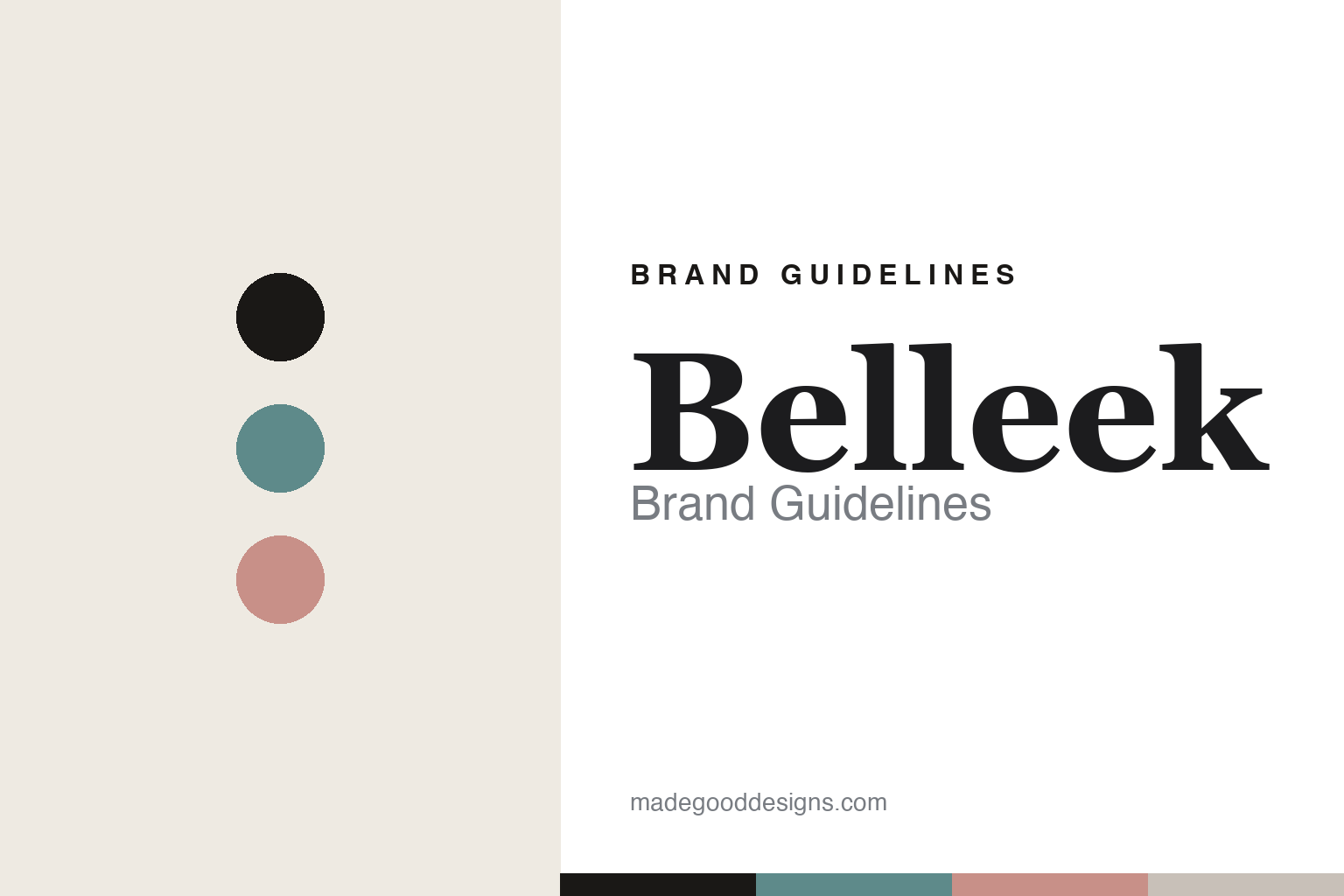
Belleek Brand Guidelines
The Parian basket.
Aa
Two constants: a marine-and-pearl palette and a delicate serif register. Abstract homage — not the Belleek ware or mark.
The Parian basket
Belleek weaves porcelain like a basket.
Belleek is a lesson in a delicate material as identity. Founded in 1857 in Belleek, County Fermanagh, Northern Ireland, by John Caldwell Bloomfield, Robert Williams Armstrong and David McBirney, it began partly to give work to tenants after the Great Famine — and is still working today.
Its identity is Parian china: a very thin, creamy ivory porcelain with a slightly iridescent, pearlescent glaze. Its most famous form is the woven basketware — individually hand-rolled porcelain strands interwoven and finished with applied flowers — alongside marine motifs of shells and coral. Each piece passes through many hands. It is porcelain made to look impossibly light.
(Honest notes: Belleek is in Northern Ireland (UK), County Fermanagh — on the border but not in the Republic — so pieces are “made in Belleek, Co. Fermanagh.” Parian production dates from the early 1860s and the firm incorporated in 1884, so we give the year as 1857 with that hedge. The Belleek Group also owns other brands (Aynsley, Galway) made elsewhere. There’s no official brand hex, so these tones are an unofficial interpretation. This is design commentary and does not promote any product.)
Colour
Belleek lives in a marine-and-pearl palette. Click a swatch to copy the hex.
Belleek’s identity is delicate, pearlescent and Irish — a marine, an ink, a coral, a pearl, and an ivory. The palette pairs a marine with a pearl — the register of iridescent ivory china and shells. It signals delicacy and craft rather than novelty. The honest caveat: with no published brand hex, these tones are an original, unofficial interpretation, not first-party values.
The lesson is a marine with a pearl signals a delicate Parian house. Belleek’s world is a woven ivory basket that catches the light. For designers, it is a reminder that a soft, pearlescent palette reads as delicate and precious — right for fine Parian china. The takeaways: make the material the identity (thin, iridescent Parian); attach it to a form (the basket); keep the palette soft; and treat any single hex as unofficial.
Typography
The register is a delicate serif — light, Irish, hand-crafted.
Belleek’s identity carries a light, Irish, hand-crafted spirit — a woven porcelain basket. A fine, high-contrast serif captures the mood: it is elegant and delicate, the register of Victorian fine china. Set in a marine-and-pearl palette, the delicate serif feels light and Irish — exactly the personality Belleek carries. It is refined rather than heavy, mirroring thin Parian. (Belleek’s real ware and mark are works we describe but do not reproduce, and the exact typeface is not ours to use.) Because it is not ours to use, the honest description is “a delicate serif spirit,” shown here in a stand-in. The type behaves like the brand: light, Irish and hand-crafted.
Aa
A delicate serif spirit — light and Irish. (Specimen set in Cormorant, a fine high-contrast serif STAND-IN; NOT the Belleek packaging or mark.)
A delicate material as identity
Belleek stands for iridescent Parian basketware.
Belleek is a lesson in making a delicate material the identity. A marine-and-pearl palette, a delicate serif and a woven ivory basket make Parian the whole brand — light, Irish, hand-crafted. The material is the differentiator. The differentiator is thin, iridescent Parian china.
For designers and brand-builders, Belleek offers a clear takeaway: make the material do the impossible. The lessons: make the material the identity (thin Parian); attach a signature form (the woven basket); keep the palette soft and pearlescent; and be honest about the story. It is also a reminder to stay accurate: it’s an 1857 Co. Fermanagh (Northern Ireland/UK) pottery, still hand-crafting on the Erne, and the palette here is an unofficial interpretation. Belleek made a delicate material the brand — proof that lightness can be the difference.
Explore & save
Keep Belleek’s identity on hand — save it to a board in the Made Good inspiration library.
Belleek identity set
Pin the marine-and-pearl palette and the delicate-serif register to your own board.