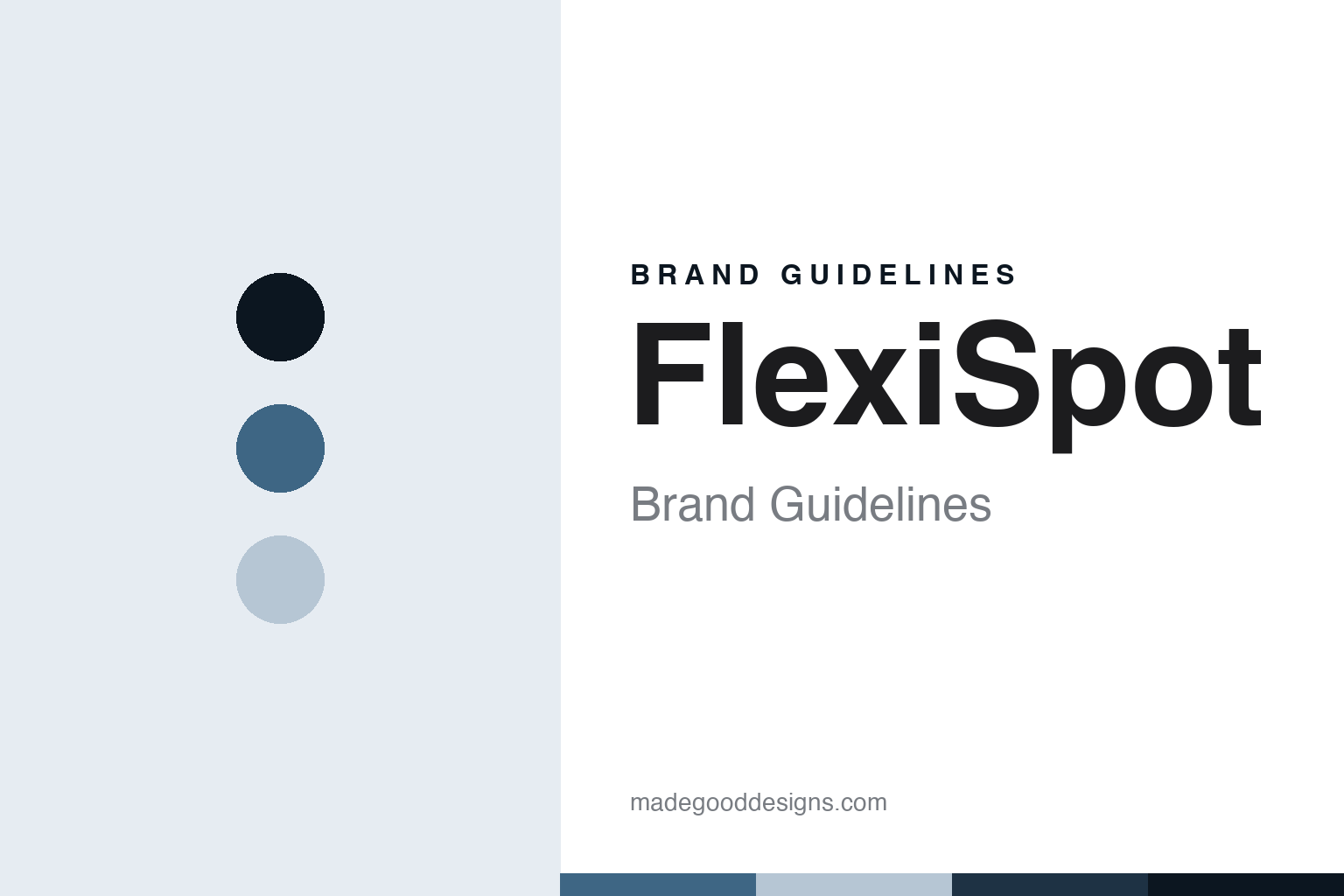
FlexiSpot Brand Guidelines
The mechanism-maker’s value brand.
Aa
Two constants: a factory-slate palette and a factory-sans register. Abstract homage — not a FlexiSpot or Loctek product or mark; no desk, mechanism or logo is reproduced.
The mechanism-maker’s value brand
FlexiSpot is the consumer face of Loctek, the listed Chinese mechanism-maker that builds the lift under many rival desks and sells its own value brand direct.
FlexiSpot brings the standing-desk round its vertically integrated node — the value brand that is also, quietly, the factory. Its parent, Loctek, is one of the companies that makes the height-adjustable lift mechanism inside many other brands’ desks. FlexiSpot is the direct-to-consumer face Loctek put on its own factory, and it arrived around 2015; Loctek itself was founded in 2002 in Ningbo, China, and is listed on the Shenzhen exchange. FlexiSpot makes and sells the desks, and its answer to a round about where standing desks are made and who owns them is unusually direct: made in-house in China and Vietnam, by the mechanism-maker itself.
Its identity is the mechanism-maker’s value brand. The vertical integration, the listed Chinese parent and the value pricing are the story here. A brand, mechanism-made. The mechanism-maker’s value brand.
(Honest notes, so the ownership and manufacture are framed accurately. FlexiSpot sells desks as its heroes — its E7, E7 Pro and E8 value electric standing desks, plus desk bikes and monitor arms — and we report its performance language as the brand’s own. On ownership: FlexiSpot is the own-brand of Loctek Ergonomic Technology, founded in 2002 in Ningbo and listed on the Shenzhen ChiNext board; we do not name a single founder, as none is cleanly documented, and note it is chaired by its named chairman. On the structure that defines it: Loctek is an original-equipment and design manufacturer whose lift mechanisms sit under many rival brands and retailer house-brands, and FlexiSpot is the direct-to-consumer face it built for its own factory — so it owns the mechanism, the desk and the customer. On where it is made: in-house in China, in Ningbo and Guangxi, and in Vietnam, with the US presence limited to sales and warehousing rather than manufacturing. Its designs and the FlexiSpot and Loctek names are IP we describe but do not reproduce; there is no official brand hex; these tones are an unofficial interpretation.)
Colour
FlexiSpot lives in a factory slate. Click a swatch to copy the hex.
FlexiSpot’s identity is value, integrated and industrial — a factory slate, an ink, a pale steel, a deep navy, and a paper. The palette leans factory slate and pale steel: a cool, industrial register that nods to a mechanism factory and a value shelf rather than a loud logo colour. It signals the mechanism-maker’s value brand — affordable, made-at-source and everywhere. The honest caveat: with no published brand hex, these values are an original, unofficial interpretation, not first-party colours.
The lesson is a factory slate signals a value, integrated identity. FlexiSpot’s world is a lift mechanism built at source and sold direct. For designers, it is a reminder that a cool factory slate and a soft pale steel can carry a maker brand — an industrial tone held as colour, not a product shot. Because these tones can fail as small text, keep type dark and let the colour live in the accents, palette and band. The takeaways: date the brand to 2015 and Loctek to 2002; note the Shenzhen listing; name the vertical integration; keep the US role to sales and warehousing; and treat any single hex as unofficial.
Typography
The register is a factory sans — value, integrated, industrial.
FlexiSpot’s identity carries a value, integrated, industrial spirit — a manufacturer’s own brand, not a marketing shell. A factory sans captures the mood: clean, plain and confident, the register of a company that makes the mechanism itself. Set in a factory-slate palette, the factory sans feels value and industrial — exactly the personality FlexiSpot carries. It behaves like a made, functional thing rather than a loud logo, mirroring a steel column and an anodised leg. (FlexiSpot’s and Loctek’s real desks, mechanisms and names are things we describe but do not reproduce, and the exact typeface is not ours to use.) Because it is not ours to use, the honest description is “a factory-sans brand,” shown here in a stand-in. The type behaves like the brand: value, integrated and industrial.
Aa
A factory-sans brand — value and integrated. (Specimen set in Archivo, a factory-sans STAND-IN; NOT the FlexiSpot logo or any mechanism.)
The standing desk
FlexiSpot stands for the mechanism-maker’s value brand.
FlexiSpot brings the round its vertically integrated node. A factory-slate palette, a factory sans and a Loctek parent make one thing — the mechanism-maker’s value brand — the whole identity: value, integrated and industrial. The vertical integration is the pitch, and the value pricing is the proof. The point is the value brand that is also the factory, in a round about where standing desks are made and who makes the parts.
Put to work, the identity is the brand told straight, ownership named and manufacture stated. A maker in this spirit would date the brand to 2015 and Loctek to 2002, note the Shenzhen listing, and name the vertical integration. A reader in this spirit would keep the facts right: FlexiSpot sells desks as its heroes, led by the E7; it is the own-brand of Loctek Ergonomic Technology, founded in 2002 in Ningbo and listed on the Shenzhen ChiNext board; Loctek makes the lift mechanism under many rival brands, and FlexiSpot is its direct-to-consumer face; and it is made in-house in China and Vietnam. FlexiSpot sits sixth in the round, after Branch. The honest editorial moves are to date the brand and the parent separately, to note the listing, to name the vertical integration, and to keep the US role to sales and warehousing.
For designers and brand-builders, FlexiSpot continues the standing desk: let vertical integration be the identity — and name the manufacturer behind the value brand. The lessons: build a consumer brand on owning the core mechanism; distinguish a brand’s founding from its parent’s; name a stock listing as part of the story; keep sales presence separate from manufacturing; and never reproduce a logo. It is also a reminder to stay precise: FlexiSpot is the consumer face of Loctek, the listed Chinese mechanism-maker that builds the lift under many rival desks and sells its own value brand direct — with the palette here an unofficial interpretation. The hook is that integration: Loctek is a listed Ningbo mechanism-maker that quietly supplies the height-adjustable lift columns behind many rival desks and retailer house-brands, and FlexiSpot is the direct-to-consumer face it put on its own factory — owning the mechanism, then the desk, then the customer, and undercutting the premium incumbents. Read that way, FlexiSpot is less a desk than a factory with a storefront: value, integrated, industrial. The lesson for a brand is that vertical integration and honest ownership reinforce each other, and naming the maker keeps the story earned. FlexiSpot made the-mechanism-maker’s-value-brand the identity — proof that owning the mechanism carries a round.
Explore & save
Keep FlexiSpot’s identity on hand — save it to a board in the Made Good inspiration library.
FlexiSpot identity set
Pin the factory-slate palette and the factory-sans register to your own board.