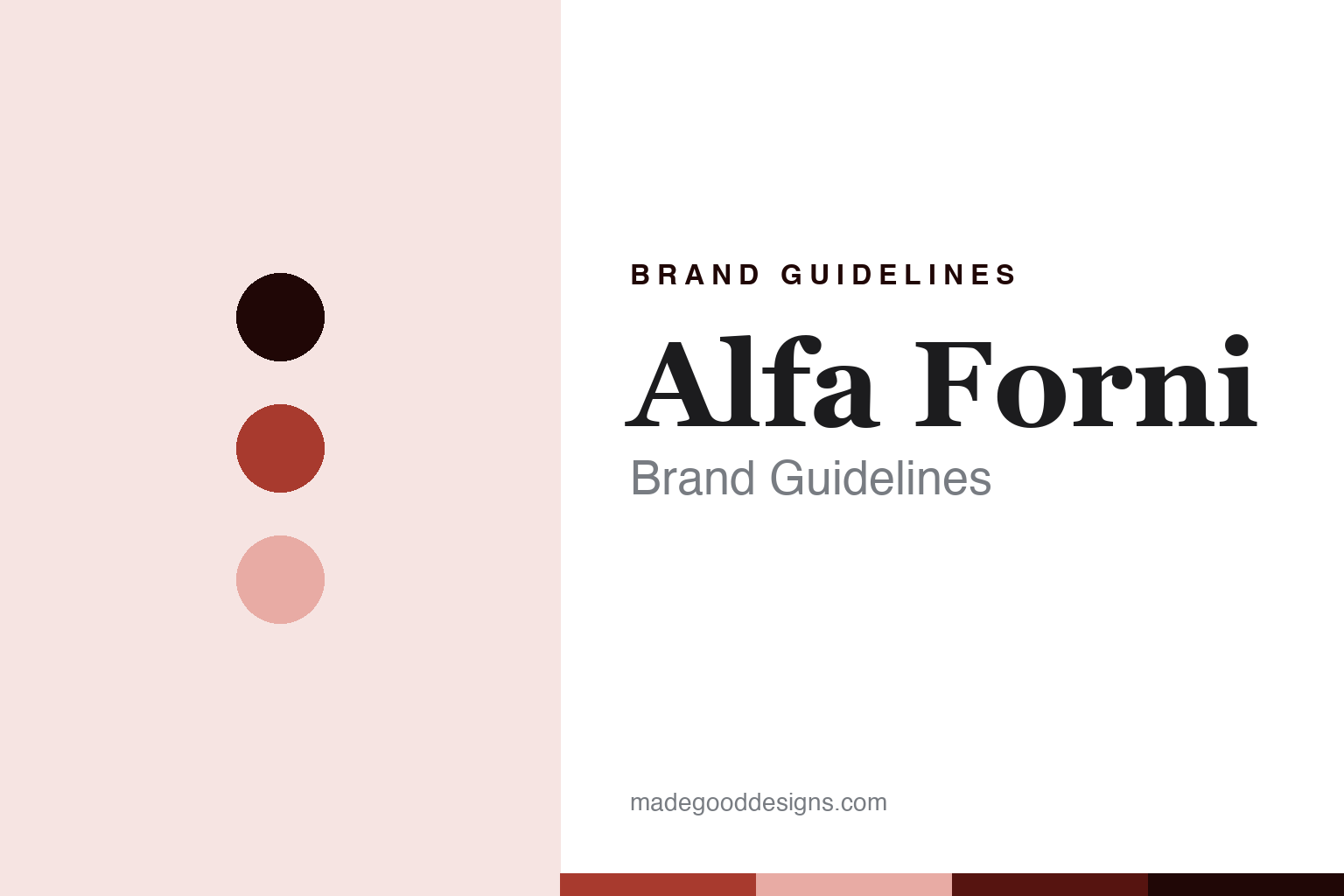
Alfa Forni Brand Guidelines
Made in Italy, baked into the clay.
Aa
Two constants: a forno-red palette and a heritage-serif register. Abstract homage — not an Alfa Forni product or mark; no oven, dome or logo is reproduced.
Made in Italy, baked into the clay
Alfa Forni is the family-run Italian oven maker whose refractory tile is still fired in the same Anagni kiln to a fifty-year-old recipe.
Alfa Forni opens the pizza-oven round as its Italian-heritage anchor — a family firm whose “made in Italy” claim is literally baked into the clay of its ovens. It was founded in 1977 by two cousins, Marcello Ortuso and Rocco Lauro, who built a wood-fired oven for their own backyard, and it is still run by their families. Alfa Forni makes and sells the ovens, and its answer to a round about where pizza ovens are made and who owns them is unambiguous: genuinely made in Italy, in-house.
Its identity is made in Italy, baked into the clay. The genuine Italian manufacture, the founding-family ownership and the refractory-tile heritage are the story here. An oven, Italian. Made in Italy, baked into the clay.
(Honest notes, so the founders, geography and models are framed correctly. Alfa Forni sells wood-fired and gas ovens as its heroes — its Moderno flagship, and its Nano, Ciao, Allegro and Brio lines — and we report its performance language as the brand’s own. On the founders: it was founded by cousins Marcello Ortuso and Rocco Lauro, so we credit the Lauro and Ortuso families and do not repeat a wrong family name; both surnames remain in today’s leadership. On where it is made, the point that carries the round: every Alfa oven is made in Anagni, in Lazio, roughly sixty-five kilometres south-east of Rome — not in Rome itself, despite some marketing shorthand — and its refractory cooking tile is fired in the historic Anagni kiln to a recipe held for over fifty years, a concrete, non-generic manufacturing claim. On models: the Moderno is the flagship; we use Brio rather than an uncertain “Futura” name, and we do not attribute an unverified “forcino” tradition. Its designs and the Alfa and Alfa Forni names are IP we describe but do not reproduce; there is no official brand hex; these tones are an unofficial interpretation.)
Colour
Alfa Forni lives in a forno red. Click a swatch to copy the hex.
Alfa Forni’s identity is heritage, Italian and fired — a forno red, an ink, a pale terracotta, a deep oxide, and a paper. The palette leans forno red and pale terracotta: a warm, earthen register that nods to fired clay and a live flame rather than a loud logo colour. It signals a made-in-Italy oven — crafted, family-run and baked at home. The honest caveat: with no published brand hex, these values are an original, unofficial interpretation, not first-party colours.
The lesson is a forno red signals a heritage, Italian identity. Alfa Forni’s world is a refractory tile fired in a fifty-year-old kiln. For designers, it is a reminder that a warm forno red and a soft pale terracotta can carry a maker brand — an earthen tone held as colour, not a product shot. Because these tones can fail as small text, keep type dark and let the colour live in the accents, palette and band. The takeaways: date it to 1977; credit the Lauro and Ortuso families; place it in Anagni, not Rome; name the tile heritage; and treat any single hex as unofficial.
Typography
The register is a heritage serif — crafted, Italian, storied.
Alfa Forni’s identity carries a crafted, Italian, storied spirit — a heritage oven house, not a mass importer. A heritage serif captures the mood: warm, classic and confident, the register of a family firm firing its own tiles. Set in a forno-red palette, the heritage serif feels crafted and storied — exactly the personality Alfa Forni carries. It behaves like a fired, made thing rather than a loud logo, mirroring refractory clay and a steel dome. (Alfa Forni’s real ovens and model names are things we describe but do not reproduce, and the exact typeface is not ours to use.) Because it is not ours to use, the honest description is “a heritage-serif brand,” shown here in a stand-in. The type behaves like the brand: crafted, Italian and storied.
Aa
A heritage-serif brand — crafted and storied. (Specimen set in Cormorant Garamond, a heritage-serif STAND-IN; NOT the Alfa Forni logo or any oven.)
The pizza oven
Alfa Forni stands for made in Italy, baked into the clay.
Alfa Forni opens the pizza-oven round as its Italian-heritage anchor. A forno-red palette, a heritage serif and a 1977 founding make one thing — made in Italy, baked into the clay — the whole identity: heritage, Italian and fired. The genuine Italian manufacture is the pitch, and the refractory tile is the proof. The point is a family firm whose ovens are made and fired at home, in a round about where pizza ovens are made and who makes them.
Put to work, the identity is the brand told straight, founders credited and geography precise. A maker in this spirit would date it to 1977, credit the Lauro and Ortuso families, and place it in Anagni, not Rome. A reader in this spirit would keep the facts right: Alfa Forni sells wood-fired and gas ovens as its heroes, led by the Moderno; it was founded in 1977 by cousins Marcello Ortuso and Rocco Lauro; it is family-owned; and it is genuinely made in Anagni, Italy, with its refractory tile fired in the historic kiln. Alfa Forni opens the round, before Clementi. The honest editorial moves are to date it to 1977, to credit the founding families, to place manufacture in Anagni, and to name the tile heritage.
For designers and brand-builders, Alfa Forni opens the pizza oven: let genuine in-country craft be the identity — and make the manufacturing detail concrete. The lessons: build a brand on real domestic manufacture; get the founders and place exactly right; anchor a made-in claim in a specific material fact; credit family ownership; and never reproduce a logo. It is also a reminder to stay precise: Alfa Forni is the family-run Italian oven maker whose refractory tile is still fired in the same Anagni kiln to a fifty-year-old recipe — with the palette here an unofficial interpretation. The hook is that continuity: from two cousins’ backyard fire in 1977 to a still-family-run maker whose refractory cooking tile is still fired in the same historic Anagni kiln to a fifty-year-old recipe — the “made in Italy” claim is baked into the literal clay, not just printed on the label. Read that way, Alfa Forni is less an oven than a fired tile with a family behind it: crafted, Italian, storied. The lesson for a brand is that in-country craft and a concrete claim reinforce each other, and firing your own clay keeps the story earned. Alfa Forni made made-in-Italy-baked-into-the-clay the identity — proof that genuine craft can open a round.
Explore & save
Keep Alfa Forni’s identity on hand — save it to a board in the Made Good inspiration library.
Alfa Forni identity set
Pin the forno-red palette and the heritage-serif register to your own board.