Clementi Brand Guidelines
The copper Neapolitan oven.
Aa
Two constants: a copper-bronze palette and an artisan-serif register. Abstract homage — not a Clementi product or mark; no oven, copper cladding or logo is reproduced.
The copper Neapolitan oven
Clementi is the Italian family firm whose founder pioneered indirect wood-fired ovens, whose copper-clad Pulcinella dresses a Neapolitan oven as furniture.
Clementi brings the pizza-oven round its second Italian-heritage node — a family firm whose founder helped pioneer the indirect wood-fired oven in Italy, and whose copper-clad ovens read as much as furniture as appliance. It was founded in 1975 by Clementino Clementi, in the Fabriano countryside in the Marche region, and it remains a family company. Clementi makes and sells the ovens, and its answer to a round about where pizza ovens are made and who owns them is direct: genuinely made in Italy, in Fabriano.
Its identity is the copper Neapolitan oven. The indirect-wood-fired heritage, the made-in-Italy manufacture and the decorative copper Pulcinella are the story here. An oven, copper Neapolitan. The copper Neapolitan oven.
(Honest notes, so the dates, place and construction are framed correctly. Clementi sells wood-fired ovens as its heroes — above all the Pulcinella, a Neapolitan-style oven reaching around five hundred degrees for a roughly ninety-second pizza via its patented Air Plus airflow, plus lines such as Aria, Remida Plus, Icon and Crosti — and we report its performance language as the brand’s own. On dates and place, corrections that matter: it was founded in 1975, not the mid-1940s, and it is based in Fabriano in the Marche, not Verona. On construction: the Pulcinella is built from a refractory base and a stainless-steel dome, and its copper cladding is a finish option, a signature look rather than the structural material. On manufacture: it is genuinely made in Italy in Fabriano, combining master craft with modern robotic production. Its designs and the Clementi, Pulcinella and Air Plus names are IP we describe but do not reproduce; there is no official brand hex; these tones are an unofficial interpretation.)
Colour
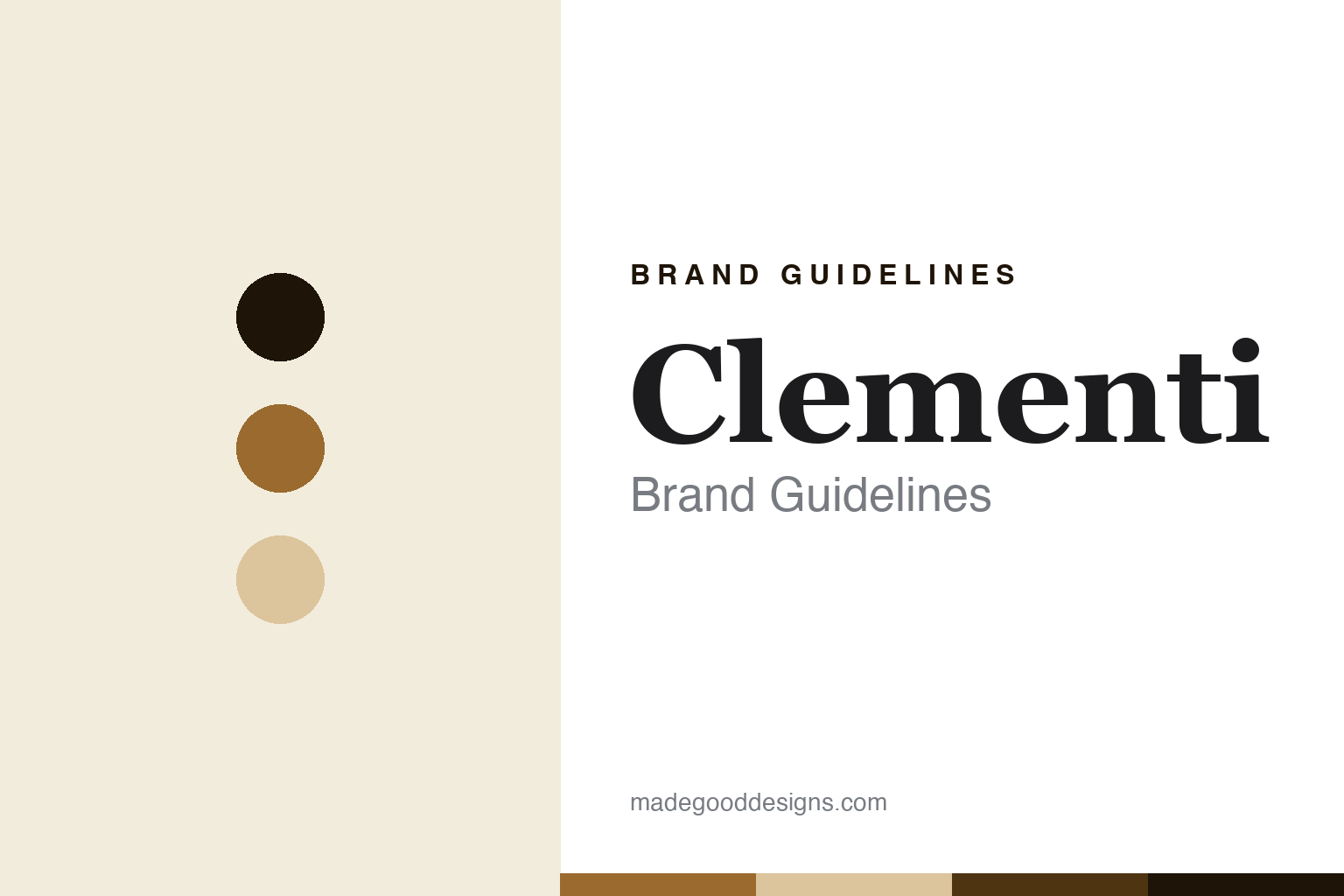
Clementi lives in a copper bronze. Click a swatch to copy the hex.
Clementi’s identity is artisan, decorative and Italian — a copper bronze, an ink, a pale brass, a deep umber, and a paper. The palette leans copper bronze and pale brass: a warm, metallic register that nods to a copper-clad oven and a wood fire rather than a loud logo colour. It signals the copper Neapolitan oven — decorative, crafted and made at home. The honest caveat: with no published brand hex, and with the copper treated as a finish signature, these values are an original, unofficial interpretation, not first-party colours.
The lesson is a copper bronze signals an artisan, decorative identity. Clementi’s world is a Neapolitan oven finished like a piece of furniture. For designers, it is a reminder that a warm copper bronze and a soft pale brass can carry a maker brand — a decorative tone held as colour, never a copper product shot. Because these tones can fail as small text, keep type dark and let the colour live in the accents, palette and band. The takeaways: date it to 1975; place it in Fabriano; credit Clementino Clementi; keep the copper as a finish; and treat any single hex as unofficial.
Typography
The register is an artisan serif — decorative, crafted, traditional.
Clementi’s identity carries a decorative, crafted, traditional spirit — a traditional oven house, not a flat-pack maker. An artisan serif captures the mood: elegant, warm and confident, the register of a copper-clad oven built to be seen. Set in a copper-bronze palette, the artisan serif feels decorative and crafted — exactly the personality Clementi carries. A copper-clad oven meant to sit outside and be admired asks for type with the same decorative confidence, warm and a little ornamental rather than industrial, so the register leans into ornament where a utilitarian brand would strip it away. It behaves like a made, finished thing rather than a loud logo, mirroring hammered copper and refractory clay. (Clementi’s real ovens, the copper cladding and the Pulcinella name are things we describe but do not reproduce, and the exact typeface is not ours to use.) Because it is not ours to use, the honest description is “an artisan-serif brand,” shown here in a stand-in. The type behaves like the brand: decorative, crafted and traditional.
Aa
An artisan-serif brand — decorative and crafted. (Specimen set in Playfair Display, an artisan-serif STAND-IN; NOT the Clementi logo or its copper cladding.)
The pizza oven
Clementi stands for the copper Neapolitan oven.
Clementi brings the round its second Italian-heritage node. A copper-bronze palette, an artisan serif and a 1975 founding make one thing — the copper Neapolitan oven — the whole identity: artisan, decorative and Italian. The indirect-wood-fired heritage is the pitch, and the copper Pulcinella is the proof. The point is a family firm that dresses a Neapolitan oven as furniture, in a round about where pizza ovens are made and who makes them.
Put to work, the identity is the brand told straight, dates and place corrected and construction precise. A maker in this spirit would date it to 1975, place it in Fabriano, and credit Clementino Clementi. A reader in this spirit would keep the facts right: Clementi sells wood-fired ovens as its heroes, led by the Pulcinella; it was founded in 1975 by Clementino Clementi in Fabriano, Marche; it is family-owned; and it is genuinely made in Italy. Clementi sits second in the round, after Alfa Forni. The honest editorial moves are to date it to 1975, to place it in Fabriano not Verona, to keep the copper as a finish rather than structure, and to name the made-in-Italy manufacture.
For designers and brand-builders, Clementi continues the pizza oven: let decorative craft be the identity — and correct the dates, place and construction precisely. The lessons: build a brand on a decorative, traditional craft; fix an incorrect founding year and location; distinguish a finish from the structural material; credit the founder; and never reproduce a logo. It is also a reminder to stay precise: Clementi is the Italian family firm whose founder pioneered indirect wood-fired ovens, whose copper-clad Pulcinella dresses a Neapolitan oven as furniture — with the palette here an unofficial interpretation. The hook is that lineage: Clementino Clementi pioneered the indirect wood-fired oven in Italy in the 1970s, and the copper-clad Pulcinella is its domestic descendant — a Neapolitan-grade oven, five hundred degrees and a ninety-second pizza via the patented Air Plus airflow, dressed as a piece of outdoor furniture. Read that way, Clementi is less an oven than a decorative object: decorative, crafted, traditional. The lesson for a brand is that craft and honest correction reinforce each other, and fixing the record keeps the story earned. Clementi made the-copper-Neapolitan-oven the identity — proof that decorative craft carries a round.
Explore & save
Keep Clementi’s identity on hand — save it to a board in the Made Good inspiration library.
Clementi identity set
Pin the copper-bronze palette and the artisan-serif register to your own board.